
Third grade is when multiplication becomes a daily part of math class. Students who understand what multiplication means, not just how to recite facts, build confidence that lasts through division, fractions, and algebra. This guide walks you through practical steps to teach multiplication to 3rd graders, common pitfalls to avoid, and free resources you can use today.
The biggest challenge at this age is the jump from addition to a new operation that feels abstract. Some students memorize facts quickly. Others need weeks of visual models before numbers click. Both paths are normal. Your job is to connect multiplication to something concrete, practice in short bursts, and give kids tools they can use when they forget a fact.
What Grade Do Students Learn Multiplication?
Most U.S. students learn multiplication in 3rd grade. The National Council of Teachers of Mathematics emphasizes that early multiplication should grow out of counting equal groups and understanding number relationships, not rote drills alone.
By the end of 3rd grade, many state standards expect fluency with facts up to 10 x 10. That does not mean every child will be fast by March. It means they should understand what 4 x 6 represents and have strategies to find the answer when memory fails. Late bloomers often catch up once they have strong models and consistent practice.
How Do You Teach Multiplication to 3rd Graders?
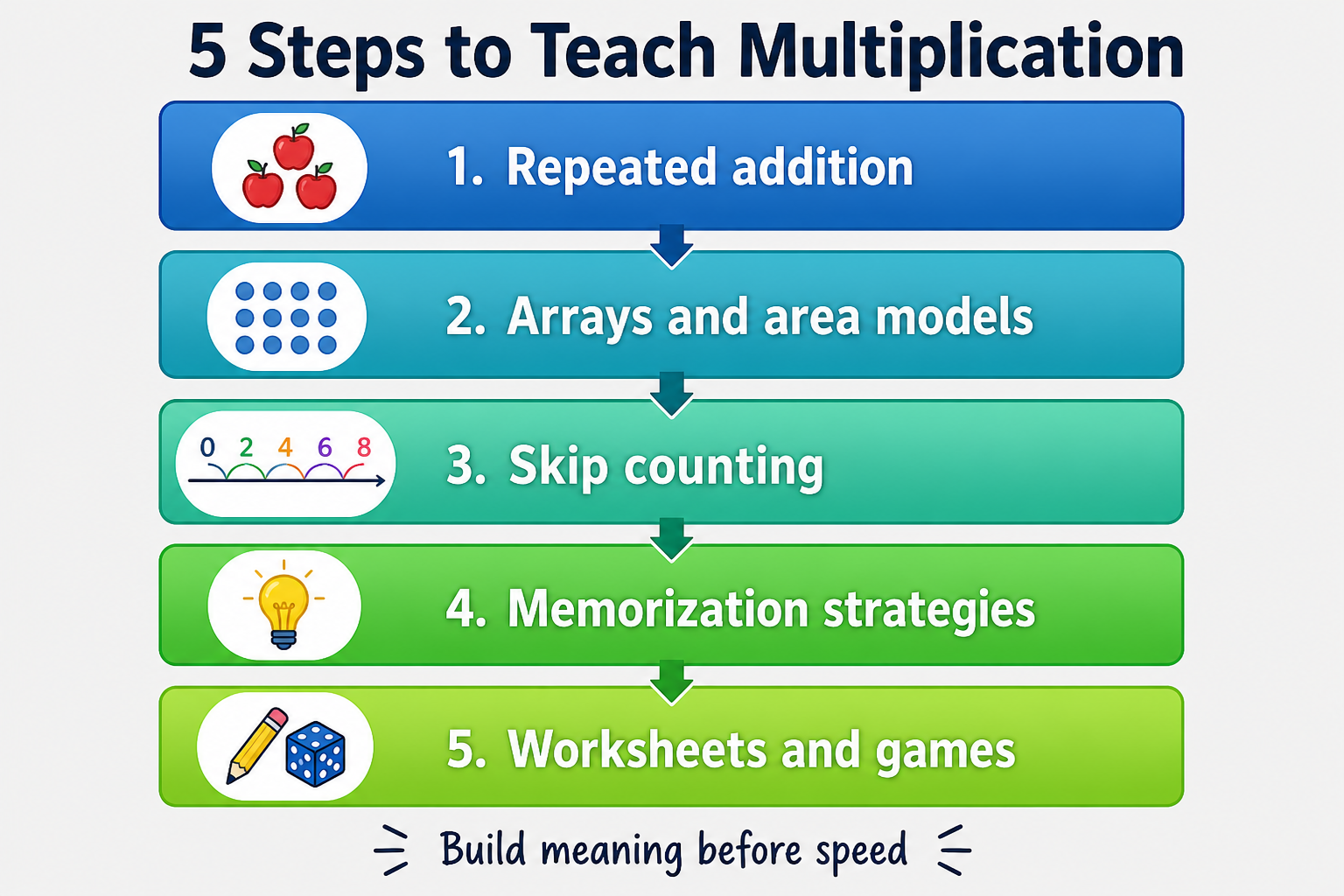
Teach multiplication to 3rd graders in five steps: repeated addition, arrays, skip counting, memorization strategies, and daily worksheet practice. Move through these steps in order and spend more time on early steps if students still think of multiplication as a trick rather than a way to count equal groups.
Step 1: Start with repeated addition
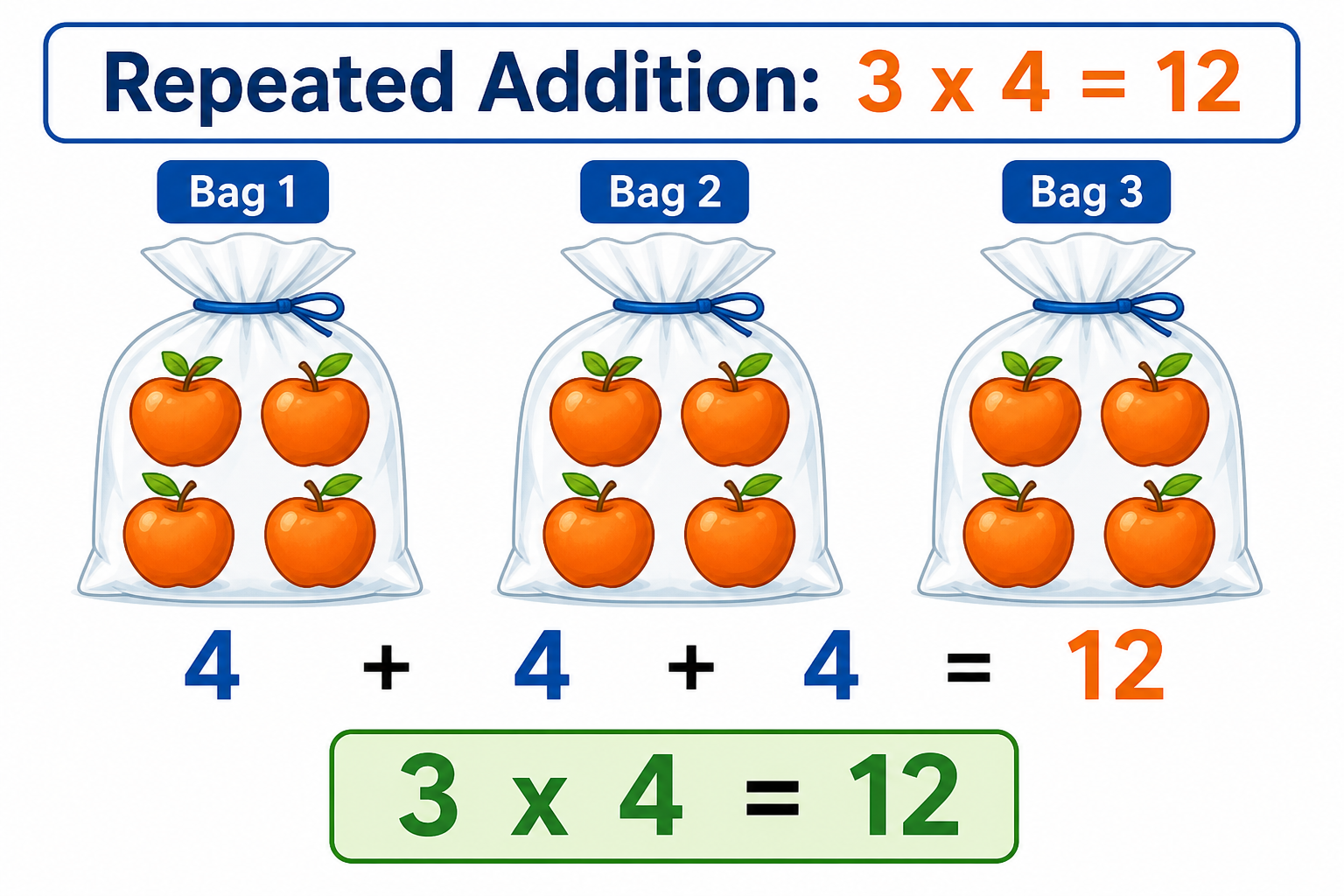
Repeated addition is the foundation: show that multiplication is a shortcut for adding equal groups. If there are 3 bags with 4 apples each, write 4 + 4 + 4 = 12, then introduce 3 x 4 = 12 as shorthand. Use counters, blocks, or drawings so the groups are visible. Ask students to explain in words before they write an equation.
Repeat this with different contexts: rows of chairs, packs of pencils, egg cartons. The goal is for students to say, "Multiplication means adding the same number again and again," without prompting.
Step 2: Use arrays and area models
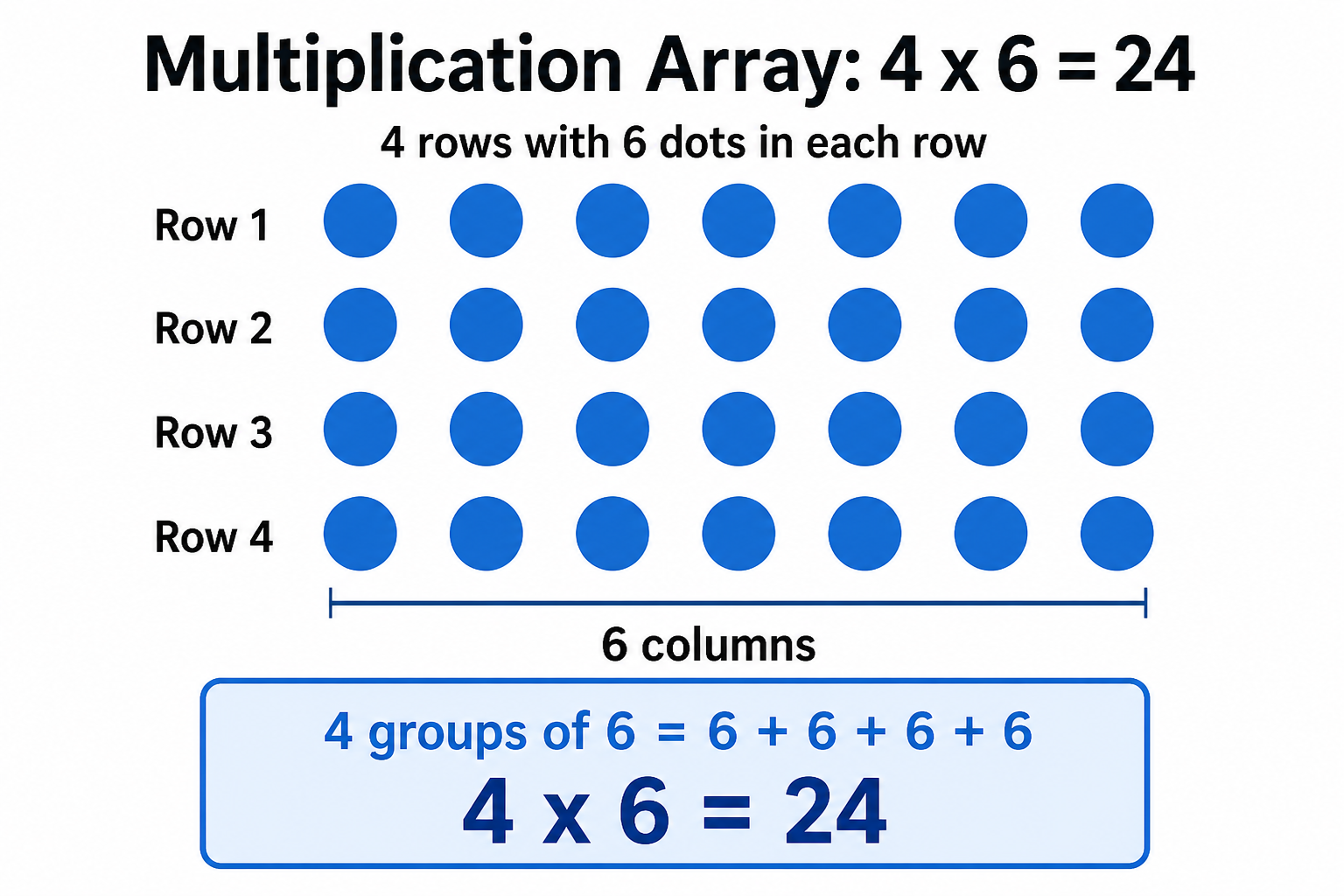
Arrays turn equal groups into rows and columns that students can see and count. A 4 x 6 array shows four rows of six; students can count all dots, skip count by six four times, or split the array into smaller parts (4 x 3 plus 4 x 3). Arrays bridge toward the area model used in later grades.
Have students build arrays on grid paper or with square tiles. Compare arrays that show the commutative property: 3 x 5 and 5 x 3 look different but have the same total. This visual proof helps more than memorizing the rule alone.
Step 3: Teach skip counting as a bridge
Skip counting connects patterns to times tables before students memorize facts. Count by 2s, 5s, and 10s first because those patterns feel familiar, then add 3s, 4s, and so on. Clap, march, or use a number line so the rhythm sticks.
Connect skip counting to facts on a chart. When a student counts by 4 up to 24, point to 6 x 4 on a printable multiplication chart. The chart is a reference tool, not a cheat sheet, until facts become automatic.
Step 4: Introduce memorization strategies
Once students understand what multiplication means, teach fluency strategies in a deliberate order rather than random fact drills:
- Zero and one: Any number times 0 is 0; times 1 stays the same.
- Doubles: 6 x 6 is like 6 + 6 + 6 + 6 + 6 + 6, or use 3 x 6 twice.
- Known facts: If you know 5 x 7, you can find 6 x 7 by adding one more group of 7.
- Commutative property: Learn 3 x 8 and you also know 8 x 3.
Work on one factor family per week. Monday introduce, Tuesday through Thursday practice, Friday quick check. Spiral back to old facts every session so nothing fades.
Step 5: Practice with worksheets and games
Daily short practice builds fluency faster than occasional long sessions. Use a mix of fill-in charts, fact drills, word problems, and games. Our multiplication worksheets for grade 3 let you print targeted practice by operation and difficulty.
For homework or centers, send home a blank multiplication chart so students fill in facts themselves. Pair worksheets with printable multiplication flash cards for partner quizzing. You can also generate custom math worksheets with the exact number of problems you need.
Teacher tip
Keep practice sessions to 10–15 minutes. End on a fact the student got right so they leave feeling capable. Confidence drives more practice than pressure ever will.
What Mistakes Should Teachers Avoid When Teaching Multiplication?
The most common mistakes when teaching multiplication are drilling facts too early, introducing too many facts at once, and relying only on timed tests. Avoid these pitfalls to keep students building real understanding:
- Skipping the concept and drilling facts too early. Students who memorize without understanding forget facts quickly and panic on word problems. Always pair drills with arrays or repeated addition first.
- Introducing too many facts at once. Focus on one table at a time. Mixing 4s, 7s, and 9s in the same worksheet overwhelms working memory.
- Only using timed tests. Timed tests measure speed, not learning. Use them occasionally, not daily, especially for anxious students.
- Ignoring the commutative property. Teach 4 x 7 and 7 x 4 together so students learn half as many unique combinations.
- Not connecting to division. When students know 6 x 4 = 24, show 24 ÷ 6 = 4 in the same lesson. The relationship deepens understanding of both operations.
- Assuming one method fits every child. Some kids need manipulatives longer. Others want pure patterns. Offer multiple entry points and celebrate progress, not just speed.
What Are the Best Resources for Multiplication Practice?
The best free resources for multiplication practice include printable charts, grade 3 worksheets, flash cards, and a custom worksheet generator. You do not need expensive curriculum; a few reliable tools used consistently are enough for most classrooms and homeschool setups.
| Resource | Best for |
|---|---|
| Printable multiplication chart | Wall reference and homework folders |
| Blank multiplication chart | Active recall practice |
| Grade 3 multiplication worksheets | Daily fact drills and homework |
| Multiplication flash cards | Partner games and quick review |
| Math worksheet generator | Custom problem sets by count and operation |
For research-backed teaching progressions, the Common Core standards for 3rd grade operations outline when students should interpret products, use properties, and fluently multiply within 100. Use standards as a pacing guide, not a rigid calendar.
Conclusion
Teaching multiplication to 3rd graders works best when you build meaning first, add strategies second, and save speed for last. Use repeated addition, arrays, and skip counting before pushing memorization. Practice a little every day with worksheets, charts, and games. Most students will not master every fact in one week, but steady progress adds up fast.
Start with one step from this guide tomorrow. Pick a single factor family, print a chart, or run a five-minute array activity. Small, consistent steps turn third graders into confident mathematicians.
Ready to print practice pages?
Create custom multiplication worksheets in seconds. Free, no account required.
Generate Custom Multiplication WorksheetsFrequently Asked Questions
Teach multiplication to 3rd graders by starting with repeated addition and equal groups, then arrays, skip counting, and memorization strategies. Practice one factor family per week for 10 to 15 minutes daily using worksheets, charts, and games. Build meaning before pushing speed.