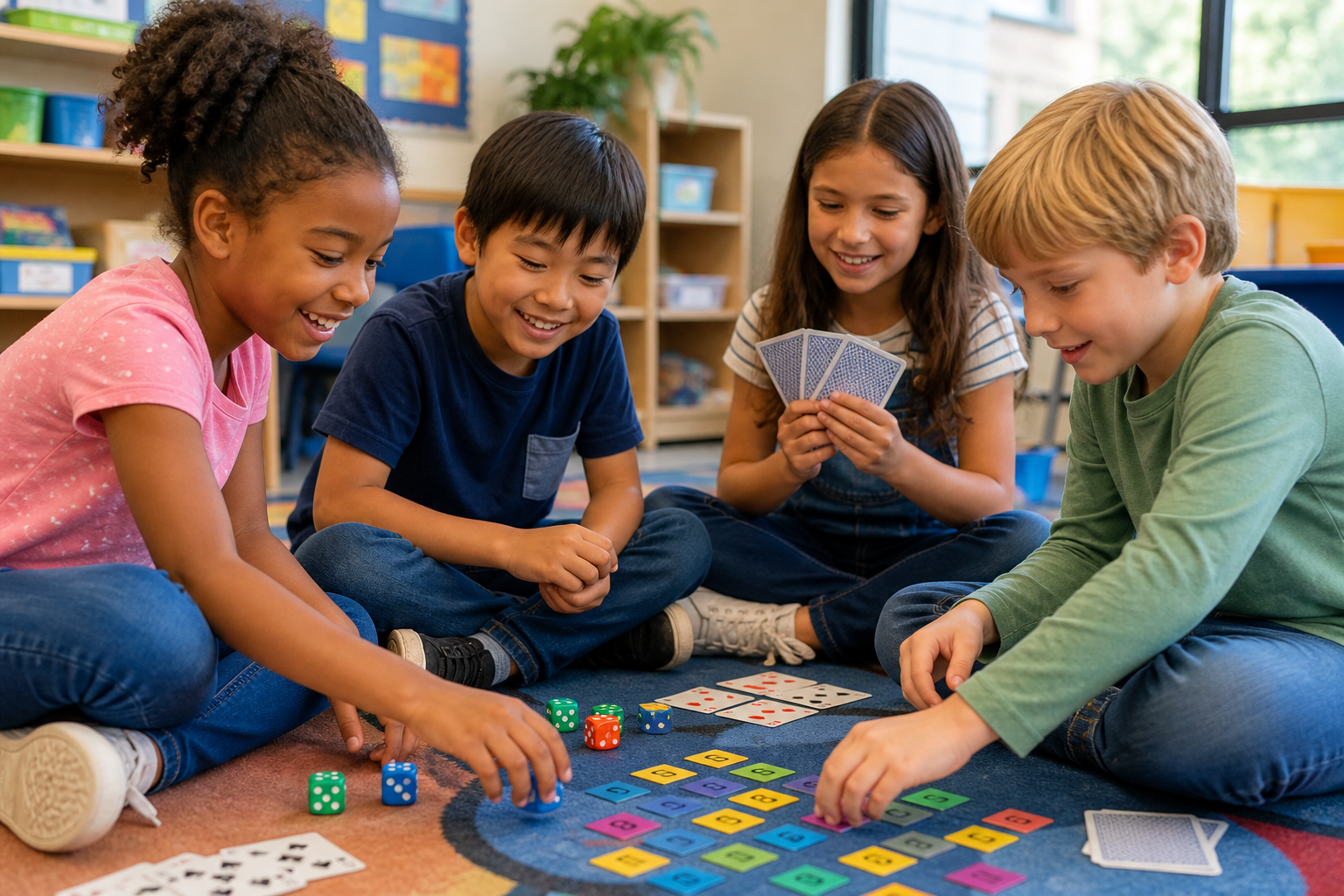
Math practice does not have to mean silent rows and timed drills. The best math games for kids turn number work into something they actually want to do. Whether you are a parent looking for rainy-day activities or a teacher filling the last ten minutes of class, these games build fluency without the friction of a traditional worksheet.
The key is matching the game to the skill and the age. A kindergartener learning to count needs different play than a fourth grader working on multiplication facts. This list gives you ten proven games, the grades they fit best, and quick tips to adapt each one up or down.
Why Should Kids Play Math Games?
Math games build fluency and confidence because kids practice skills in a low-stress, repeatable format. The National Council of Teachers of Mathematics encourages playful problem solving as a path to deeper understanding, not just a reward after worksheets.
Games also reveal what a child actually knows. You hear their thinking out loud when they explain a move or defend an answer. That is harder to see on a silent worksheet. Use games for engagement, then follow with short printable practice to lock in skills.
What Are 10 Fun Math Games for Kids?
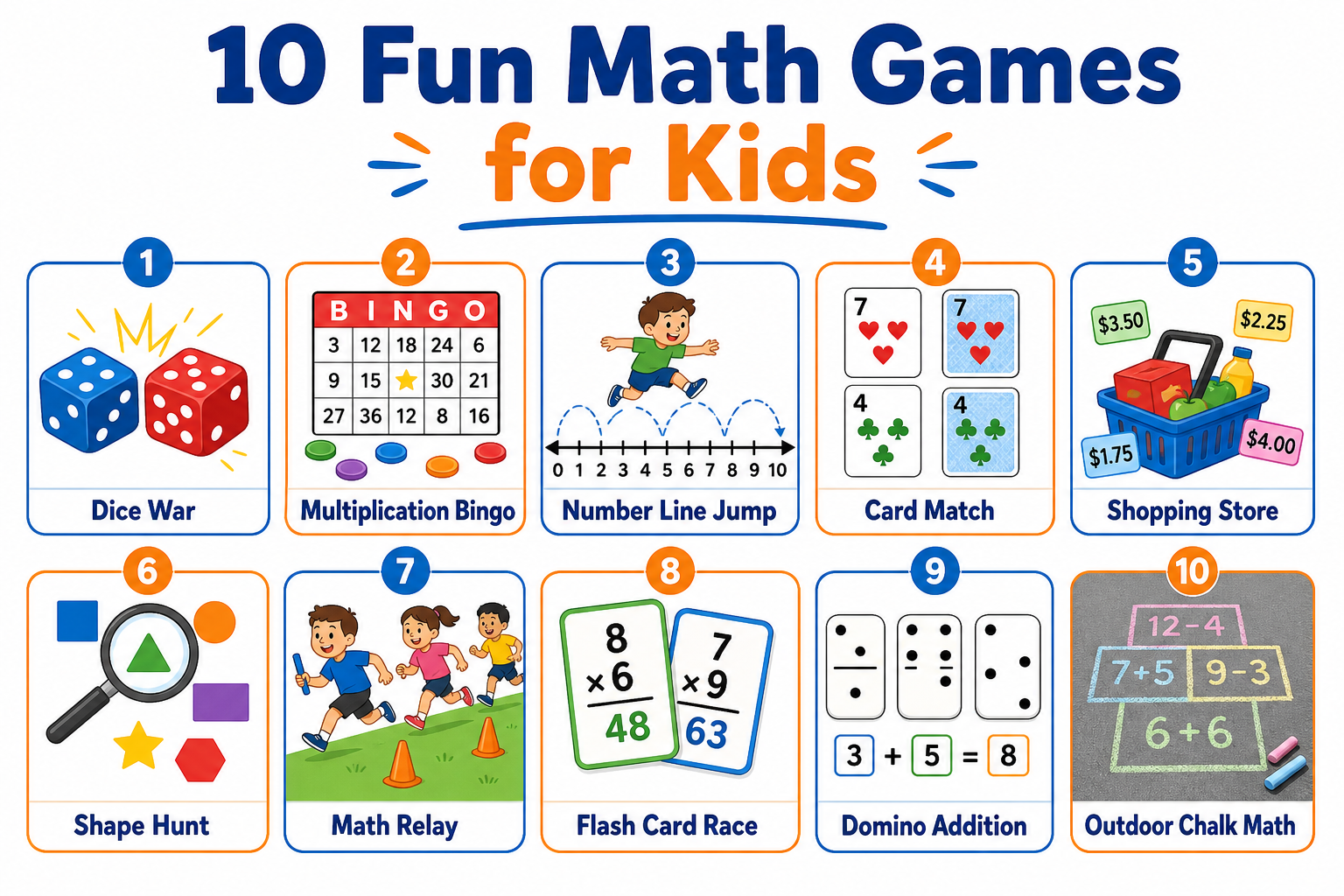
These ten math games need little or no prep and work at home, in centers, or as a whole-class warm-up. Each entry lists the best grade range and the main skill it targets.
1. Dice War
Grades K–3 · Comparing numbers, addition
Each player rolls two dice and adds (or compares) the totals. The higher sum wins the round. First to 10 rounds wins the match.
Tip: Use one die for kindergarteners. Switch to multiplication for older kids by multiplying the two dice instead of adding.
2. Multiplication Bingo
Grades 3–5 · Multiplication facts
Create a 5x5 grid and fill squares with products (12, 18, 24, etc.). Call out facts like "3 x 4" and players mark the answer. First full row wins.
Tip: Start with facts through 5 x 5 before expanding to the full times table.
3. Number Line Jump
Grades K–2 · Counting, addition, subtraction
Draw a number line from 0 to 20 on paper or tape on the floor. Roll a die and jump forward that many spaces. Roll again to practice addition or subtract on the way back.
Tip: Use two dice and add the results for a harder version in second grade.
4. Math Card Match
Grades 1–4 · Facts, memory
Write equations on half the cards and answers on the other half (e.g., "7 + 5" and "12"). Lay them face down and play memory. Match each equation to its answer.
Tip: Focus on one operation per game so kids are not overwhelmed.
5. Pretend Store
Grades 1–4 · Money, addition, subtraction
Set price tags on toys or snacks using play money. Give each child a wallet with coins and bills. They add costs, make change, and practice real-world math.
Tip: Limit items to amounts under one dollar for first graders. Raise prices for older students.
6. Shape Scavenger Hunt
Grades K–3 · Geometry, observation
Hand out a checklist: find a circle, rectangle, triangle, and square in the house or classroom. Count how many of each shape students find in five minutes.
Tip: Ask students to draw each shape after they find it to reinforce vocabulary.
7. Math Relay Race
Grades 2–5 · Fluency under light pressure
Split into two teams. Each runner solves one problem at a station before tagging the next teammate. Problems can be addition, subtraction, or multiplication cards at each stop.
Tip: Keep problems at a level where most students can answer in under 10 seconds.
8. Flash Card Challenge
Grades 2–5 · Fact fluency
Partners quiz each other with printable flash cards. Correct answers earn a point. Switch roles every two minutes. Track scores on a simple chart.
Tip: Print a fresh set from our flash card page so you always have the facts you need.
9. Domino Addition (or Multiplication)
Grades K–4 · Addition, multiplication
Place dominoes face down. Each player flips one and adds the dots. Highest total wins the domino. Play until the pile is gone.
Tip: For third grade and up, multiply the two sides of the domino instead of adding.
10. Sidewalk Chalk Math
Grades K–5 · Any operation, outdoor engagement
Draw a hopscotch board with numbers instead of squares 1–10. Call out problems and kids hop to the answer. Or write a row of products and have kids circle the multiples of 3.
Tip: Outdoor play works well on days when sitting at a desk feels hard.
Want a custom practice page after game time?
Generate a worksheet with the same skills your students just practiced.
Create Free Math WorksheetsHow Do You Pick Math Games by Grade?
Match the game to what students are learning that month. Kindergarteners and first graders need counting and comparing. Second and third graders need addition, subtraction, and early multiplication. Fourth grade and up can handle multi-step problems, fractions, and strategy.
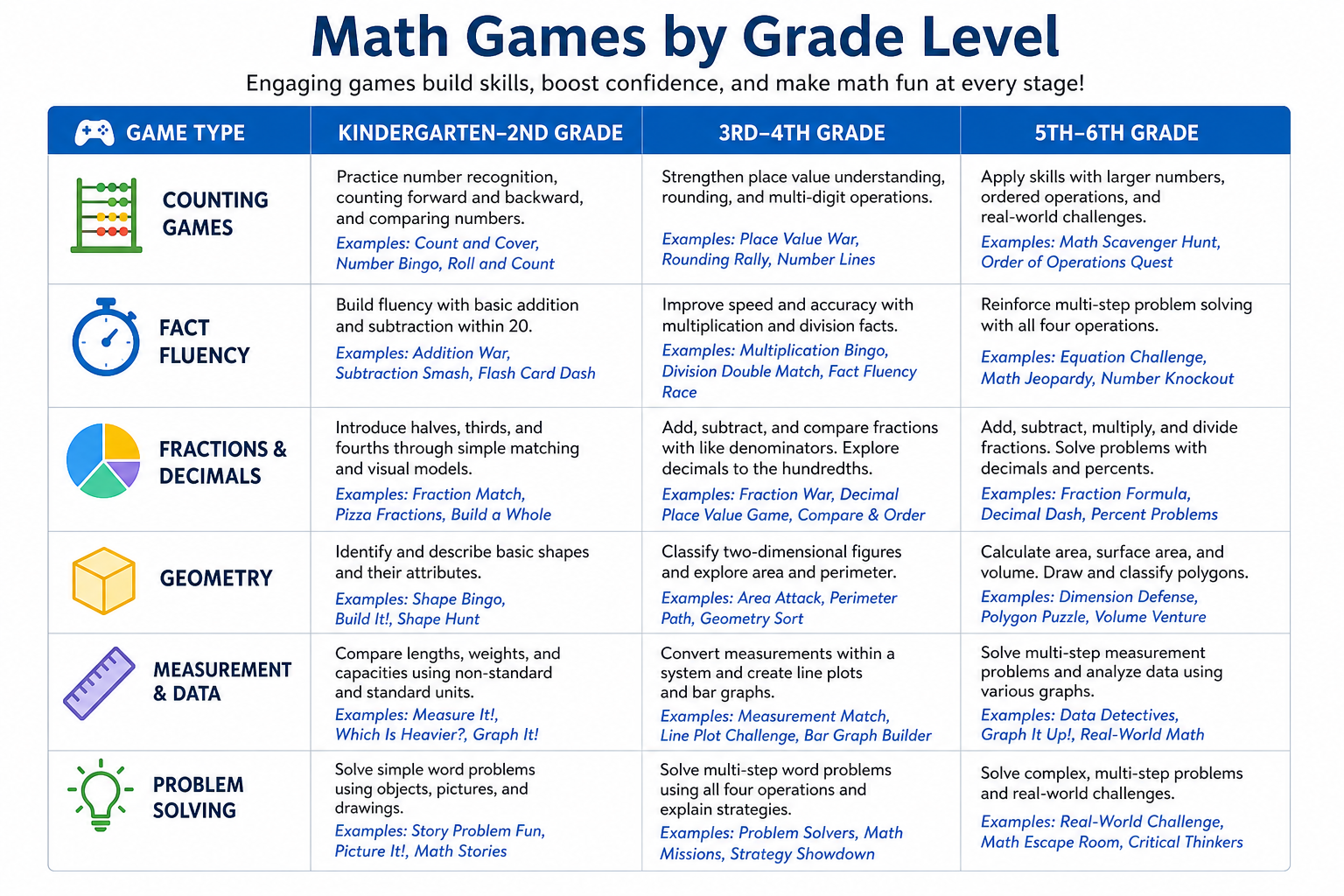
| Grade | Best games from this list | Worksheet link |
|---|---|---|
| K–1 | Dice War, Number Line Jump, Shape Hunt | Kindergarten math worksheets |
| 2–3 | Card Match, Flash Card Challenge, Domino Math | 2nd grade math worksheets |
| 3–4 | Multiplication Bingo, Math Relay, Pretend Store | Grade 3 multiplication worksheets |
| 5–6 | Relay Race, Chalk Math (fractions/decimals) | 5th grade math worksheets |
What Worksheets Pair With Math Games?
Games and worksheets work best together: games build motivation, worksheets build stamina. After Multiplication Bingo, print a short fact drill. After Pretend Store, use money word problems on paper. The Common Core math standards outline grade-level expectations so you can align both play and print practice.
- Multiplication flash cards for Flash Card Challenge and Bingo follow-up
- Printable multiplication chart as a reference during bingo and relay games
- Math worksheet generator for custom problem sets after any game session
- AI quiz generator for a quick review quiz on the same topic
- How to teach multiplication to 3rd graders for deeper teaching strategies beyond games
Conclusion
Fun math games for kids work when they are short, skill-matched, and repeatable. Pick two or three favorites from this list and rotate them through the week. Add worksheets when you want structured proof of progress. Most children will practice longer when it feels like play.
Start with Dice War or Number Line Jump tomorrow. You need almost no materials, and you will see quickly which skills need more work on paper.
Ready for printable practice?
Build a custom math worksheet in seconds. Free, no account required.
Generate Custom Math WorksheetsFrequently Asked Questions
Fun math games turn practice into play using dice, cards, movement, and everyday objects. Strong choices include Dice War for comparing numbers, Multiplication Bingo for fact fluency, and a pretend store for money skills. Pick games that match your child's grade level and keep sessions short.