Common Core math standards shape what your child learns in each grade, from counting in kindergarten to ratios in sixth grade. If homework looks unfamiliar or word problems demand explanations you never had to write, the standards are often the reason. Understanding Common Core math standards by grade helps you support learning at home without fighting the school's approach.
This guide explains what the standards are, how they differ from older math instruction, and what students should know at each grade level. You will also find practical ways to practice at home with free worksheets that align to common classroom goals.
What Are Common Core Math Standards?
Common Core math standards are a set of learning goals adopted by most U.S. states to create consistency in what students learn each year. The official standards are published at thecorestandards.org. They cover domains such as operations, number sense, measurement, geometry, and data across kindergarten through high school.
Each standard describes a specific skill or understanding. For example, a third grade standard might require students to interpret products of whole numbers, such as understanding that 5 × 7 means five groups of seven. Standards are grouped by grade so curriculum writers, teachers, and parents can see how skills connect year to year.
How Is Common Core Math Different?
Common Core math emphasizes understanding why a procedure works, not just getting a fast answer. Students draw models, write explanations, and compare strategies. This can feel slower at first but builds a foundation for algebra and higher math.
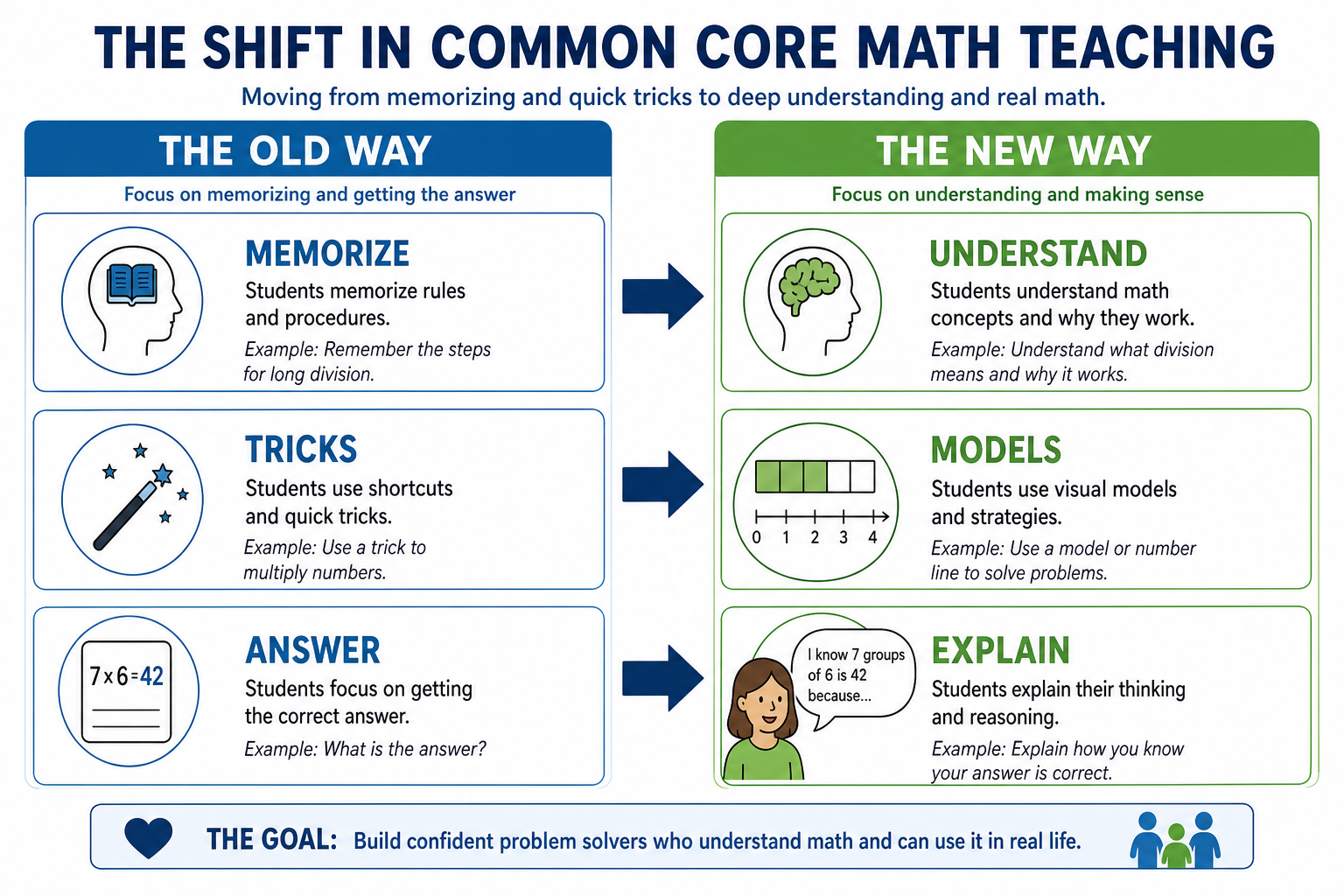
Three shifts define the approach. First, students balance procedural skill with conceptual understanding. Second, they connect math topics across grades instead of treating each chapter as isolated. Third, they practice applying math to real-world problems and explaining their reasoning in words and pictures.
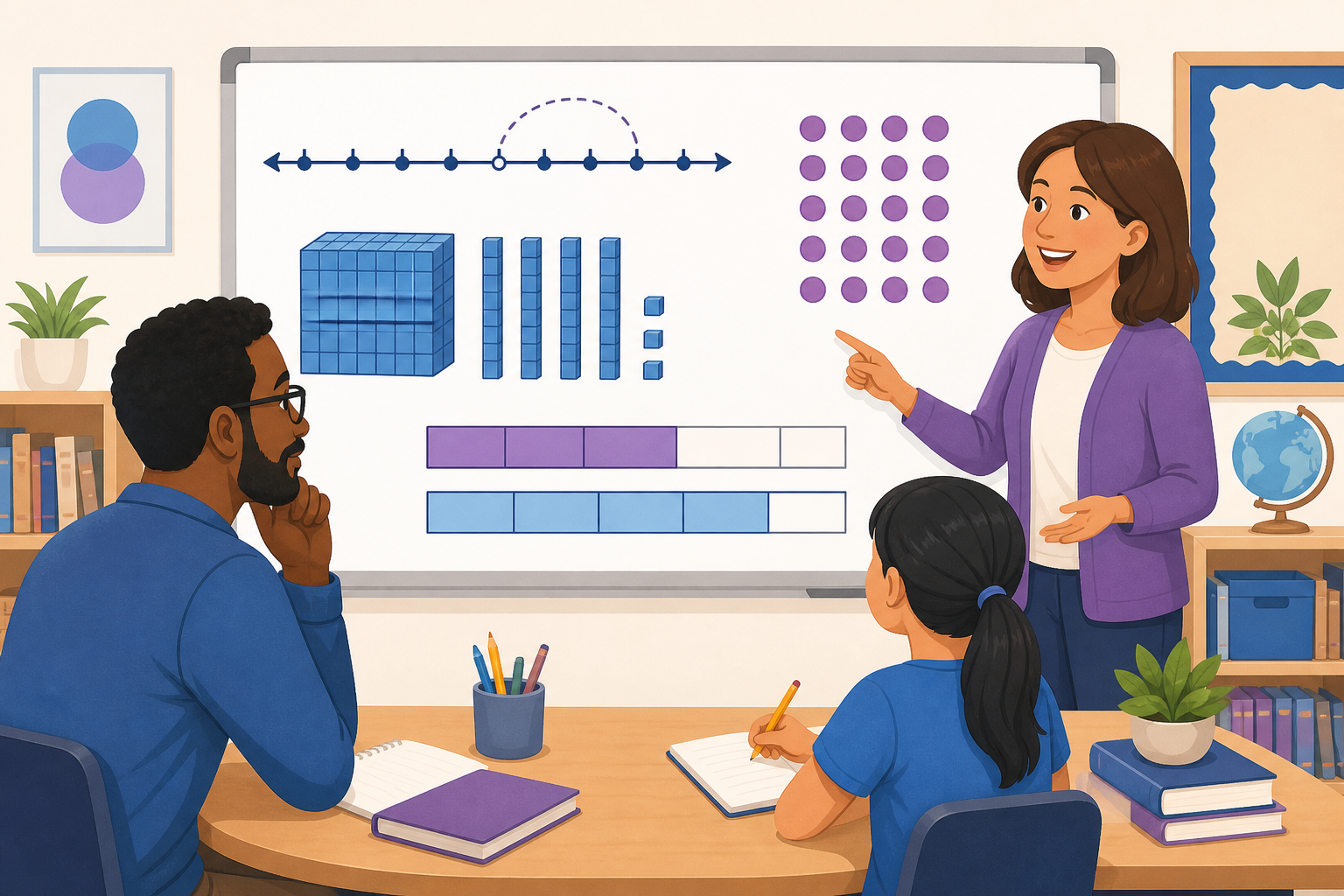
If your child draws tape diagrams, number bonds, or area models, that is intentional. These visuals are bridges to abstract thinking, not extra busywork.
What Are the Common Core Math Standards by Grade?
The table below summarizes major focus areas for kindergarten through sixth grade. Your state may use slightly different wording, but the sequence is broadly similar nationwide.
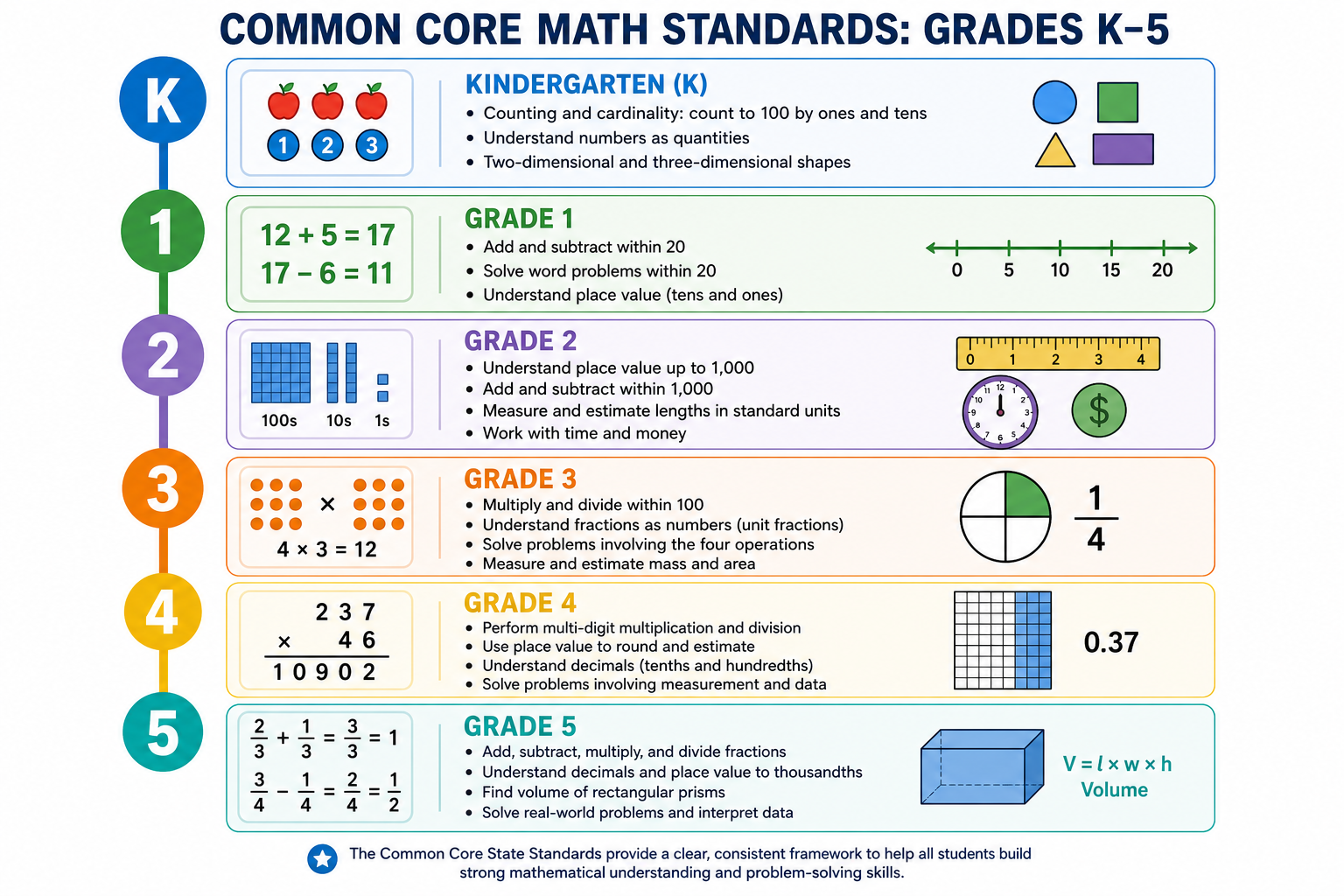
Kindergarten
Focus: Counting, number names, comparing quantities, basic shapes
Examples: Count to 100, compare two numbers, identify circles and squares
Grade 1
Focus: Addition and subtraction within 20, place value (tens and ones)
Examples: Solve word problems within 20, understand 14 is 1 ten and 4 ones
Grade 2
Focus: Addition and subtraction within 100, measurement, time, money
Examples: Add two-digit numbers with regrouping, tell time to five minutes
Grade 3
Focus: Multiplication, division, fractions as numbers, area
Examples: Know products of single-digit facts, understand 1/4 on a number line
Grade 4
Focus: Multi-digit operations, fraction equivalence, decimals intro, angles
Examples: Multiply four-digit by one-digit, compare fractions with different denominators
Grade 5
Focus: Fraction operations, decimal operations, volume, coordinate plane
Examples: Add fractions with unlike denominators, find volume of rectangular prisms
Grade 6
Focus: Ratios, dividing fractions, negative numbers, statistical thinking
Examples: Understand ratio concepts, divide fractions by fractions
Third grade is a major turning point. Multiplication and division become central, and fractions appear on the number line for the first time. Our guide to teaching multiplication in 3rd grade walks through the strategies classrooms use to meet those standards. For place value in earlier grades, practice with place value worksheets and equivalent fractions sheets in fourth and fifth grade.
Practice grade-level skills with custom worksheets
Pick a topic and grade, generate a page, and print. Free and aligned to common elementary math goals.
Math Worksheet GeneratorHow Can Parents Support Common Core Math at Home?
You do not need to memorize every standard to help at home. Focus on habits that match what teachers want: thinking, explaining, and connecting math to real situations.
- Ask "How do you know?" This prompts explanation, which is a core Common Core skill on homework and tests.
- Use objects and drawings: Counters, number lines, and sketches support the visual models students learn at school.
- Match the school method first: If your child uses partial products for multiplication, practice that before showing your shortcut.
- Practice the current grade skill: Extra worksheets on today's topic beat random review from other grades.
- Keep homework calm: Our math homework help guide shows how to coach without doing the work for them.
The National Council of Teachers of Mathematics also emphasizes reasoning, problem solving, and connections across math topics, goals that align closely with the Common Core approach.
What Are Common Misconceptions About Common Core?
Several myths create unnecessary stress for parents. Clearing them up helps you support your child more effectively.
- "Common Core bans traditional methods." It does not. Students still learn standard algorithms. They often learn conceptual models first so the procedures make sense.
- "It is only for public schools." Many private and homeschool curricula cover similar topics in a similar sequence even if they do not use the label.
- "More steps means worse math." Extra steps early on often reduce errors later when math becomes abstract.
- "Parents cannot help if they did not learn this way." You can learn alongside your child. Ask them to teach you the school method.
Conclusion
Understanding Common Core math standards by grade gives you a roadmap for what your child is learning and why homework may look different from your own school days. Focus on the big ideas at each grade level, support explanation and visual thinking, and use targeted practice when your child needs more reps.
Check your state's standards page, print a worksheet for this week's skill, and ask your child to walk you through one problem tonight. That single conversation builds more understanding than a stack of unexplained answers.
Ready to practice this week's math skill?
Generate grade-level worksheets in seconds. Free, print-ready, no signup.
Create a Custom Math WorksheetFrequently Asked Questions
Common Core math standards are grade-by-grade learning goals that describe what students should understand and be able to do in mathematics. They emphasize conceptual understanding, problem solving, and explaining reasoning rather than only memorizing procedures. Many U.S. states have adopted or adapted these standards for public schools.