To teach 2-digit by 2-digit multiplication, start with the area model so students see how place value splits a problem into four smaller products. Move to partial products, then the standard algorithm once students can explain each step. Fourth graders who master this sequence understand why the math works, not just how to line up digits.
Multi-digit multiplication is where times tables meet place value. A problem like 23 x 14 is not a new fact to memorize. It is four familiar facts arranged by tens and ones. Students who rush to the stacked algorithm without models often misalign columns or forget partial products. This guide covers grade-level expectations, the area model, a five-step lesson, common mistakes, and free printable practice.
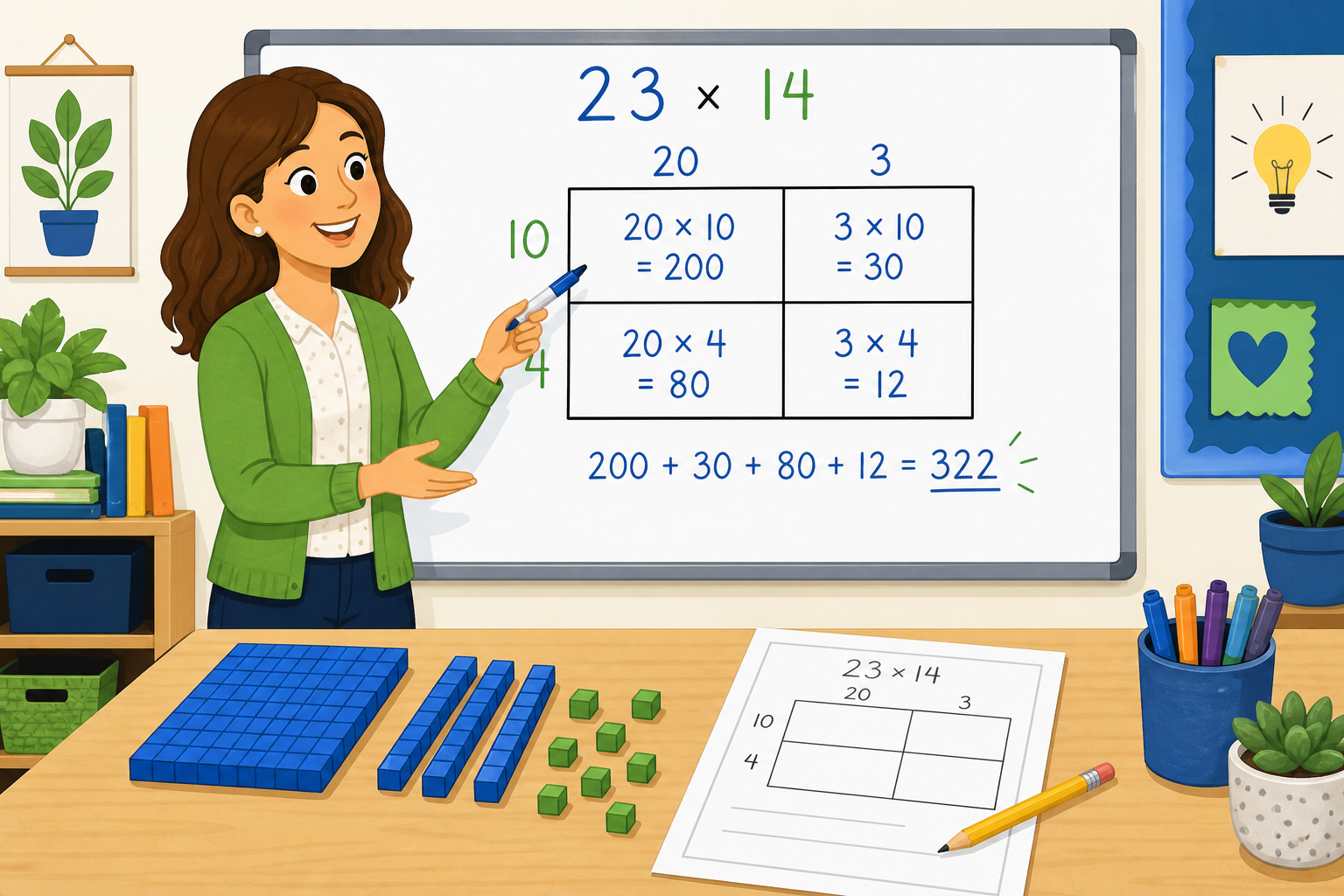
What Grade Learns 2-Digit by 2-Digit Multiplication?
Most U.S. students learn 2-digit by 2-digit multiplication in 4th grade. The Common Core grade 4 number standards expect students to multiply two two-digit numbers using place value strategies and explain their work with equations, arrays, or area models.
Third grade lays the foundation with basic facts and 1-digit by 2-digit multiplication. Our guide to teaching multiplication in 3rd grade covers that earlier stage. Fourth grade extends the same place value thinking to two factors with two digits each.
How Does the Area Model Work?
The area model treats multiplication as finding the area of a rectangle. Split each side by place value, find the area of each smaller rectangle, then add the pieces. For 23 x 14, decompose 23 into 20 and 3, and 14 into 10 and 4.
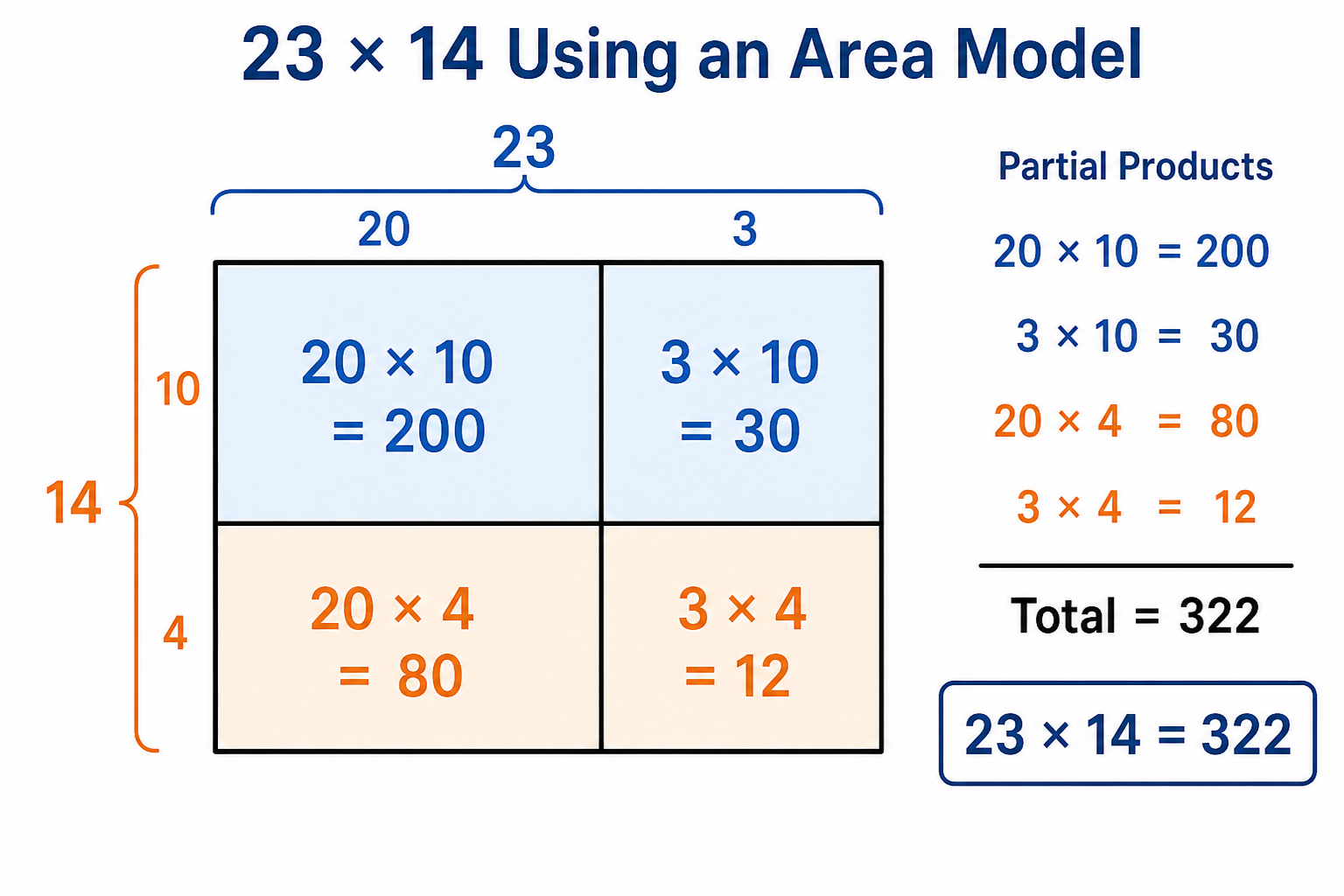
- 20 x 10 = 200 (tens times tens)
- 20 x 4 = 80 (tens times ones)
- 3 x 10 = 30 (ones times tens)
- 3 x 4 = 12 (ones times ones)
- Total: 200 + 80 + 30 + 12 = 322
Students who draw this rectangle can explain every digit in the answer. That understanding prevents the random carrying errors that appear when kids only know the algorithm.
What Five-Step Lesson Works?
Spread these steps across one to two weeks. Each layer needs practice before the next one makes sense.
Students need fluent facts through 10 x 10 before multi-digit work. Review with flash cards or a quick facts quiz at the start of each unit.
Practice 4 x 23 and 6 x 47 using place value (20 x 4 + 3 x 4). This is the bridge between basic facts and full 2-digit by 2-digit problems.
Draw rectangles split by tens and ones. Find each partial area and add. Students see why 23 x 14 breaks into four smaller products.
Record each piece in expanded form: (20 + 3) x (10 + 4) = 200 + 80 + 30 + 12. Students connect the written work to the rectangle.
Once partial products are solid, introduce the compact stacked method. Students recognize it as a faster version of the same math.
Print 2-digit by 2-digit multiplication worksheets
Custom problem counts, answer keys, and unlimited prints for classroom or homeschool.
2-Digit by 2-Digit Multiplication WorksheetsHow Do Partial Products Lead to the Algorithm?
Partial products write out what the area model shows. Students record each piece, then add. The standard algorithm compresses the same work into fewer lines.
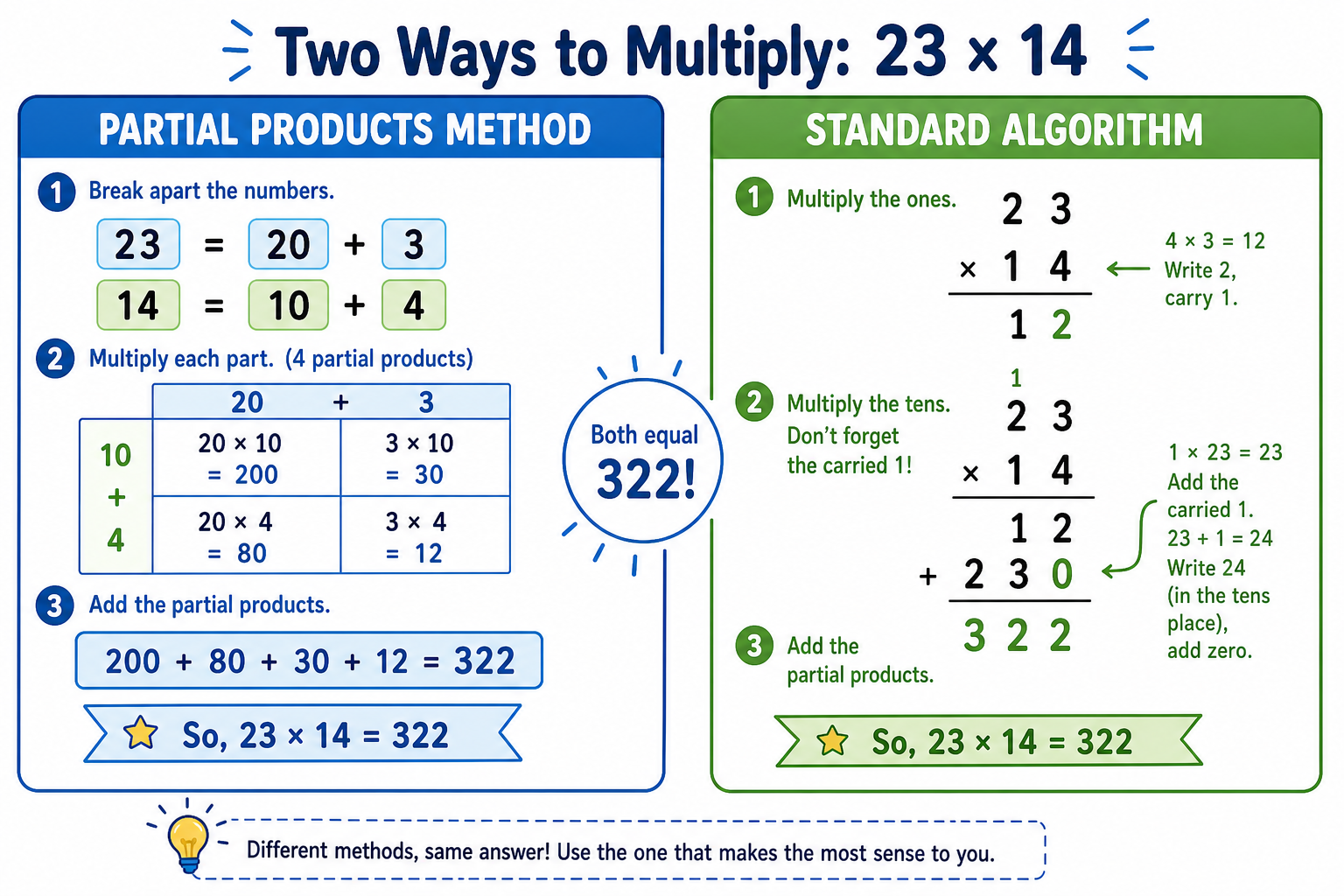
When introducing the algorithm, solve one problem both ways side by side. Students should see that 92 (23 x 4) and 230 (23 x 10) in partial products match the rows in the stacked method. Connect to 4th grade multiplication worksheets for mixed practice once both methods are familiar.
What Mistakes Should Teachers Watch For?
- Jumping to the standard algorithm before the area model
- Misaligning partial products when writing the expanded form
- Forgetting to add a zero placeholder when multiplying by the tens digit
- Adding partial products incorrectly under time pressure
- Skipping estimation to check if an answer is reasonable
- Assigning only 2-digit by 2-digit problems without 1-digit review mixed in
Estimation is the fastest fix. Before solving 23 x 14, round to 20 x 15 = 300. If a student gets 132, the estimate catches the error immediately. Pair this habit with routines from our complete guide to 4th grade math.
How Do Worksheets Support Practice?
Worksheets follow instruction, not replace it. After an area model lesson, assign four problems with space to draw rectangles. Later, shift to partial products and finally the algorithm. Generate fresh sets from the math worksheet generator or use premade 2-digit multiplication pages.
Review basic facts with multiplication flash cards or a printable multiplication chart at the start of each session. Facts still matter inside every multi-digit problem.
Key Takeaways
- Fourth grade is the typical year for 2-digit by 2-digit multiplication.
- Area model first, partial products second, algorithm last.
- Each problem breaks into four partial products based on place value.
- Estimation catches misaligned columns and addition errors.
- Short daily practice with mixed review builds lasting fluency.
Conclusion
Teaching 2-digit by 2-digit multiplication works when students see the rectangle before the stack. Place value splits big problems into small ones. Partial products record what the model shows. The standard algorithm becomes a shortcut students trust because they built it themselves.
Free 2-digit by 2-digit multiplication worksheets
Printable practice with custom problem counts for 4th grade and up.
2-Digit by 2-Digit Multiplication WorksheetsRelated Articles
- How to Teach Multiplication to 3rd Graders — foundation before multi-digit work
- A Complete Guide to 4th Grade Math Topics — where multiplication fits the year
- How to Help Kids Master Long Division — next major multi-digit skill
Frequently Asked Questions
Most students learn 2-digit by 2-digit multiplication in 4th grade after mastering basic facts and 1-digit by 2-digit multiplication in 3rd grade. The Common Core standard 4.NBT.B5 expects students to multiply two two-digit numbers using strategies based on place value and the properties of operations.