To help kids master long division, confirm multiplication facts and remainder division first, then teach the four-step algorithm—divide, multiply, subtract, bring down—with graph paper and color coding. Use partial quotients for students who need a gentler on-ramp, follow a short daily practice routine, and connect every session to one word problem so the steps have meaning beyond the worksheet.
Long division is where many elementary students hit a wall. The algorithm has more steps than any operation they have learned, and one weak multiplication fact can collapse the whole problem. This guide covers prerequisites, the standard four-step method, an alternative partial-quotients approach, a weekly practice plan, common mistakes, and free printable tools.

Why Does Long Division Matter?
Long division is the capstone of elementary operations. It combines multiplication, subtraction, and place value in one procedure. Students who master it enter middle school ready for fractions, ratios, and algebra. Students who skip understanding and memorize steps often stall when divisors have two digits or decimals appear.
The Common Core fourth grade number standards expect fluency with multi-digit division. Fourth grade pacing details are in our complete 4th grade math guide.
What Prerequisites Should Be Solid First?
Do not introduce the full algorithm until these skills are in place. Gaps here cause most long division frustration.
- Multiplication facts through 12 × 12 (or at least through 9 × 9)
- Division as equal groups with manipulatives
- Division with remainders notation and checking with multiplication
- Place value alignment when writing multi-digit products
- Estimation: about how many groups of the divisor fit?
Review remainders with our division with remainders guide. Build fact speed with daily math fact practice and a printable division table before adding multi-digit dividends.
Multiplication and division are inverse operations—see teaching multiplication to 3rd graders for the fact fluency foundation that long division depends on.
What Are the Four Steps of Long Division?
Teach one step at a time across multiple days. Use graph paper so digits line up in columns. Color-code: divide in blue, multiply in green, subtract in red, bring down in purple.
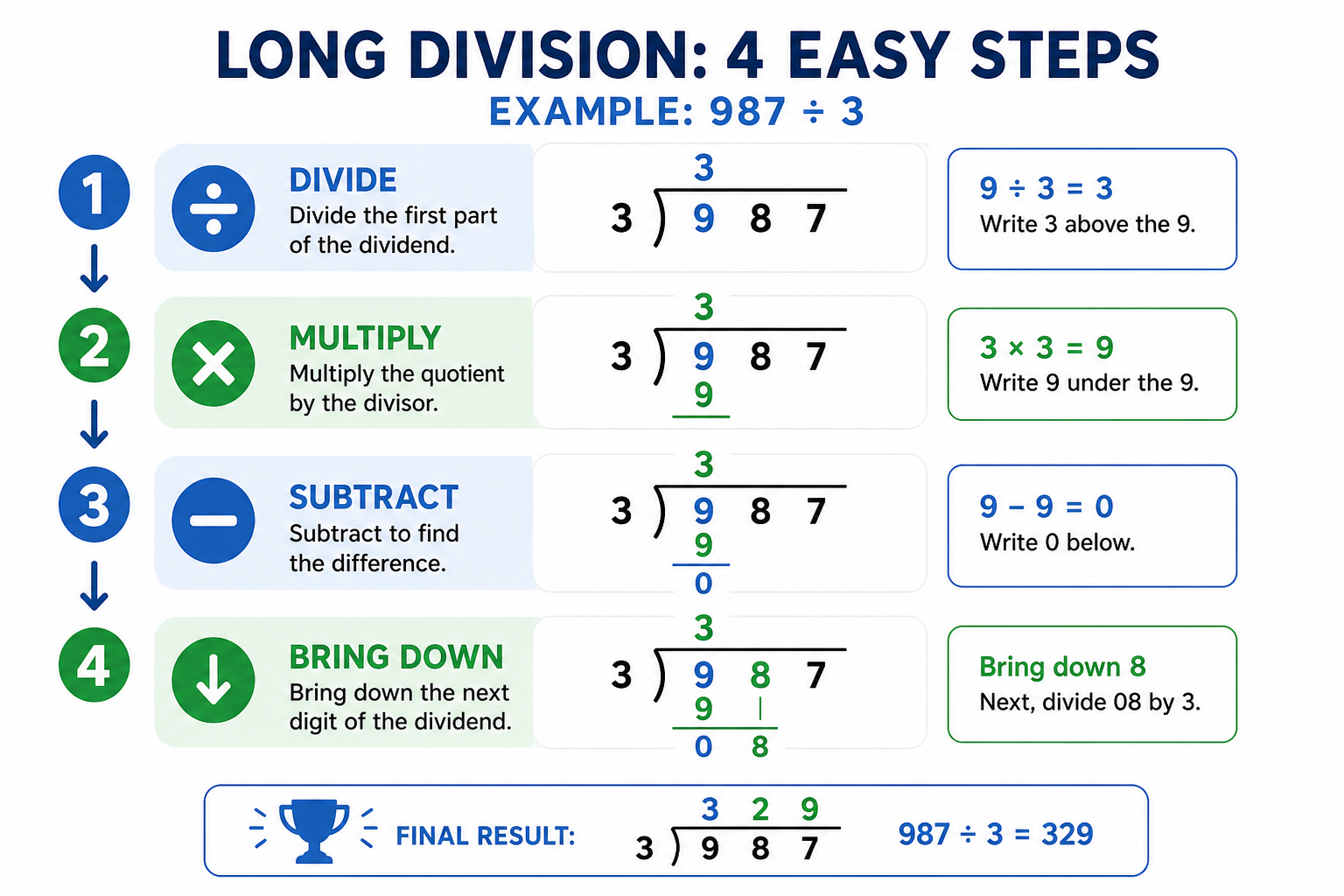
Ask how many times the divisor fits into the first digit (or first group of digits). Write that number above the dividend.
Multiply the divisor by the quotient digit you just wrote. Place the product directly under the digits you divided into.
Subtract the product. The result must be smaller than the divisor. If not, the quotient digit is too large.
Bring down the next digit from the dividend beside the remainder. Repeat divide, multiply, subtract until no digits remain.
Walk through 84 ÷ 4 as a class: 4 goes into 8 two times, write 2, multiply 4 × 2 = 8, subtract 8 − 8 = 0, bring down 4, 4 goes into 4 one time, answer 21. Then try a problem with a remainder before moving to larger dividends.
Print long division practice by level
Generate custom division worksheets—one-digit divisors first, then two-digit, with fresh problems every time.
Free Math Worksheet GeneratorHow Do Partial Quotients Help?
Partial quotients let students subtract chunks they know instead of guessing one quotient digit at a time. For 156 ÷ 6, a student might subtract 60 (10 × 6), then 60 again, then 36 (6 × 6), and add the partial quotients: 10 + 10 + 6 = 26.
This method builds number sense and works well for students who panic at the standard layout. After two to three weeks of partial quotients, many students transition smoothly to the compact algorithm because they already understand what each step means.
The NCTM Principles and Standards encourage multiple division strategies before formal algorithms. Offer both paths in your classroom.
What Weekly Practice Routine Works?
Consistency beats marathon sessions. A twenty-minute daily block with this rhythm builds mastery over weeks.
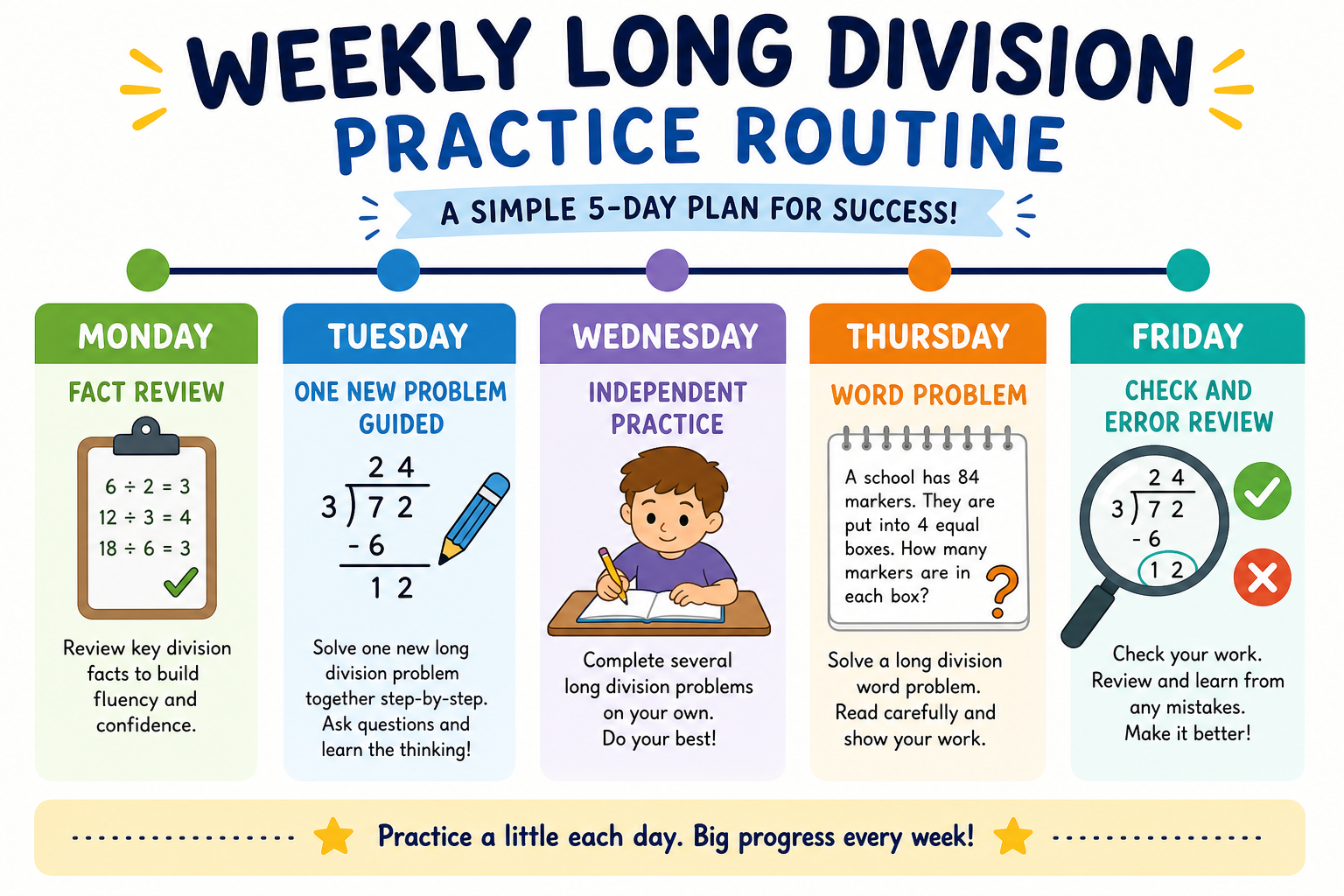
Track which step causes errors—divide, multiply, subtract, or bring down—and reteach that step on Monday before new problems. Spaced repetition from our spaced repetition guide applies directly to long division fact maintenance.
What Mistakes Should Teachers Watch For?
- Quotient digit too large—subtraction result equals or exceeds the divisor
- Misaligned columns so subtraction uses wrong place values
- Skipping multiply or subtract steps when rushing
- Bringing down the wrong digit or forgetting to bring down at all
- Remainder larger than the divisor (quotient digit was too small)
- Starting the standard algorithm before fair-sharing models make sense
When subtraction does not yield a number smaller than the divisor, the quotient digit is wrong—have students erase and try one less. This self-check prevents cascading errors through the rest of the problem.
How Do You Connect Long Division to Word Problems?
Long division word problems ask how many equal groups fit or how many each person gets. Students must decide whether the remainder matters in context before computing.
- Draw a bar model or equal-groups picture before writing the division sentence.
- Label quotient and remainder in words: "6 buses with 3 students walking."
- Check with multiplication: (divisor × quotient) + remainder = dividend.
- Discuss whether to round up (need another bus) or use the remainder as leftover.
Our word problems step-by-step guide pairs with Thursday's routine above. One story problem per week keeps division connected to real reasoning.
Key Takeaways
- Secure multiplication facts and remainders before the full algorithm.
- Teach DMSB one step at a time with graph paper and color coding.
- Offer partial quotients as a bridge for struggling students.
- Practice three to five problems daily, not thirty in one sitting.
- Review errors every Friday and reteach the broken step on Monday.
Conclusion
Helping kids master long division takes patience, fact fluency, and a repeatable weekly routine. Start with models and partial quotients, introduce the standard algorithm when students can explain each step, and keep practice short and frequent. Long division is hard—but it is learnable when prerequisites are solid and errors get fixed the same week they appear.
Run one color-coded problem on the board tomorrow, print three fresh problems from the generator, and end with a single word problem. That trio is enough for a strong long division day.
Free long division practice worksheets
Custom division problems by grade—unlimited prints, no signup.
Free Math Worksheet GeneratorRelated Articles
- How to Teach Division with Remainders — prerequisite before long division
- How to Teach Multiplication to 3rd Graders — fact fluency foundation
- How to Teach Word Problems Step by Step — division story problems
Frequently Asked Questions
Most students begin long division in fourth grade after multiplication facts and basic division with remainders are solid. Some curricula introduce the standard algorithm in late third grade; others wait until fifth grade for larger dividends. Do not rush the algorithm if a student cannot explain fair sharing with manipulatives or check answers with multiplication.