
The science of spaced repetition in math practice explains why a child remembers multiplication facts better after ten short sessions across a month than after one long drill afternoon. Spacing reviews over time strengthens memory, while cramming produces quick but fragile gains. This guide covers the research in plain language, five principles you can use tomorrow, a sample weekly schedule, and free tools for mixed review worksheets and quizzes.
Teachers and parents often default to "more problems today" when scores slip. Spaced repetition suggests a different question: "When did we last revisit this skill?" Timing matters as much as volume—especially for math facts, procedures, and vocabulary students must recall under pressure.
What Is Spaced Repetition in Math Practice?
Spaced repetition is a study schedule that revisits material at planned intervals instead of clustering all practice in one block. In math, that might mean practicing the 6 times table on Monday, again on Wednesday, mixed into a spiral sheet the following week, and once more before a unit test.
The opposite approach—massed practice—cramming thirty identical problems in one sitting—can improve same-day performance but fades fast. Spacing exploits how memory consolidates: each successful retrieval after a gap makes the memory trace stronger.
Elementary math is full of skills that benefit from spacing: addition and subtraction facts, regrouping steps, multiplication tables, fraction equivalence, and word-problem keywords. Spacing does not replace teaching new concepts. It secures what you already taught.
What Does the Research Say About Spaced Practice?
Cognitive scientists have studied spacing and retrieval for over a century. German psychologist Hermann Ebbinghaus documented how memories decay over time without review—the forgetting curve. Later experiments showed that spreading study sessions apart improves retention on tests weeks later.
Modern research on retrieval practice—actively recalling information rather than re-reading—supports the same conclusion for school subjects including math. Resources from Retrieval Practice.org summarize hundreds of studies: low-stakes quizzes and spaced review raise long-term learning more than repeated rereading of notes or worked examples.
For children, sessions stay shorter than college study blocks, but the principle holds. A What Works Clearinghouse review of elementary math interventions consistently finds that systematic practice and progress monitoring support fact fluency and procedural skill—spacing is how you make that practice systematic.
How Does the Forgetting Curve Apply to Math?
Without review, students forget a surprising amount within days. The forgetting curve is steepest right after learning—that is why a next-day review matters so much. Each review resets the curve at a higher baseline if the student successfully retrieves the skill.
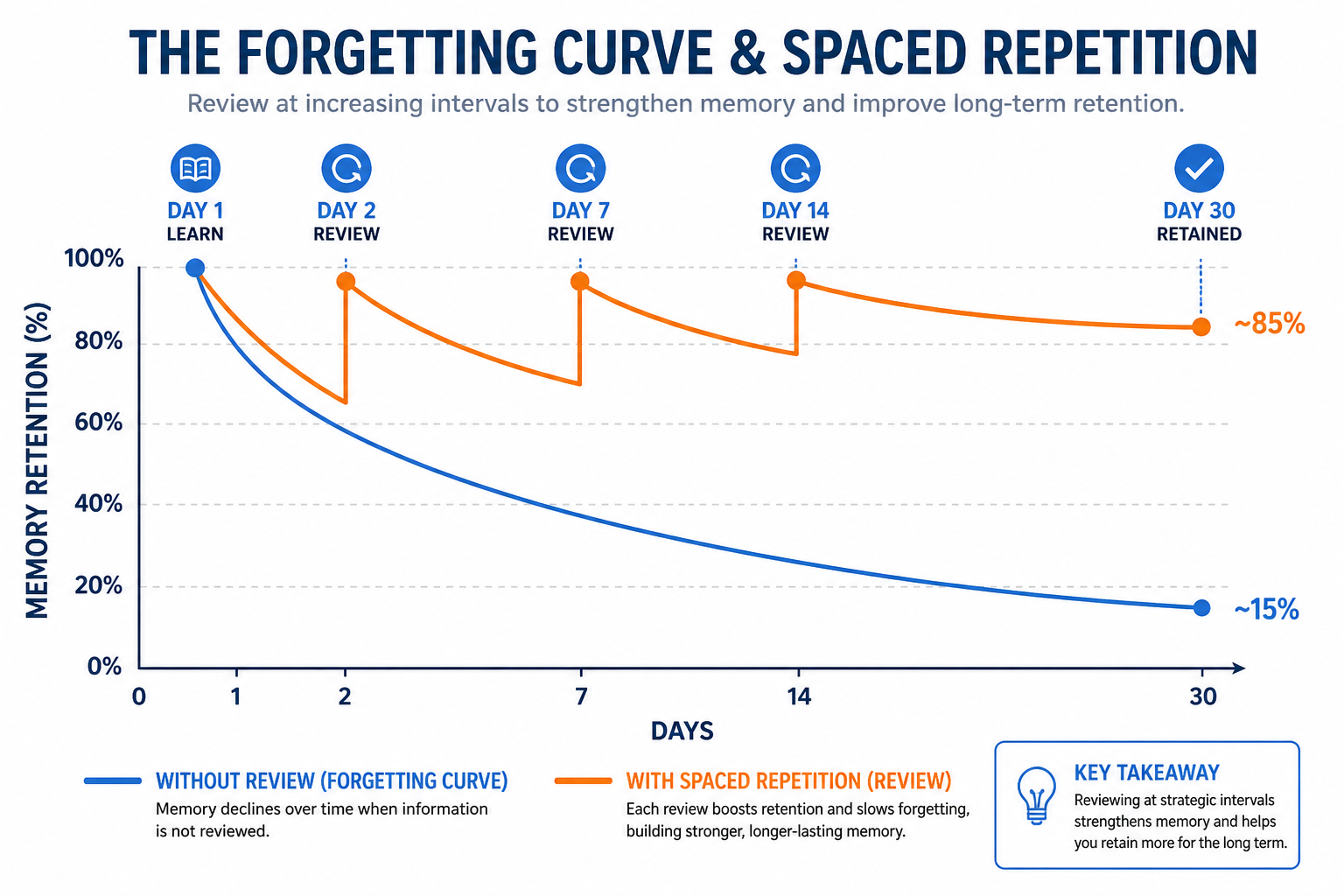
Imagine teaching two-digit subtraction with regrouping on Monday. By Wednesday, students who never practiced again may revert to old errors. Students who solved five fresh problems Tuesday and four mixed problems Friday retain the procedure longer. That is spacing in action—not more total time, better-timed time.
Summer break makes the curve visible. Our summer math review guide applies spacing principles so students return in fall without starting from zero.
What Are Five Principles for Spaced Math Practice?
Translate research into classroom and home habits with these five principles. None require special software—just intentional scheduling.
1. Short sessions beat long marathons
Ten to fifteen minutes of focused practice daily outperforms a single ninety-minute weekend session. Elementary attention spans and memory consolidation both favor brief, repeated exposure.
2. Mix old and new skills
Interleaved practice—alternating problem types on one sheet—forces retrieval. A page with addition, subtraction, and two multiplication facts strengthens memory more than a full page of identical addition.
3. Increase intervals as mastery grows
Review a new skill after one day, then three days, then one week, then two weeks. If the student misses items, shorten the interval. Spacing is flexible, not rigid.
4. Test retrieval, not just re-read
Closing the book and solving problems—without looking at examples—builds stronger memory than passively reading solutions. Quizzes and flash cards are retrieval practice.
5. Track what you reviewed last
A simple log prevents accidental gaps. Note the date you last practiced fractions or the 7 times table. What you do not schedule often gets skipped.
Principle two pairs naturally with times table work. Our times tables guide recommends short daily fact practice—spacing by design. Use printable flash cards on a rotation: different families each day instead of one family for an hour.
What Does a Weekly Spaced Math Schedule Look Like?
This sample week fits a typical elementary classroom or homeschool block. Adjust days to your calendar—the pattern matters more than exact labels.
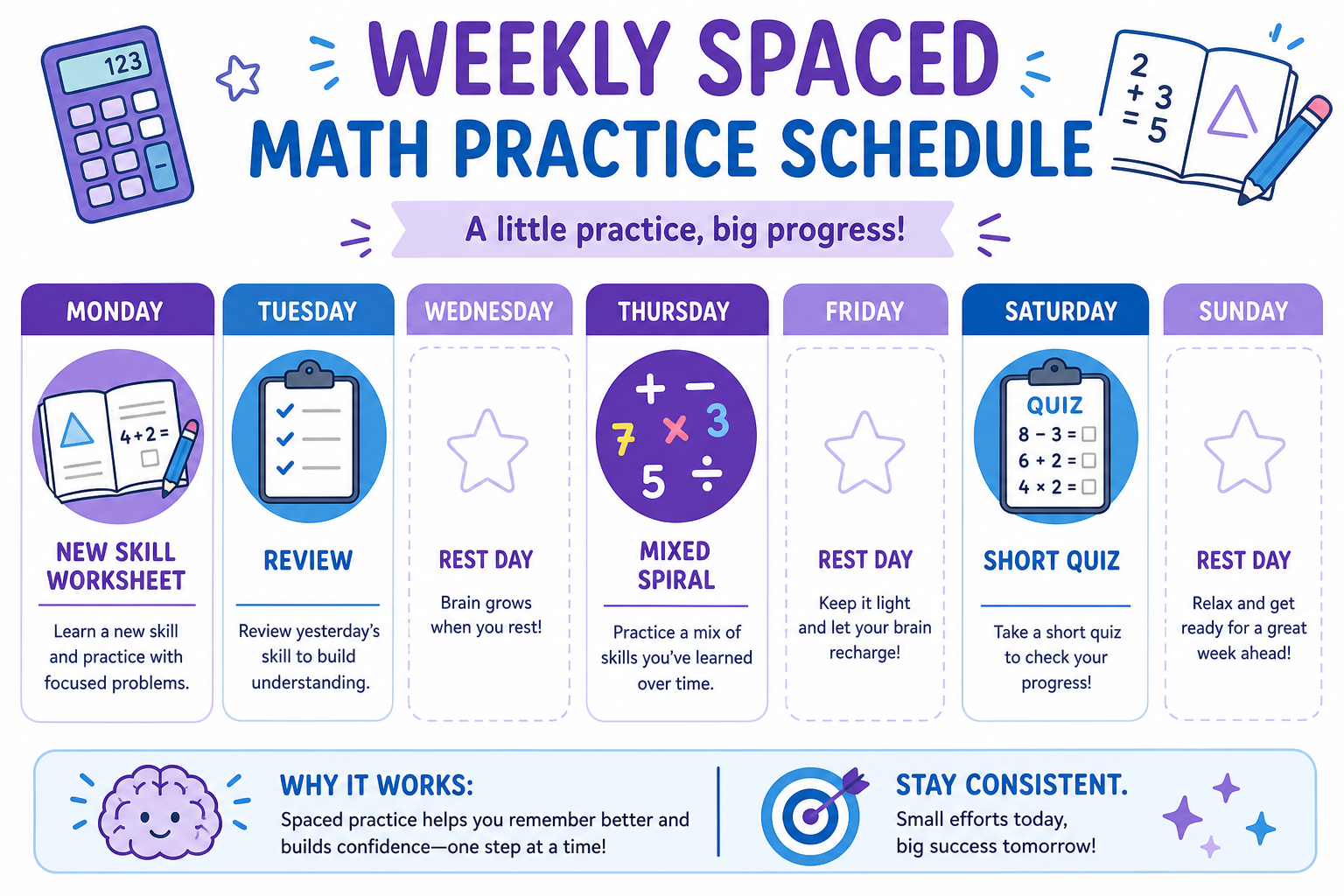
Monday
Focus: New skill or lesson follow-up
Tool: Focused worksheet on today's objective (8–10 problems)
Tuesday
Focus: Next-day review
Tool: Same skill, new numbers—generator fresh page
Wednesday
Focus: Hands-on or game day
Tool: Math games; light or no paper
Thursday
Focus: Mixed spiral review
Tool: Problems from last 2–3 weeks combined
Friday
Focus: Quick retrieval check
Tool: Short quiz or five-problem exit ticket
Generate fresh review sheets each week
New problems every time—perfect for spaced practice without repeat pages.
How Do Teachers and Parents Apply Spacing?
The same science plays out differently by setting. Pick the column that matches your role and combine with related routines from our other guides.
Classroom teachers
Use Thursday spiral sheets as morning work. Rotate fact families weekly on flash card stations. End units with a mixed quiz, not only a chapter test.
Parents at home
Five minutes after dinner beats homework cramming Sunday night. Keep a list of skills introduced at school; review each within 48 hours.
Tutors
Open each session with three problems from prior weeks before teaching new content. Document intervals in session notes.
Morning work routines are ideal for Tuesday and Thursday spacing slots. See morning work with worksheets for setup ideas. Before assessments, layer spacing with test prep strategies so review starts weeks early, not the night before.
Keep practice engaging with games from our fun math practice at home and math games guide—Wednesday game day in the weekly schedule is not a break from learning; it is spaced retrieval in a different format.
What Free Tools Support Spaced Math Practice?
- Math worksheet generator — new problem sets for each review day
- Quiz generator — Friday retrieval checks without reusing old tests
- Quiz library — ready-made mixed-topic practice
- Differentiated worksheets — spacing at the right level per student
Key Takeaways
- Spaced repetition spreads math practice over time for stronger long-term memory.
- The forgetting curve shows why next-day and weekly reviews matter.
- Use short sessions, mixed problem types, and retrieval quizzes—not cramming.
- Follow a weekly pattern: teach, review, spiral, quiz.
- Generators create fresh pages so spacing never means repeating identical drills.
Conclusion
The science of spaced repetition in math practice is clear: when you review matters as much as how much you review. Elementary students build lasting fluency through brief, well-timed sessions—not marathon worksheets the day before a test. Add one spacing habit this week—a Tuesday review sheet or a Friday five-question quiz—and watch retention improve without adding hours of homework.
Memory is not a filing cabinet you fill once. It is a path you walk again and again, a little further apart each time, until the skill feels automatic.
Start spaced practice with a fresh worksheet
Generate new math problems for today's review. Free, no signup.
Free Math Worksheet GeneratorRelated Articles
- When Should Kids Learn Their Times Tables? — daily spaced fact practice
- Summer Math Review — spacing over long breaks
- Morning Work Routine with Worksheets — build review into each school day
Frequently Asked Questions
Spaced repetition means reviewing math skills at increasing intervals instead of cramming in one session. You practice a skill, revisit it a day later, then again after several days and weeks. Research shows this schedule strengthens long-term memory better than massed practice where the same skill is drilled repeatedly in one sitting.