
Effective test prep strategies for elementary students balance skill review, format practice, and emotional readiness—not last-minute cramming. When teachers and parents spread preparation across three or four weeks with short daily sessions, children arrive at assessment day knowing both the math and how the test works. This guide covers seven proven strategies, a four-week plan, grade-level focus areas, and free practice tools you can use right away.
State and district assessments in grades 2 through 5 often mix skills from the entire year. That means test prep is really smart review: spiral practice, familiar formats, and confidence habits that help scores without turning school into nonstop drilling.
Why Does Thoughtful Test Prep Matter in Elementary School?
Test prep matters because assessments measure both content and stamina. A child who understands fractions but has never seen a two-page test may freeze—not from lack of knowledge, but from unfamiliar format and pacing. Thoughtful prep closes that gap without replacing good daily instruction.
The U.S. Department of Education and state agencies use standardized results to monitor school progress. Whether you emphasize scores or not, students benefit when test day feels predictable. Our Common Core standards by grade guide shows which skills typically appear at each level.
Prep also surfaces gaps early. A March practice quiz might reveal that half the class struggles with perimeter—giving you time to reteach before the May assessment. That diagnostic value alone justifies structured review.
What Are Seven Core Test Prep Strategies for Elementary Students?
Use these strategies together. One practice test the week before is not a plan—the combination of spiral review, format work, and confidence building is what moves results.
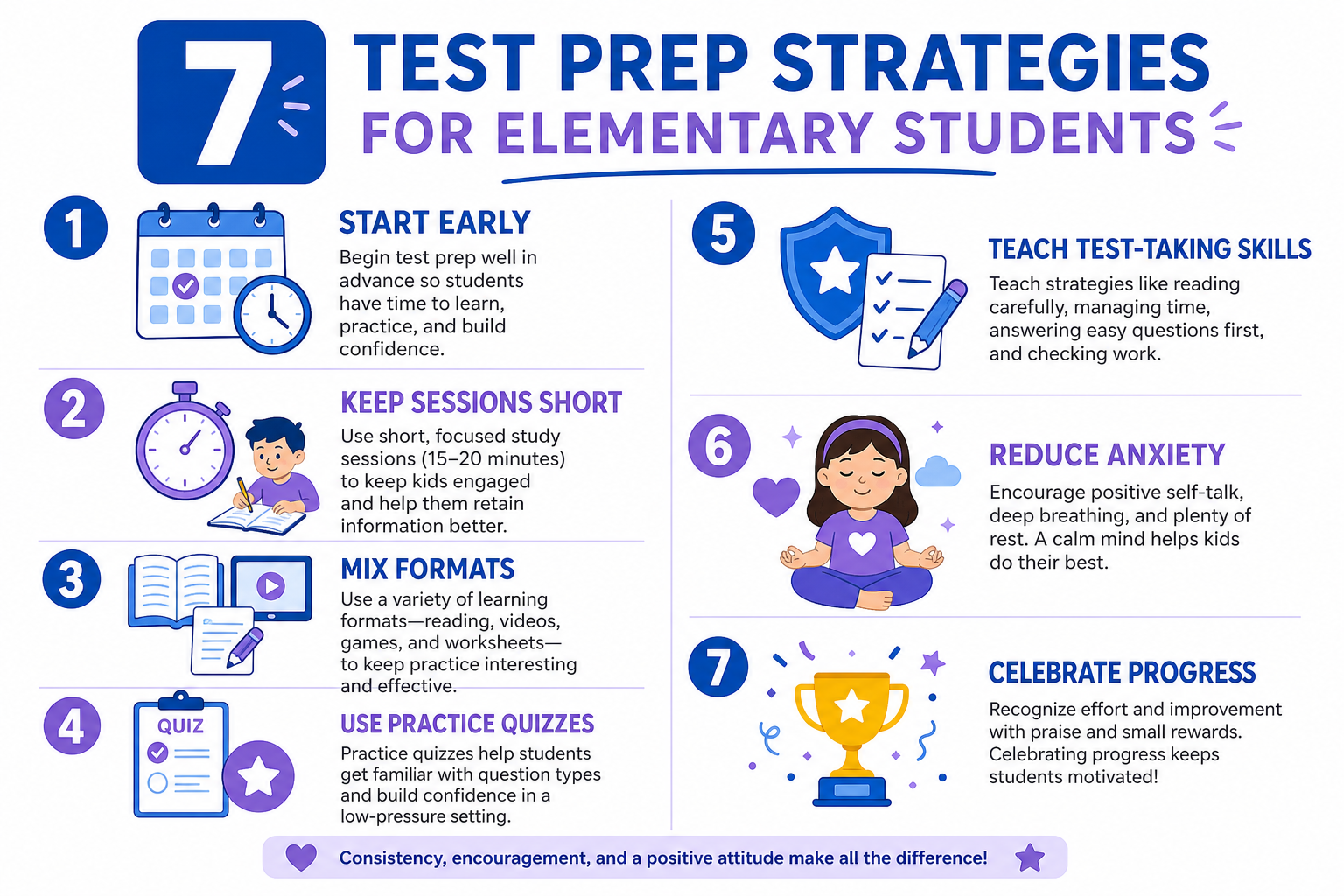
1. Start early with spiral review
Review skills from earlier units—not only the current chapter. State tests mix topics. A five-problem spiral sheet three times per week keeps addition, fractions, and geometry fresh without reteaching entire units.
2. Keep sessions short and consistent
Fifteen to twenty minutes daily maintains focus. Long cram sessions tire young brains and increase anxiety. Consistency across three or four weeks beats one intensive weekend.
3. Mix formats: worksheets, quizzes, and games
Tests use multiple-choice, short answer, and show-your-work items. Rotate formats so students practice each type. Games build fluency; quizzes build stamina; worksheets build written work habits.
4. Teach test-taking skills explicitly
Model reading directions aloud, underlining key words, eliminating wrong answers, and marking questions to revisit. These meta-skills raise scores even when content knowledge is solid.
5. Use practice quizzes for format familiarity
Weekly quizzes in test-like conditions reduce surprise on assessment day. Review mistakes in small groups the next day—focus on why an answer was wrong, not just the correct letter.
6. Differentiate review by need
Not every student needs the same prep. Use quick checks to assign support, on-level, or challenge practice. Custom worksheets let you target gaps without rebuilding the whole plan.
7. Protect sleep, nutrition, and confidence
Scores drop when children are tired or scared. Celebrate growth on practice sets, avoid public score rankings, and keep test talk proportional—important, but not the only measure of success.
Strategy six pairs naturally with tiered worksheets. See our full differentiation guide for building support and challenge versions from one objective.
What Does a Four-Week Elementary Test Prep Plan Look Like?
This timeline assumes a major assessment in week five. Adjust start dates to match your district calendar. Keep classroom instruction moving—prep replaces some homework or center time, not core lessons.
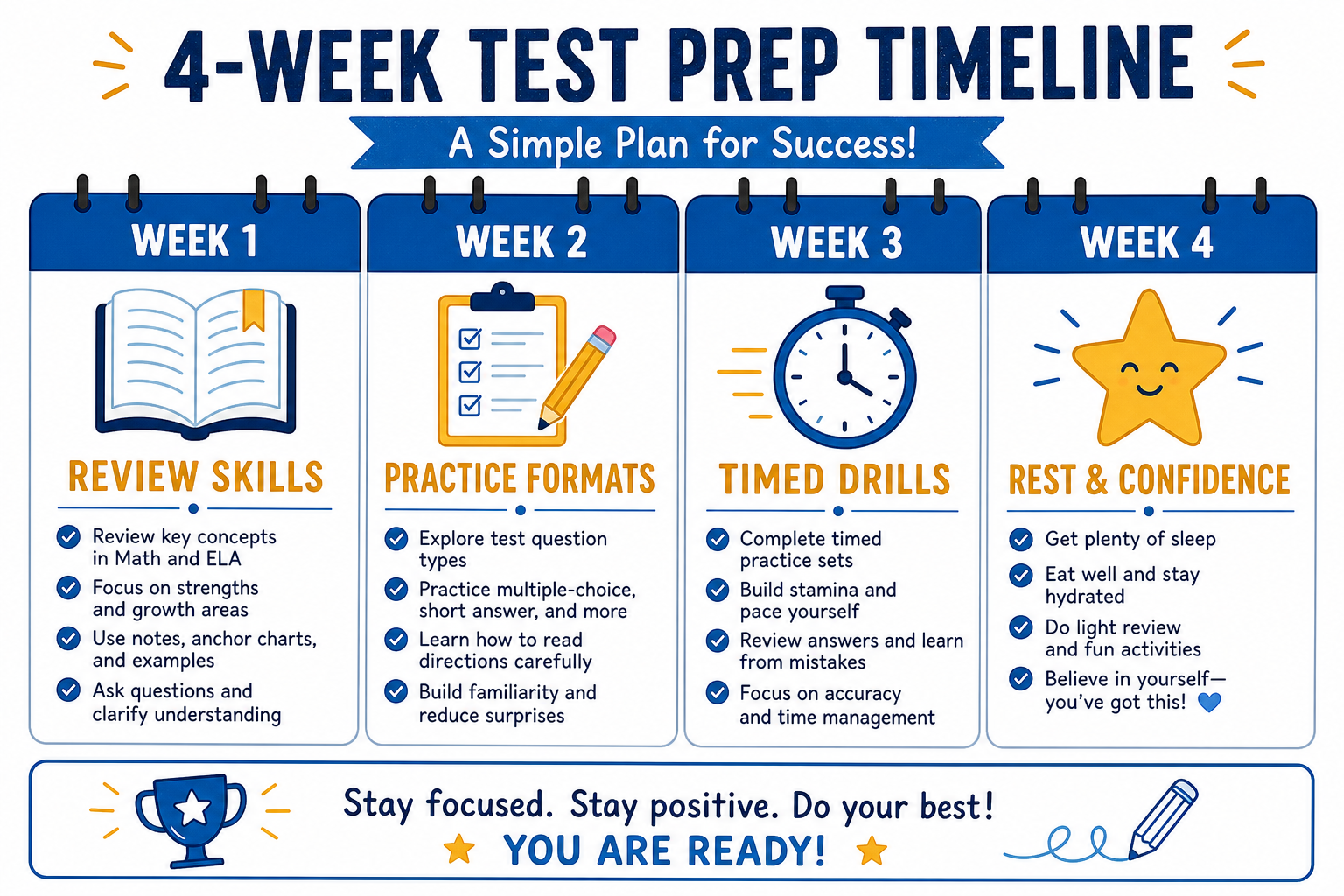
Week 1 — Diagnose and spiral
Focus: Quick checks on major strands; assign review by gap
Activities: Mixed-skill worksheet, class game, note top three weak areas per student
Week 2 — Format practice
Focus: Multiple-choice, open response, show-your-work layouts
Activities: Practice quiz, timed fact drill (optional), review test directions together
Week 3 — Timed stamina
Focus: Pacing without panic; skip-and-return strategy
Activities: Half-length practice test, partner check, reteach one common error type
Week 4 — Confidence and rest
Focus: Light review, routines, emotional readiness
Activities: Short warm-up sheet, test-day walkthrough, early bedtimes the night before
Run a practice quiz this week
Free quiz generator and ready-made quizzes for math review—no signup required.
What Should Each Grade Focus On for Test Prep?
Match review to grade-level expectations. Second and third graders need fluency and calm routines; fourth and fifth graders need multi-step stamina and written explanations.
Grades 2–3
Key skills: Addition/subtraction fluency, place value, basic word problems, reading directions
Tip: Keep timing optional; focus on format familiarity and calm routines
Grade 4
Key skills: Multi-digit operations, fractions, measurement, multi-step word problems
Tip: Introduce light timing on one section per week, not full tests at first
Grade 5
Key skills: Fraction/decimal operations, volume, coordinate graphs, complex word problems
Tip: Practice showing work on open-response items; many state tests weight explanations
Third graders often face multiplication fluency checks. Combine grade 3 multiplication worksheets with flash card practice and our times tables guide. Fifth graders reviewing fractions should use visual fraction models before symbolic drill.
What Test-Taking Skills Should Elementary Students Learn?
Content review alone is not enough. Teach these habits explicitly during week two format practice. Post them on the board during every practice quiz.
- Read the entire question before solving
- Underline important numbers and words
- Eliminate obviously wrong multiple-choice options
- Skip hard questions and return later
- Show work on open-response items even when unsure
- Check answers if time remains
The Khan Academy offers free skill practice by grade if students need extra review at home. Pair online practice with paper formats—most state tests are still pencil-and-paper in elementary grades.
How Do You Avoid Test Prep Burnout?
Burnout shows up as tears, refusal, or dropping scores on practice sets. Prevent it by keeping prep proportional and mixing in low-stakes activities.
- Cap daily prep time: Twenty minutes maximum for homework-style review.
- Alternate with games: Use ideas from our math games guide twice a week so practice stays playful.
- Avoid public scoreboards: Track growth privately or in student folders.
- Skip new content during prep month: Review only—new lessons plus test pressure overwhelms struggling students.
- Plan rest week four: Light warm-ups, not full simulations every day.
Summer break review uses the same principles at a slower pace. Our summer math review plan works well for families who want low-pressure spiral practice between school years.
What Free Tools Support Elementary Test Prep?
These WorksheetGenius resources help teachers and parents build prep routines without buying workbook sets.
- Quiz generator — custom multiple-choice practice by topic
- Quiz library — ready-made math quizzes by category
- Math worksheet generator — spiral review with custom problem counts
- Effective classroom worksheet use — keep prep purposeful, not busy work
Key Takeaways
- Start test prep three to four weeks early with short daily sessions.
- Combine spiral review, format practice, quizzes, and test-taking skill lessons.
- Follow a four-week plan: diagnose, format, stamina, then rest.
- Differentiate review by student need; one size does not fit all.
- Protect confidence—sleep, calm talk, and games matter as much as drill.
Conclusion
Test prep strategies for elementary students work best when they feel like steady review—not a sudden panic in April. Spread practice across weeks, teach how tests work as well as what is on them, and use free quizzes and worksheets to target gaps before assessment day.
Pick one action for this week: a five-question spiral sheet, a practice quiz, or a ten-minute lesson on reading directions carefully. Small consistent steps beat a single cram session every time.
Start test prep with a free practice quiz
Generate custom quizzes or browse the library. No signup required.
Free Quiz GeneratorRelated Articles
- Differentiate Math with Custom Worksheets — tier review by student need
- Summer Math Review — low-pressure spiral practice
- 5 Ways to Make Math Practice Fun at Home — balance prep with engaging activities
Frequently Asked Questions
Start reviewing skills three to four weeks before a major assessment, not the night before. Daily sessions of 15 to 20 minutes beat cramming. For younger students in grades 2 and 3, begin with low-pressure practice formats so testing feels familiar before you add timing.