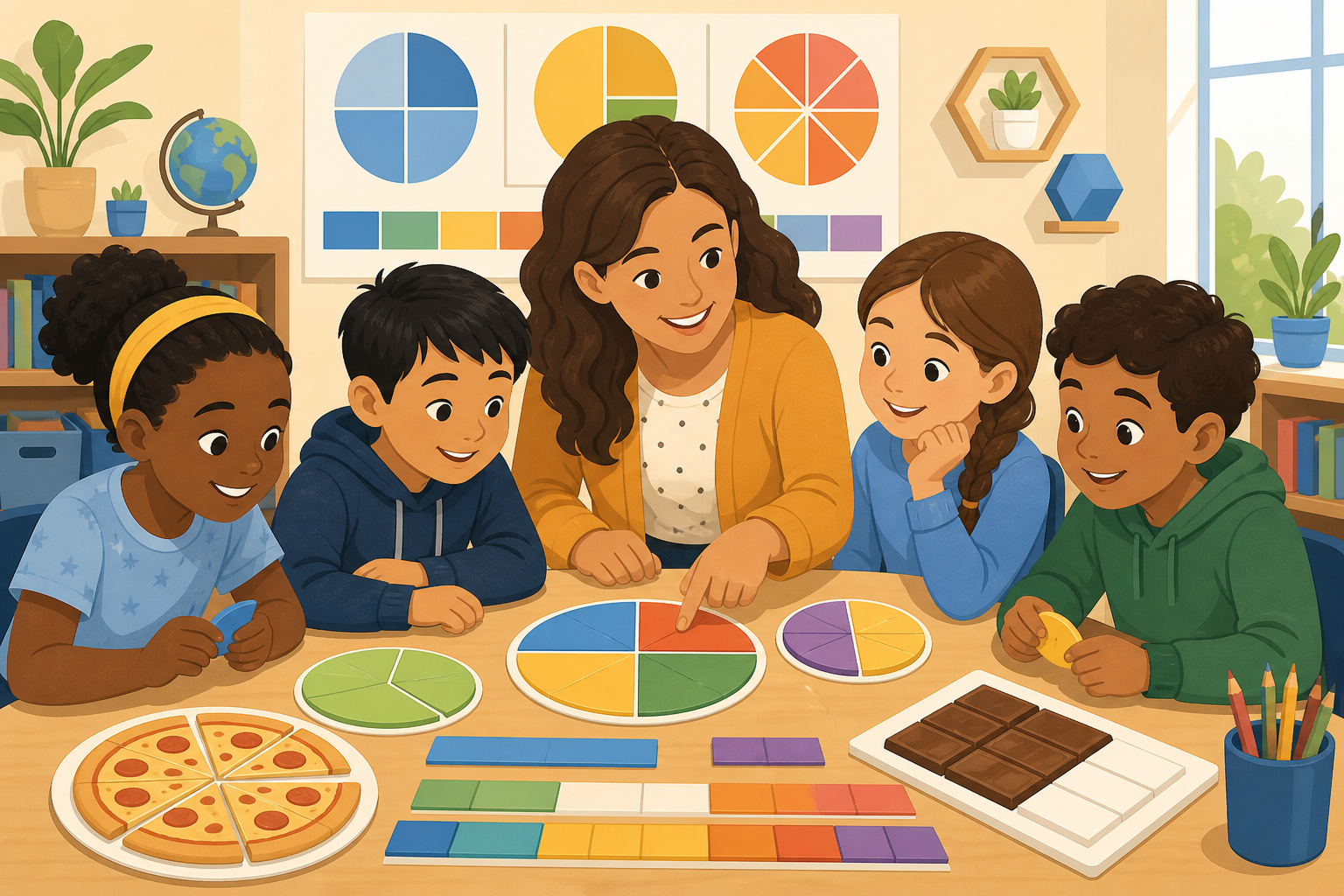
Teaching fractions with visual models gives students something concrete before they face bare numbers like 3/8 on a worksheet. When children shade two parts of a four-part bar or place 1/4 on a number line, they learn that a fraction names a relationship—not two unrelated digits. This guide covers the four essential models, a five-step lesson you can use this week, and free worksheets for practice after the hands-on work.
Fractions trip up many students because the notation is compact but the idea is not. Visual models slow instruction in a productive way. They align with how Common Core fraction standards expect third through fifth graders to reason about parts of a whole before operating on fractions abstractly.
Why Do Visual Models Matter for Teaching Fractions?
Visual models matter because fractions describe equal parts of a defined whole. Without a picture, many students treat the top and bottom numbers as separate values. A bar divided into four equal sections with two shaded makes the meaning of 2/4 obvious in a way that digits alone do not.
The National Council of Teachers of Mathematics recommends multiple representations so students connect area, length, and set views of fractions. Research on rational number learning consistently shows that students who work with models before algorithms retain concepts longer and make fewer errors when denominators change.
Models also reduce fraction anxiety. A student who can point to 1/3 on a circle has a strategy when a test question feels hard. That confidence carries into fourth-grade equivalence work and fifth-grade addition with unlike denominators.
What Are the Four Main Fraction Models?
Most elementary fraction units use four model types. Teach area models first, then expand. Using more than one model for the same fraction is a feature, not redundancy—it builds flexible thinking.
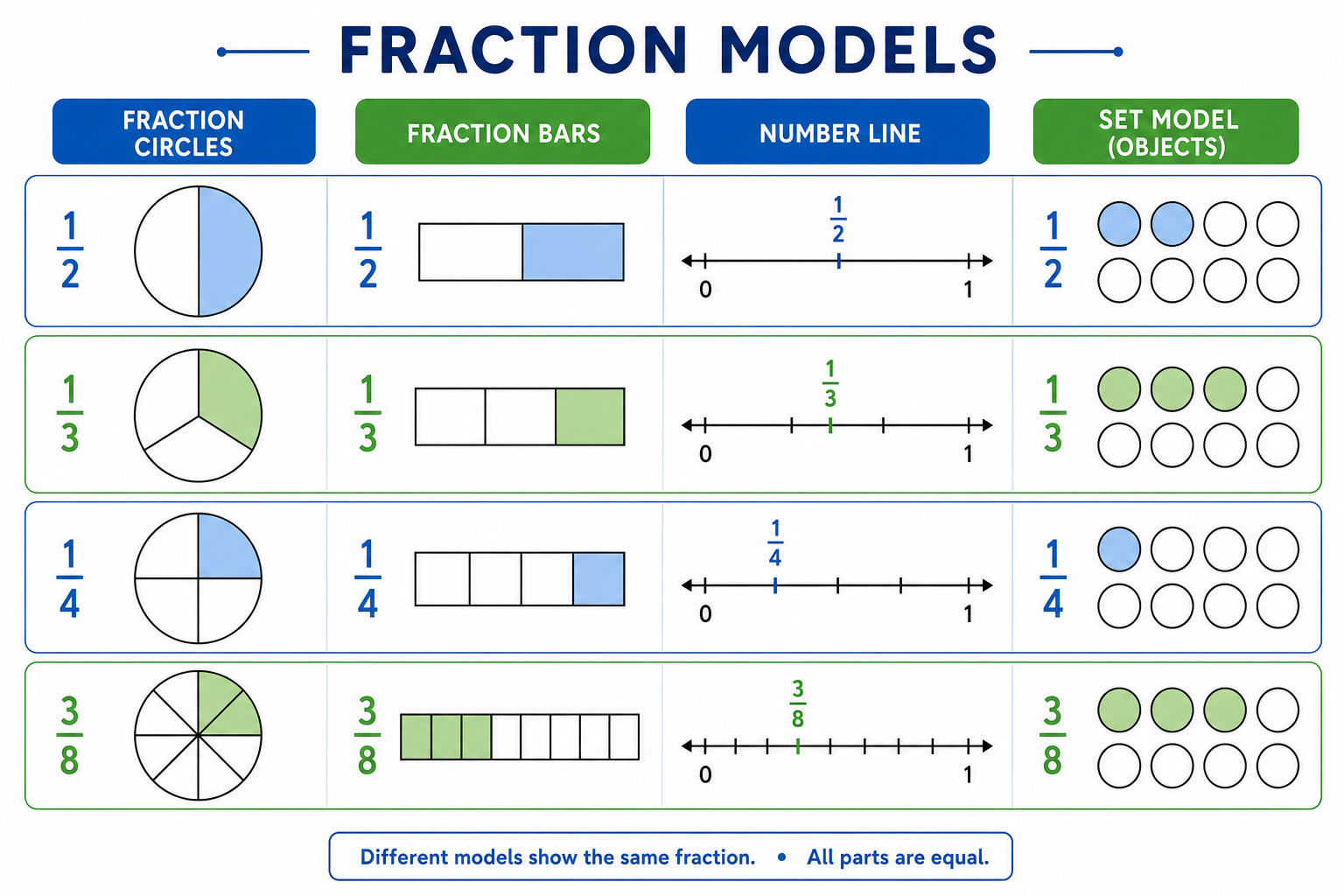
Fraction circles
Best for: Part-whole relationships, comparing unit fractions
Start with halves and fourths. Have students name the shaded part and the whole before writing symbols.
Fraction bars (area model)
Best for: Equivalence, addition with like denominators
Draw one bar divided into equal sections. Shade the numerator. Stack two bars to compare 1/3 and 1/4.
Number line
Best for: Fractions as numbers between 0 and 1, ordering, benchmarks
Mark 0, 1, and 1/2 first. Partition further for fourths and eighths. Third grade standards expect number line placement.
Set model
Best for: Fractions of a group (3 out of 12), later probability
Use after area models. Emphasize that the denominator is the total objects in the set, not just the shaded ones.
Real-life contexts reinforce models without extra prep. Cutting a sandwich into halves, measuring 1/2 cup of flour, or folding a paper strip into thirds connects classroom work to daily life. Our math practice at home guide has more ideas for kitchen and craft-based fraction practice.
What Is a Five-Step Lesson Plan for Fractions?
Use this sequence for any new fraction skill. Keep the order consistent: whole, partition, shade, compare models, practice. Adjust the fraction (halves, sixths, tenths) for your grade, but do not skip steps.
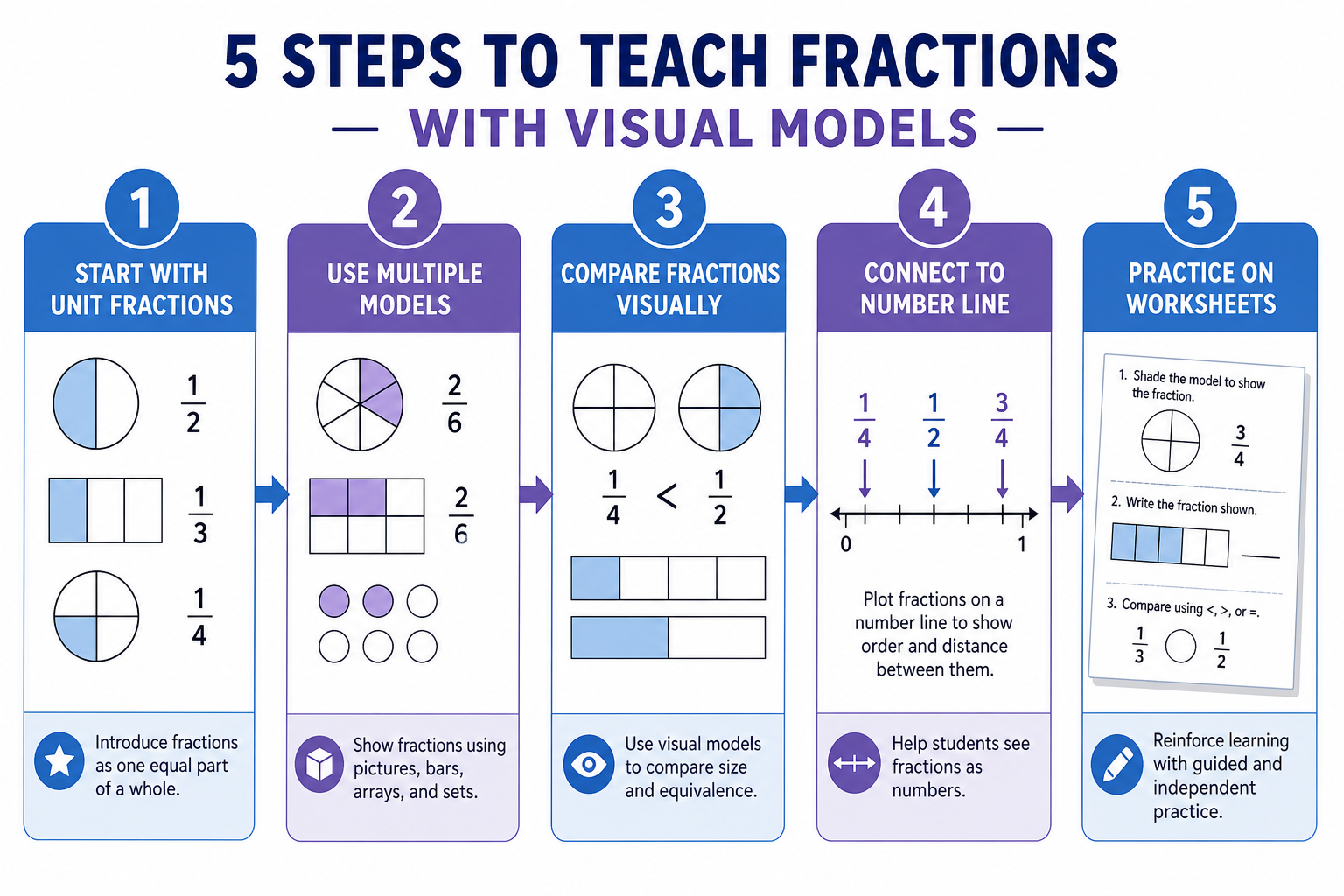
1. Define the whole
Before any fraction symbol appears, name the whole: one circle, one bar, one number line from 0 to 1, or one set of 8 counters. Students who skip this step often treat the numerator and denominator as separate numbers.
2. Partition into equal parts
Fold paper, draw lines, or use physical fraction tiles. Stress equal parts. Unequal cuts are the most common source of fraction confusion in early lessons.
3. Shade or count the parts
Shade 2 of 4 parts and say two fourths aloud. Write 2/4 only after the verbal description. Connect numerator (how many) and denominator (how many in the whole).
4. Compare with a second model
Show the same fraction on a bar and a number line. Multiple representations build flexible understanding and prepare students for equivalence.
5. Transfer to symbols and practice
Move to worksheets once students can explain the model in words. Keep a model sketch on the board during independent work for students who need it.
Reinforce today's fraction lesson on paper
Free equivalent-fraction and simplifying worksheets match typical visual-model lessons.
What Should Each Grade Focus On With Fraction Models?
Fraction expectations jump in complexity from second to fifth grade. Match your models and denominators to the standards for your grade so students build on a solid foundation instead of memorizing tricks.
Grade 2
Focus: Partition circles and rectangles into halves, thirds, and fourths
Sample activity: Fold paper squares, shade half of a shape, use the word halves not symbols only
Grade 3
Focus: Unit fractions, number lines, fractions greater than one on a line
Sample activity: Place 1/4 and 3/4 on a line, compare two fractions with the same denominator using bars
Grade 4
Focus: Equivalence, comparing unlike denominators, adding fractions with like denominators
Sample activity: Overlay bars to show 1/2 = 2/4, use benchmarks like 1/2 to compare 3/8 and 5/8
Grade 5
Focus: Operations with unlike denominators, connecting models to algorithms
Sample activity: Draw common denominators on bars before teaching the multiplication shortcut
Third grade is the gateway year for fraction number lines and unit fractions. Our guide to teaching multiplication in third grade pairs well with fraction units because equal groups and arrays support part-whole thinking. For the full K-6 standards picture, see Common Core math standards by grade.
What Mistakes Should Teachers Avoid With Fraction Models?
The biggest mistake is introducing symbols before models. Students who write 3/4 without explaining three parts of four equal parts will struggle when denominators change. Other pitfalls are easy to prevent with small routine shifts.
- Unequal partitions: Always verify that cuts or lines create equal parts. Unequal slices invalidate the model.
- One model only: Students need circles, bars, and number lines—not just one type for the entire unit.
- Skipping the whole: Name what represents 1 before discussing parts.
- Rushing equivalence: Show 1/2 = 2/4 with overlapping bars before teaching multiply-top-and-bottom rules.
- No link to place value: Tenths and hundredths connect fractions to decimals. Our place value with base-ten blocks guide supports that bridge in fourth grade.
When students struggle with word problems, return to drawing a quick bar model before solving. The same strategy helps in our math homework help guide.
What Free Fraction Resources Help After Visual-Model Lessons?
Hands-on lessons stick when follow-up practice uses the same vocabulary. These free tools on WorksheetGenius support typical fraction-model instruction.
- Equivalent fractions worksheets for matching and finding missing numerators
- Simplifying fractions worksheets for reducing to lowest terms
- Math worksheet generator for custom fraction problem sets
- Quiz generator for quick fraction checks after a unit
Key Takeaways
- Visual models make the whole, equal parts, and numerator visible before symbols.
- Teach fraction circles and bars first; add number lines in third grade.
- Use a five-step sequence: whole, partition, shade, compare models, practice.
- Match models and denominators to grade-level standards (2–5).
- Follow model lessons with equivalent-fraction and simplifying worksheets.
Conclusion
Teaching fractions with visual models is one of the most effective ways to build lasting understanding in elementary math. Students who can draw, fold, and explain a fraction before calculating with it handle equivalence and operations with far less frustration. Keep lessons short, use multiple representations, and bridge to paper only after the model makes sense in words.
Try one five-step lesson tomorrow: hand out paper strips, fold fourths, shade three parts, and ask students to describe three fourths before anyone writes 3/4. That single habit prevents months of numerator-denominator confusion later.
Print fraction practice for your next lesson
Free equivalent and simplifying worksheets. No signup required.
Free Fraction WorksheetsRelated Articles
- Teaching Place Value with Base-Ten Blocks — connects to decimal and fraction bridges
- Common Core Math Standards by Grade — where fractions fit in grades 3–5
- Summer Math Review — spiral fraction skills over break
Frequently Asked Questions
Visual models are pictures and manipulatives that show fractions as parts of a whole. Common models include fraction circles, fraction bars (rectangles), number lines, and set models where some objects are shaded. They help students see that the denominator is the total equal parts and the numerator is how many parts are counted.