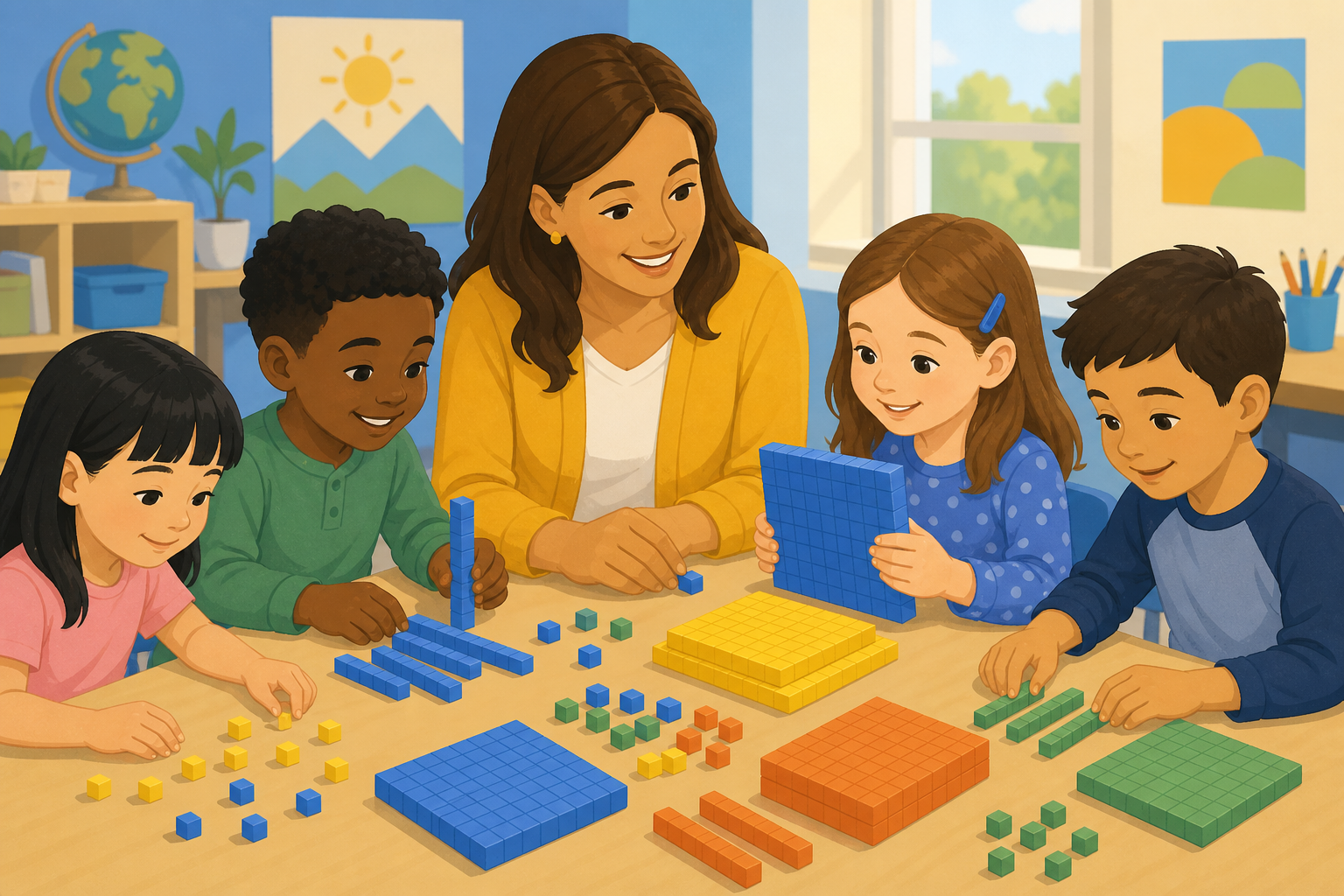
Teaching place value with base-ten blocks turns an abstract idea into something students can see and touch. When children build 35 as three tens and five ones, regrouping stops feeling like a trick and starts making sense. This guide walks through what each block means, a five-step lesson you can use tomorrow, and free worksheets for practice after the hands-on work.
Place value is the foundation for almost every elementary math skill that follows. Students who rush to paper-and-pencil without models often memorize steps they do not understand. Base-ten blocks slow the process in a good way and build number sense that lasts.
Why Do Base-Ten Blocks Work for Place Value?
Base-ten blocks work because they match how our number system is built: groups of ten. Students who only see digits on a page may not understand why the 3 in 34 is worth thirty. Blocks make that value visible. Research and classroom practice both support concrete models before symbols.
The Common Core place value standards expect students to understand tens and ones in first grade and hundreds in second grade. Base-ten blocks align directly with those goals. The National Council of Teachers of Mathematics has long recommended manipulatives for building number sense in the early grades.
Blocks also reduce math anxiety. Trading ten ones for one ten is a physical action students can repeat until it feels natural. That repetition builds confidence before timed worksheets or tests enter the picture.
What Does Each Base-Ten Block Represent?
Each base-ten block type maps to one place value. Teach the names and values together on day one so students use consistent language: unit cube, rod, flat, and optional thousand cube.
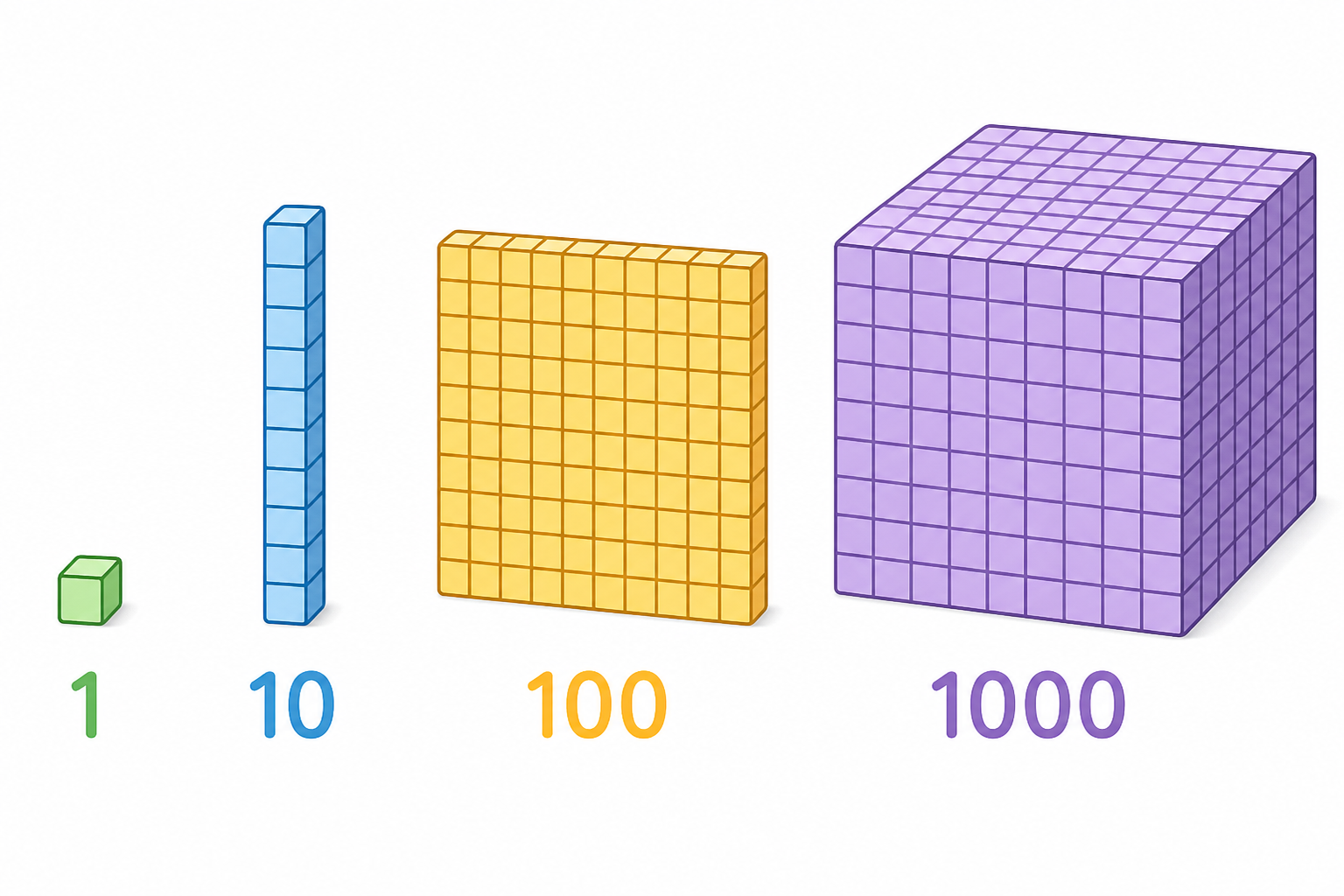
Unit cube (ones) = 1
Single small cube. Count one at a time for numbers under 10.
Rod (tens) = 10
Ten cubes joined in a line. Trade 10 ones for 1 rod.
Flat (hundreds) = 100
Ten rods in a square. Show that 10 tens equal 1 hundred.
Cube (thousands) = 1,000
Optional for third grade and up. Connects to larger number sense.
Post a printable place value chart next to your block station so students connect the physical model to the columns they will use on worksheets. Charts support the transition from blocks to symbols.
What Is a Five-Step Lesson Plan for Place Value?
Use this five-step sequence for any place value lesson. Adjust the number range for your grade, but keep the order the same: build, label, compare, trade, transfer.
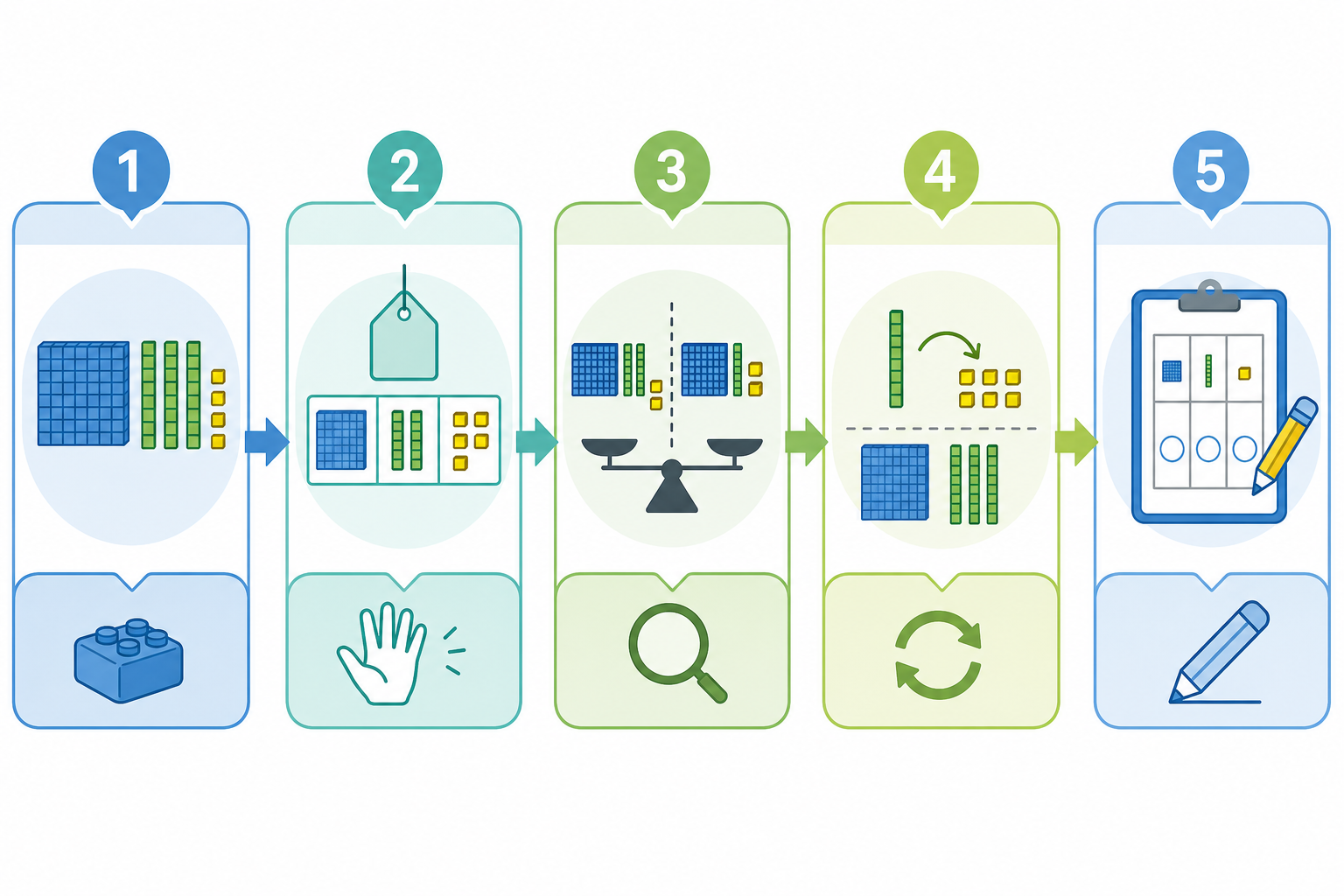
1. Build the number
Say a number like 34 and have students place 3 rods and 4 unit cubes. They see three tens and four ones before writing digits.
2. Count and label
Count the tens first, then the ones. Write the number in expanded form: 30 + 4. Link the physical model to the written symbols.
3. Compare two numbers
Build 34 and 43 side by side. Students see that digit order matters even when the same digits appear. Ask which is larger and why.
4. Practice trading (regrouping)
Add 8 ones to 34. Trade ten ones for one ten to make 4 rods and 2 ones (42). Physical trading prepares students for carrying on paper.
5. Transfer to symbols
Draw a quick sketch of the blocks, then solve the same problem with digits only. Keep a chart nearby for reference during the transition.
Reinforce today's block lesson on paper
Free place value worksheets and charts match what students built with blocks.
What Should Each Grade Focus On With Base-Ten Blocks?
Not every grade uses every block type every week. Match your lessons to developmental expectations so students master one level before jumping ahead.
Grades K–1
Focus: Tens and ones to 20, then to 100
Sample activity: Build teen numbers, count groups of ten, match blocks to numerals
Grades 2
Focus: Hundreds, expanded form, comparing three-digit numbers
Sample activity: Build 247, write expanded form, add and subtract with regrouping models
Grades 3–4
Focus: Review regrouping, connect to algorithms
Sample activity: Use blocks for tricky addition/subtraction, then fade to drawn models
Second grade is the peak year for hundreds with blocks. Our parent guide to 2nd grade math lists place value as a core skill. Pair block lessons with 2nd grade math worksheets and addition with regrouping worksheets once trading feels automatic.
What Mistakes Should Teachers Avoid With Base-Ten Blocks?
The biggest mistake is moving to paper too fast. Students need repeated physical trading before regrouping on a worksheet makes sense. Other common pitfalls are easy to fix with small routine changes.
- Skipping comparison activities: Building one number is not enough. Compare two or three numbers side by side.
- Letting students count ones by ones forever: Prompt trading once they have ten or more unit cubes.
- Using blocks only once: Return to models when algorithms break down, even in upper elementary.
- No link to expanded form: Always write 30 + 4 alongside the rods and cubes for 34.
- Insufficient practice time: Fifteen minutes daily beats one long block lesson per month.
For the full K-6 picture, see our Common Core math standards by grade guide. It shows where place value fits in the bigger sequence.
What Free Place Value Resources Help After Block Lessons?
Hands-on lessons stick better when follow-up practice uses the same vocabulary and layout. These free tools on WorksheetGenius match typical base-ten block instruction.
- Place value worksheets for expanded form and digit practice
- Place value chart for classroom display or student folders
- Kindergarten math worksheets for early tens-and-ones introduction
- Math worksheet generator for custom number ranges
Key Takeaways
- Base-ten blocks make tens and ones visible before students use digits alone.
- Teach build, label, compare, trade, then transfer to symbols.
- Spend extra time on trading; it is the foundation for regrouping.
- Match block activities to grade-level expectations (ones, tens, hundreds).
- Follow block lessons with place value charts and worksheets for retention.
Conclusion
Teaching place value with base-ten blocks is one of the highest-impact methods in elementary math. Students who understand what each digit represents can learn addition, subtraction, and multiplication with meaning instead of memorized steps. Keep lessons short, repeat the five-step sequence, and bridge to paper with charts and worksheets.
Pull out the blocks tomorrow, build one three-digit number with your class, and have students explain it in words before they write anything down. That single habit prevents months of regrouping confusion later.
Print place value practice for your next lesson
Free charts and worksheets. No signup required.
Free Place Value WorksheetsRelated Articles
- A Parent's Guide to 2nd Grade Math — place value in the second grade year
- How to Teach Multiplication to 3rd Graders — what comes after place value fluency
- Morning Work Routine with Worksheets — daily place value review ideas
Frequently Asked Questions
Base-ten blocks are math manipulatives that represent ones (unit cubes), tens (rods), hundreds (flats), and sometimes thousands. Students use them to build numbers, trade ten ones for one ten, and understand place value before working with digits alone. They make abstract place value concrete and visible.