
Learning how to differentiate math instruction with custom worksheets lets you meet every student where they are—without spending your Sunday night rewriting three versions of the same page by hand. When you adjust number ranges, problem counts, and scaffolds around one clear objective, struggling learners build confidence while advanced students stay challenged. This guide covers a three-tier model, a five-step process, and free generator tools that make tiered practice practical on a busy schedule.
Differentiation is not a separate curriculum. It is the same skill taught with different entry points. Custom worksheets are especially useful in mixed-ability classrooms because paper practice is easy to assign, collect, and review in small groups while you teach another rotation.
Why Does Differentiation Matter in Elementary Math?
A single worksheet handed to the whole class often misses the mark. Some students finish in two minutes and disengage. Others stall on problem three and decide they are "bad at math." Differentiation closes that gap by matching practice to readiness while keeping everyone on a path toward the same standard.
The NCTM Principles to Actions framework calls for equitable instruction that supports both struggling and advanced learners. Custom worksheets are one practical tool—not the whole solution, but a reliable way to assign purposeful practice during centers, independent work, and homework.
Generators remove the prep barrier. When tiered pages take minutes instead of hours, teachers actually differentiate daily instead of reserving it for formal observations. That consistency matters more than perfect lesson design once a quarter.
What Is a Three-Tier Worksheet Model?
Most elementary teachers use three tiers: support, on-level, and challenge. Students should not know which tier is "low"—use neutral names like Group A, B, and C, or color-code folders without labeling ability in front of the class.
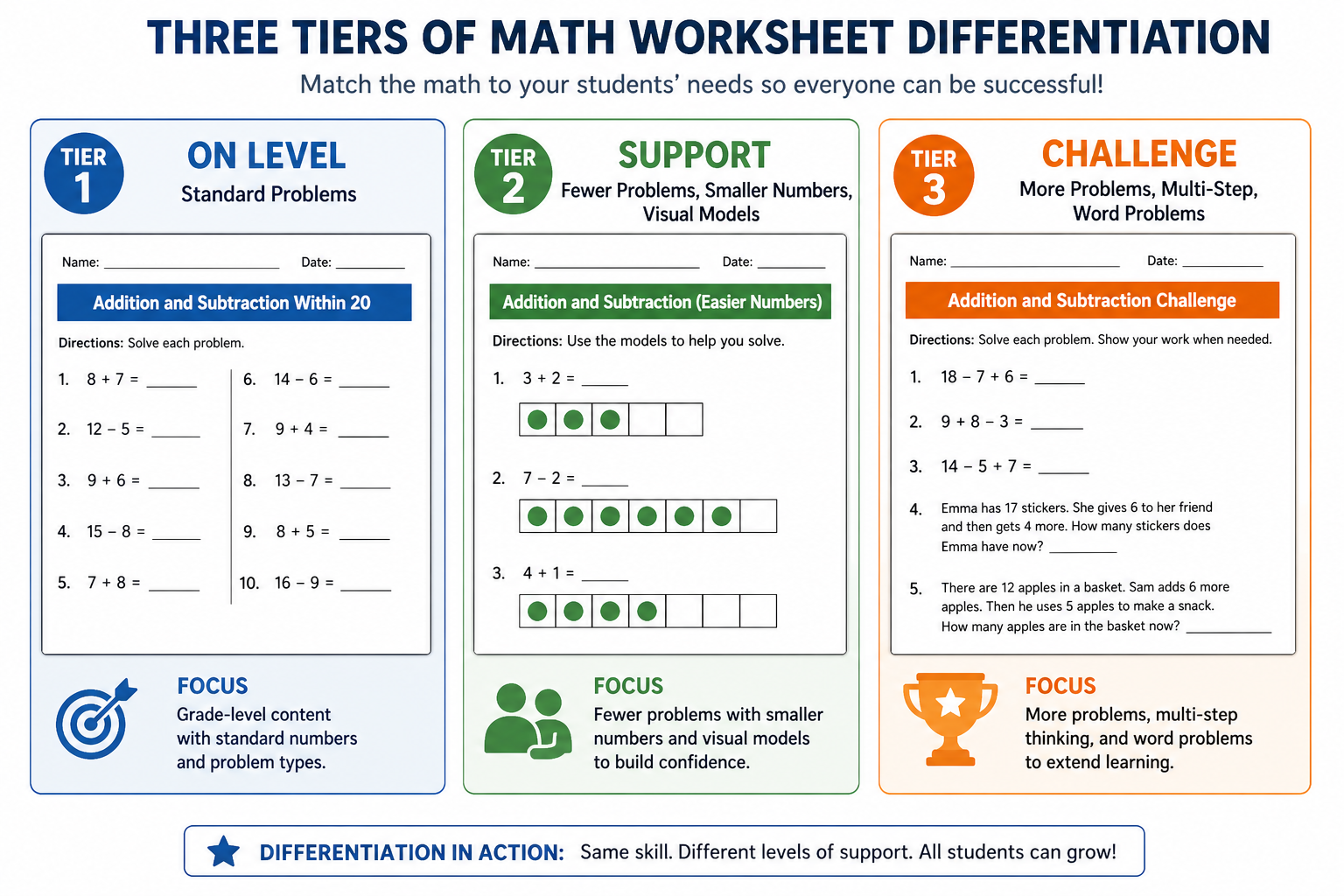
Tier 1 — Support
For: Students who need scaffolds or slower pacing
Adjustments: Fewer problems (5–8), smaller numbers, visual models, no regrouping yet
Example: Addition to 20 without regrouping instead of two-digit with regrouping
Tier 2 — On level
For: Most of the class meeting the current standard
Adjustments: Standard problem count (10–12), grade-appropriate number range, mix of formats
Example: Two-digit addition with regrouping matching the week’s lesson
Tier 3 — Challenge
For: Students ready for extension or faster fluency
Adjustments: More problems, multi-step items, word problems, larger numbers
Example: Three addends, missing-number problems, or two-step word problems
For place value units, support tier might use two-digit numbers with a place value chart printed on the page. Challenge tier might ask students to write numbers in expanded form up to thousands. Same week, same concept, different load.
What Is a Five-Step Process to Differentiate With Custom Worksheets?
Follow this workflow every time you plan independent practice. It keeps differentiation systematic instead of something you only do when you have extra time.
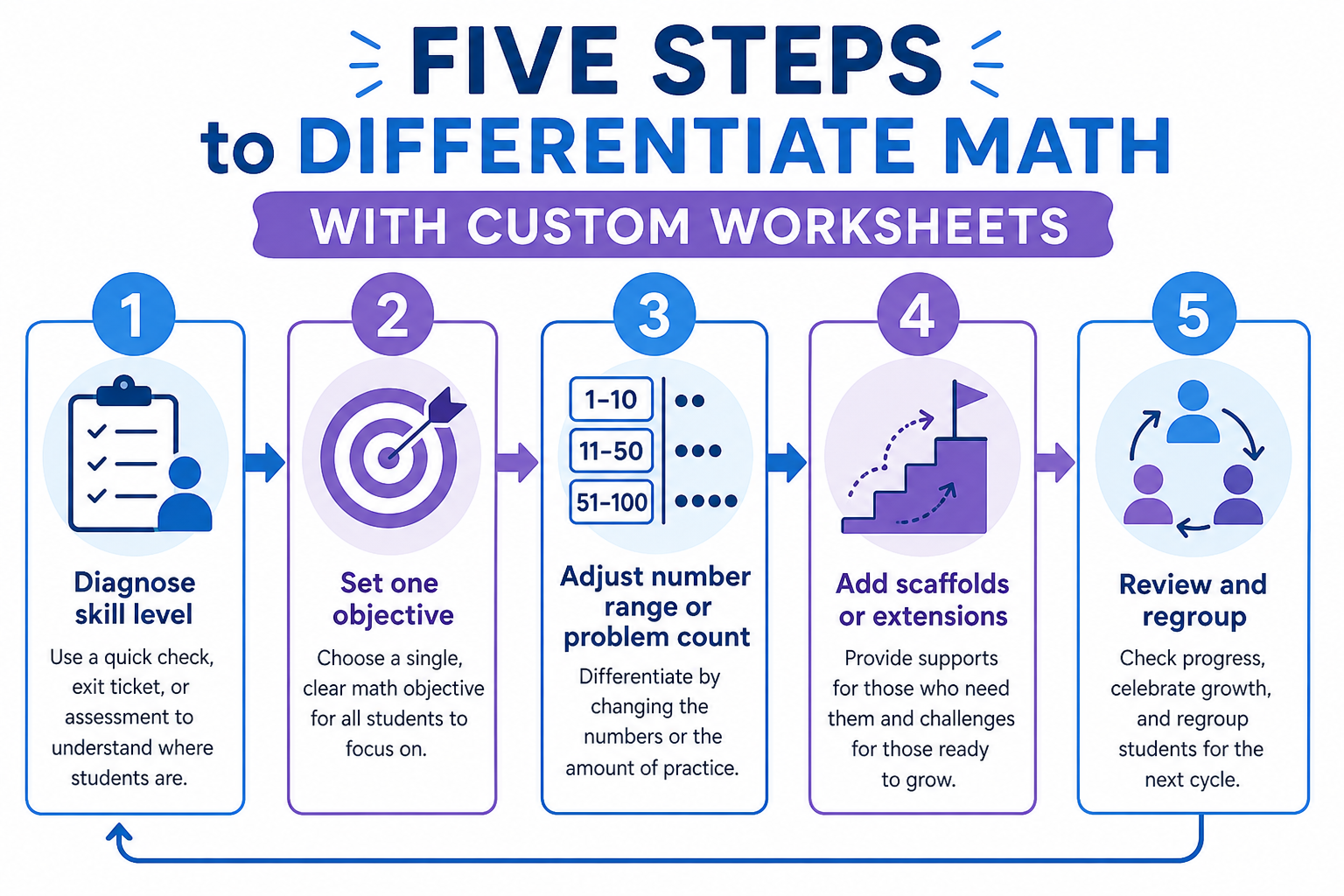
1. Diagnose with a quick check
Use five problems at the end of a lesson or a short exit ticket. Sort into ready, almost there, and needs support. You do not need a formal test—ten minutes of observation plus one page is enough.
2. Set one objective for everyone
Write the goal in student language: "I can subtract two-digit numbers with regrouping." Every tier works toward that goal. Differentiation adjusts the path, not the destination—unless a student is far below grade level.
3. Adjust number range or problem count
This is the fastest lever. Support tier: numbers under 50 and six problems. Challenge tier: numbers to 999 and fifteen problems. Same operation, different load.
4. Add scaffolds or extensions
Scaffolds include hundred charts, base-ten sketches, or worked examples at the top. Extensions include explain-your-thinking boxes, create-your-own problems, or peer tutoring roles.
5. Review and regroup weekly
Students move between tiers as they grow. A child on support for regrouping this week may join on-level next week. Flexible grouping prevents labels and keeps expectations high.
Build three tiers in one sitting
Set number range and problem count, generate, print, repeat for each group.
What Can You Adjust on a Custom Math Worksheet?
You have more levers than "make it easier" or "make it harder." Mix these adjustments so tiers feel meaningfully different, not just shorter or longer copies of the same page.
| Lever | Support tier | Challenge tier |
|---|---|---|
| Number range | Smaller values, no regrouping | Larger values, more digits |
| Problem count | 5–8 problems | 12–20 problems or timed fluency |
| Question format | Computation only, vertical layout | Word problems, missing addends |
| Visual supports | Number lines, place value charts on page | No models—mental math emphasis |
| Response mode | Circle the answer, match pairs | Show work in two strategies |
Multiplication units benefit from tiered fact ranges. Support: facts through 5×5 with a multiplication chart on the desk. On-level: facts through 10×10. Challenge: missing-factor problems or two-step word problems. Our multiplication teaching guide pairs well with tiered fact practice.
What Routines Make Worksheet Differentiation Manageable?
Differentiation fails when prep time explodes. These routines keep tiered worksheets sustainable across the school year.
- Folder system: Three labeled folders at the math center. Students take the sheet that matches their group card—no public ability labels.
- Same-day generation: Build tiers right after your exit ticket while results are fresh. Ten minutes Friday afternoon beats Sunday night stacks.
- Partner check: Students in the same tier check each other's work before you collect. Frees you to teach a small group.
- Weekly regroup: Move one or two students between tiers based on fluency checks, not permanent tracks.
- Balance with non-paper work: Not every day needs three worksheet versions. Alternate with games and manipulatives from our math games guide.
Morning work is another natural slot for tiered practice. See morning work routines for scheduling ideas, and effective classroom worksheet use for rules that keep paper practice purposeful.
What Differentiation Mistakes Should Teachers Avoid?
Even well-intentioned differentiation can backfire. Watch for these common traps when using custom worksheets in math.
- Changing the objective on support tier: Easier problems, not a different skill—unless the student is significantly below grade level.
- Permanent low groups: Students rise when practice matches readiness and regrouping is routine.
- Only differentiating quantity: Twelve vs. four problems helps, but also vary format and scaffolds.
- No feedback loop: Unchecked tiered sheets do not improve learning. Spot-check or review together.
- Worksheets as the only differentiation: Pair paper practice with small-group reteaching and hands-on models from our place value blocks guide.
The Universal Design for Learning guidelines remind us to offer multiple means of engagement and representation—not just multiple worksheets. Use custom pages as one part of a broader differentiated plan.
What Free Resources Support Differentiated Math Practice?
These WorksheetGenius tools help you build tiers quickly without hunting through generic PDF libraries.
- Math worksheet generator — custom operations, ranges, and problem counts
- Addition with regrouping worksheets — tier by with/without regrouping
- Grade 3 multiplication worksheets — on-level fact practice
- 2nd grade math worksheets — support-tier number ranges
- Quiz generator — quick checks to sort tiers
Key Takeaways
- Differentiate by adjusting path, not always by changing the learning objective.
- Use support, on-level, and challenge tiers with different ranges and problem counts.
- Follow diagnose → objective → adjust → scaffold → regroup every week.
- Generate custom tiers in minutes with a free math worksheet generator.
- Pair tiered worksheets with games, small groups, and timely feedback.
Conclusion
Differentiating math instruction with custom worksheets is practical when you keep one clear objective and vary the rigor—not when you rewrite the curriculum three times. Quick checks, flexible grouping, and a reliable generator turn tiered practice into a weekly habit instead of a special occasion.
Try it tomorrow: run a five-problem exit ticket, sort into two groups, and generate two versions of tomorrow's practice before you leave school. That fifteen-minute investment beats a stack of one-size-fits-all pages every time.
Create differentiated math worksheets now
Free generator. Custom ranges and problem counts. No signup.
Free Math Worksheet GeneratorRelated Articles
- How to Use Worksheets Effectively in the Classroom — rules for purposeful paper practice
- Morning Work Routine with Worksheets — daily tiered practice scheduling
- Common Core Math Standards by Grade — align tiers to grade-level goals
Frequently Asked Questions
Differentiation means adjusting practice so all students work toward the same learning goal at a level that fits their current skill. With worksheets, you might change the number range, problem count, visual supports, or question type while keeping the same objective. Custom generators make this fast without creating entirely separate lessons.