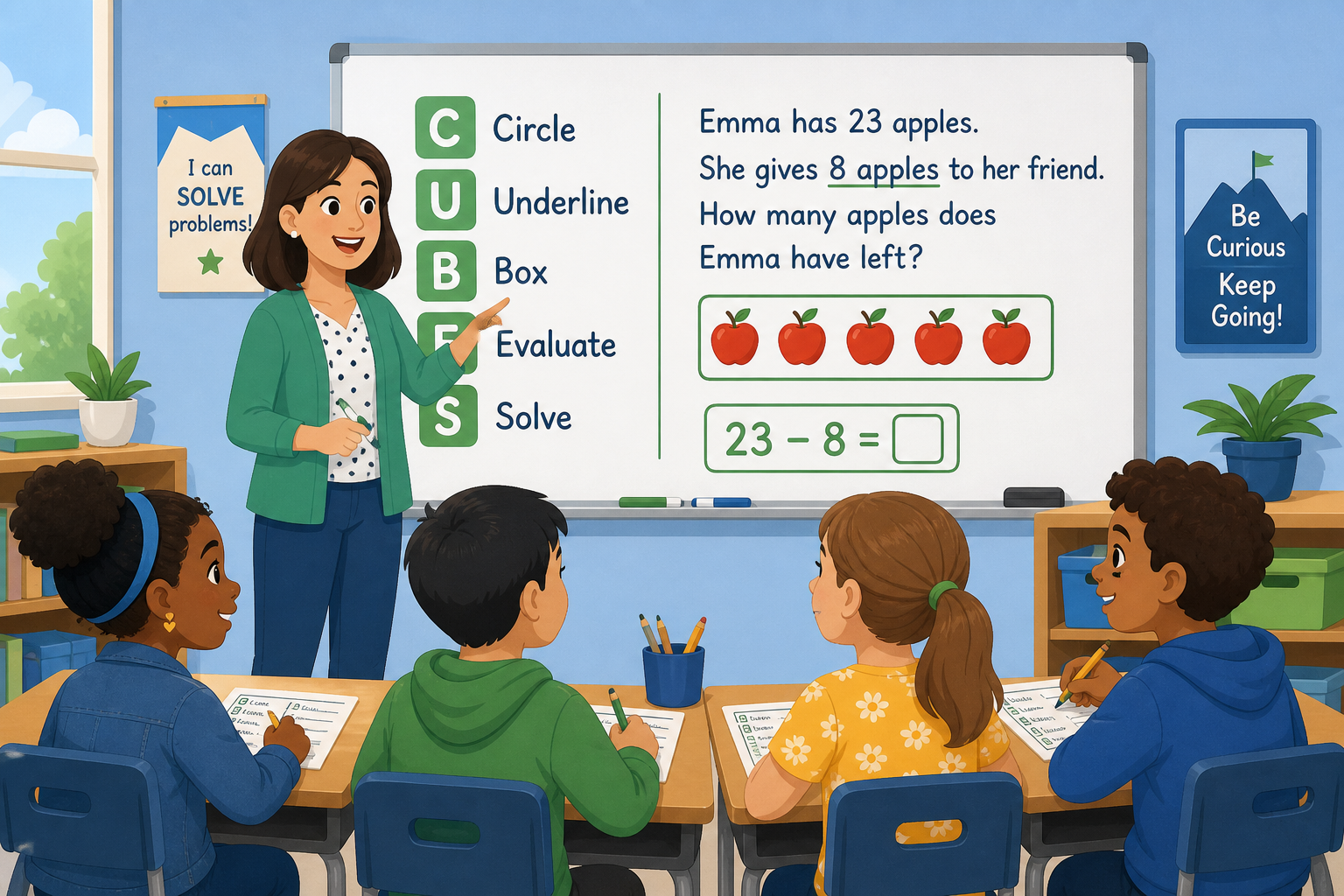
To teach word problems step by step, give students a repeatable routine: read twice, retell the story, draw a model, choose an operation, solve, and check the answer in context. Word problems fail when children treat them as number hunts instead of stories. This guide covers the CUBES strategy, a five-step classroom routine, problem types by grade, bar models, common mistakes, and a weekly practice plan with free worksheet tools.
Strong word-problem instruction builds reading and math together. Students who can compute fluently still stumble if they cannot picture the situation. Your job is to slow them down at first so the routine becomes automatic.
Why Do Students Struggle with Word Problems?
Word problems ask students to translate language into math. That is harder than solving 24 ÷ 6 on a worksheet because the operation is hidden inside a story. Students who rush often add the first two numbers they see, even when the problem calls for subtraction or division.
Reading level matters. A third grader ready for multiplication may still stumble on a problem with long sentences or extra details. Strip problems down when you introduce a new operation, then add complexity once the routine is solid.
Fact fluency is the other half of the puzzle. A student who understands the story but cannot multiply quickly will look like they "cannot do word problems." Build facts with daily math fact practice and grade 3 multiplication worksheets so story problems test reasoning, not recall speed alone.
What Is the CUBES Strategy?
CUBES is a widely used acronym that gives students a checklist before they calculate. Post it on the wall and require students to show each step on scratch paper until the habit sticks.
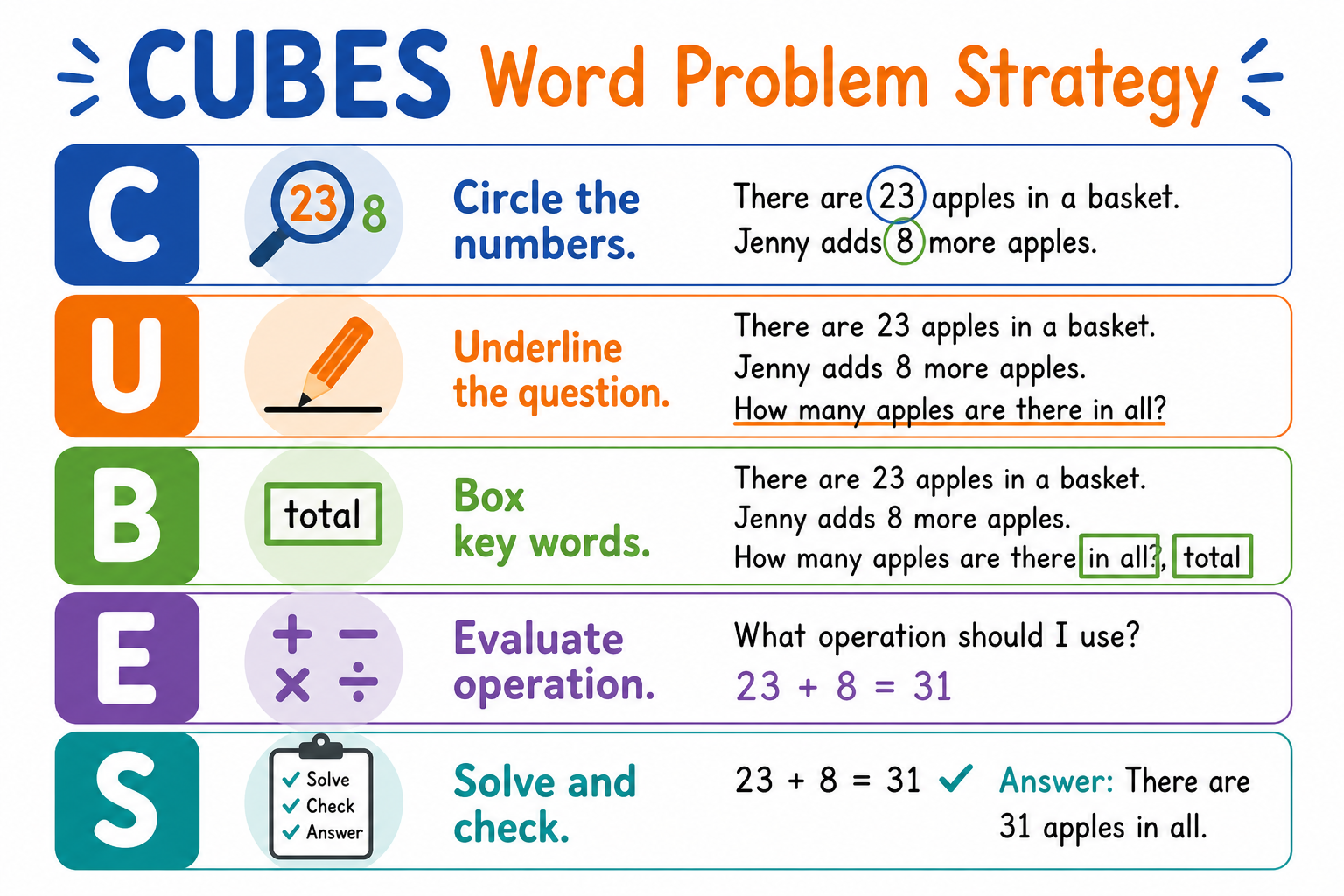
C — Circle the numbers
Students circle every number in the problem, including numbers written as words ("four dozen"). This slows them down enough to read carefully instead of grabbing the first two digits they see.
U — Underline the question
The question sentence tells students what to find. Underlining it keeps the goal visible while they work. If there is no question mark, have them rewrite the task in their own words.
B — Box key words
Box words that signal an operation: "in all" and "total" often mean addition; "left" and "remain" suggest subtraction; "each" and "groups of" point to multiplication or division. Teach that keywords are hints, not rules.
E — Evaluate and choose an operation
Ask: "What is happening in the story?" Joining sets, taking away, comparing, or splitting into equal groups? Students state the operation before writing any numbers.
S — Solve and check
Write the equation, solve, and answer in a complete sentence. The check step asks: "Does this number make sense?" A negative number of apples or a fractional number of children signals an error.
The National Council of Teachers of Mathematics recommends that problem solving include understanding the situation, choosing strategies, and reflecting on results. CUBES supports the first and last parts of that cycle.
What Five-Step Routine Should You Teach?
CUBES handles annotation. This five-step routine handles thinking. Use both together in grades 2–5 until students internalize the flow.
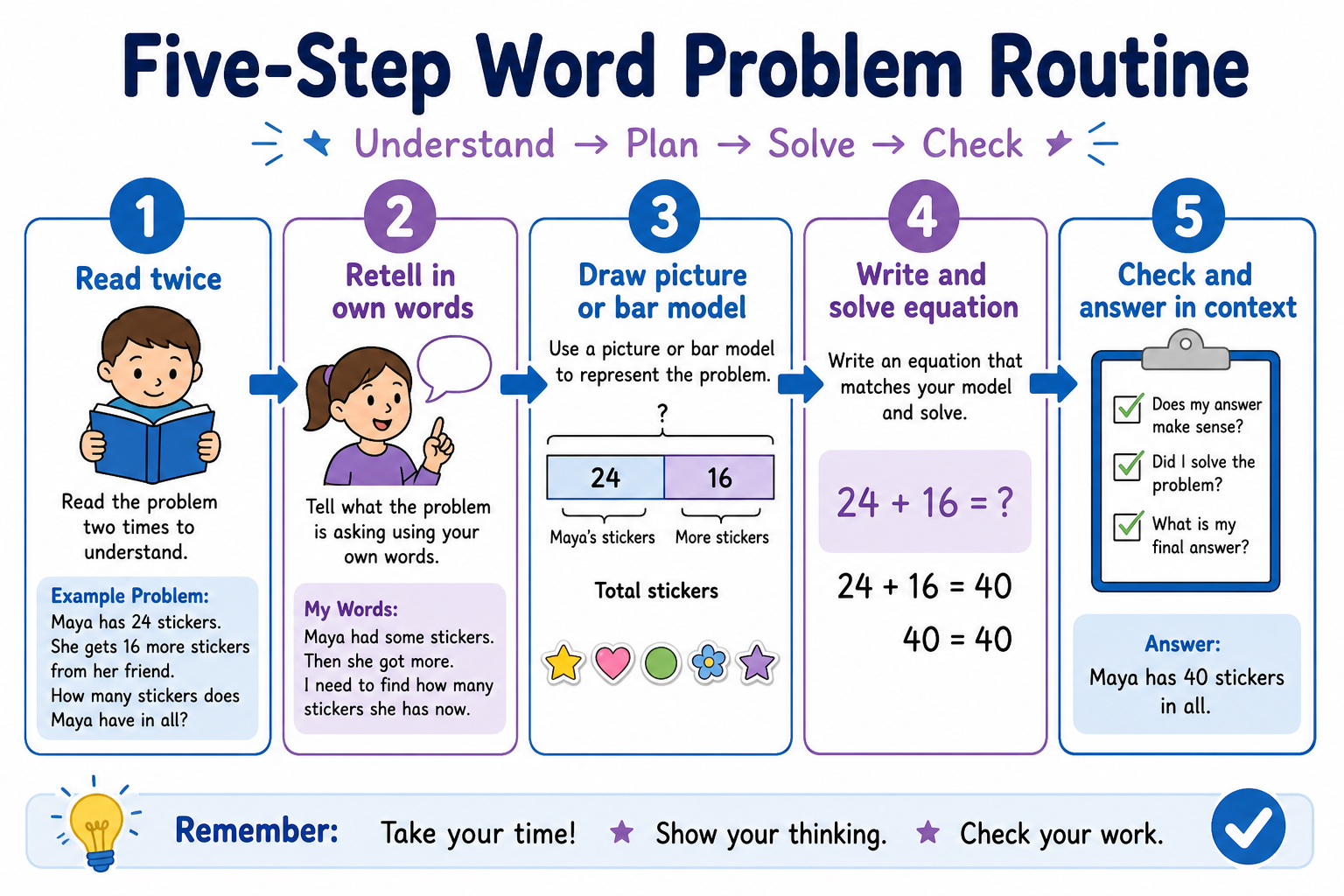
Step 1: Read the problem twice
First read for the story. Second read to find numbers and the question. Pair struggling readers with a buddy or read aloud as a class before independent work.
Step 2: Retell in your own words
Students say or write one sentence summarizing the situation without numbers. If they cannot retell it, they are not ready to pick an operation.
Step 3: Draw a picture or bar model
Sketch the story: groups, a comparison bar, or a number line. The drawing should match the operation, not decorate the page.
Step 4: Write and solve the equation
Translate the model into an equation. Label units. For multi-step problems, solve one part at a time and update the drawing.
Step 5: Check and answer in context
Plug the answer back into the story. Write a full sentence: "Maria has 12 stickers left." Estimation before solving catches operation errors early.
Generate custom word problem worksheets by operation and grade
Mix story problems with fact drills. Print fresh sets for centers and homework.
What Problem Types Appear by Grade?
Match story structure to your standards pacing. The Common Core operations standards expect students to interpret products and quotients in context by third grade and multi-step problems by fourth. Use this grade-level map as a planning guide.
| Grade | Problem types | Example |
|---|---|---|
| K–1 | Join, separate, and compare within 10–20 | "Sam has 5 marbles. He gets 3 more. How many now?" |
| 2 | Two-digit add/subtract stories, missing addend, intro arrays | "There are 24 chairs. 9 are taken. How many empty?" |
| 3 | Multiplication, division, two-step, area and perimeter stories | "4 bags with 6 apples each. How many apples?" |
| 4–5 | Multi-step, fractions, decimals, remainders in context | "Share 47 stickers among 6 friends. How many left over?" |
Second grade teachers can pull join and separate stories from 2nd grade math worksheets. Third and fourth grade classes benefit from 3rd grade math worksheets and our 4th grade math topics guide for pacing multi-step and fraction stories.
How Do Bar Models and Drawings Help?
A quick sketch forces students to decide what the numbers represent before they calculate. Bar models work for part-whole, comparison, and equal-group problems. Arrays and area grids support multiplication and perimeter stories.
- Join problems: One bar split into two parts that combine to a whole.
- Compare problems: Two bars side by side showing the difference.
- Equal groups: Repeated segments or an array with rows and columns.
- Division with remainders: Groups plus a small leftover section. See our division with remainders guide for context questions students must answer.
Require the model on every problem for two weeks, then allow students to skip the drawing only when they can explain their equation without it. Struggling students should keep drawing longer. Confidence-building strategies pair well with low-stakes story problem practice in small groups.
What Mistakes Should Teachers Watch For?
Most word-problem errors are process errors, not calculation errors. Watch for these patterns during conferring and on assessments.
- Grabbing numbers in the order they appear instead of reading the question
- Treating every "more" problem as addition (comparison problems are different)
- Skipping the drawing step and guessing an operation
- Forgetting units or writing a naked number with no context sentence
- Not checking whether the remainder or fraction answer fits the story
- Assigning only story problems without building fact fluency first
When a class repeatedly misreads comparison problems, stop and teach that problem type in isolation for a full lesson. Differentiated worksheets let you assign simpler stories to students who need them while others tackle multi-step challenges on the same day.
How Do You Plan Weekly Word Problem Practice?
Short, focused sessions beat long problem sets. Two to four story problems per day with one clear strategy keeps students engaged and gives you time to discuss wrong answers productively.
| Day | Focus | Practice |
|---|---|---|
| Monday | Single-step join or separate (review) | 2 problems, read aloud |
| Tuesday | Comparison or missing addend | 2 problems, CUBES on anchor chart |
| Wednesday | Multiplication or division story | 2 problems, bar model required |
| Thursday | Two-step or challenge problem | 1 problem, partner check |
| Friday | Student-created story problem | Write and swap with a classmate |
Before state testing season, add one timed story problem per week using strategies from our elementary test prep guide. The goal is calm routine, not speed drills every day.
Key Takeaways
- Word problems need a repeatable routine, not tricks.
- CUBES plus read-retell-draw-solve-check covers most elementary stories.
- Match problem type to grade and strip extra reading load when introducing skills.
- Bar models and pictures come before equations.
- Practice two to four stories per session and build fact fluency alongside.
Conclusion
Teaching word problems step by step means teaching students to slow down, understand the story, and prove their thinking with a model before they calculate. Post CUBES, model the five-step routine daily for two weeks, and discuss wrong answers as strategy errors worth fixing. When reading and computation both have support, story problems become the part of math class students can explain out loud.
Pick one problem type for next week, print a short set from the math generator, and require a bar model on every answer. By Friday, listen for students retelling stories in their own words—that is when word-problem instruction is working.
Build word problem practice sets in seconds
Choose operation, grade level, and problem count. Print unlimited worksheets free.
Free Math Worksheet GeneratorRelated Articles
- How to Teach Division with Remainders — remainder stories in context
- How to Teach Multiplication to 3rd Graders — equal groups before story problems
- Helping Struggling Math Students Build Confidence — low-stakes practice for anxious solvers
Frequently Asked Questions
The most reliable approach combines reading comprehension with a consistent problem-solving routine. Teach students to read the story twice, identify what is being asked, underline key numbers, choose an operation, draw a picture or bar model, write an equation, and check whether the answer makes sense in context. The CUBES or read-draw-write-check frameworks work well for grades 2–5.