
Learning how to teach division with remainders starts with a simple idea: sometimes equal groups leave something over. When seventeen counters are shared into groups of five, you get three full groups and two left—that leftover is the remainder. This guide walks through visual models, a five-step lesson you can use tomorrow, word-problem strategies, and free division practice tools for grades 3–5.
Remainders confuse students who only practiced division facts that come out even. Manipulatives and careful vocabulary prevent the remainder from feeling like a random extra digit. Connect every symbolic answer back to a picture students can explain in words.
What Is Division with Remainders?
Division with remainders answers two questions: how many full equal groups can you make, and how much is left over? The quotient counts full groups. The remainder counts what does not fit into another full group of that size. Written as 17 ÷ 5 = 3 R2, it means three groups of five and two counters left.
The Common Core third grade operations standards expect students to understand division as an unknown-factor problem and to interpret whole-number quotients with remainders in context. Multiplication fluency supports division—see our multiplication teaching guide and times tables timeline if students struggle to find how many groups fit.
A key rule students must internalize: the remainder is always less than the divisor. If the remainder is 5 when dividing by 5, you can make one more group—so the answer is not finished.
How Do Visual Models Help Teach Remainders?
Counters, arrays, and number lines make remainders visible before students write R2 on paper. The same problem should look identical in the model and in the equation.
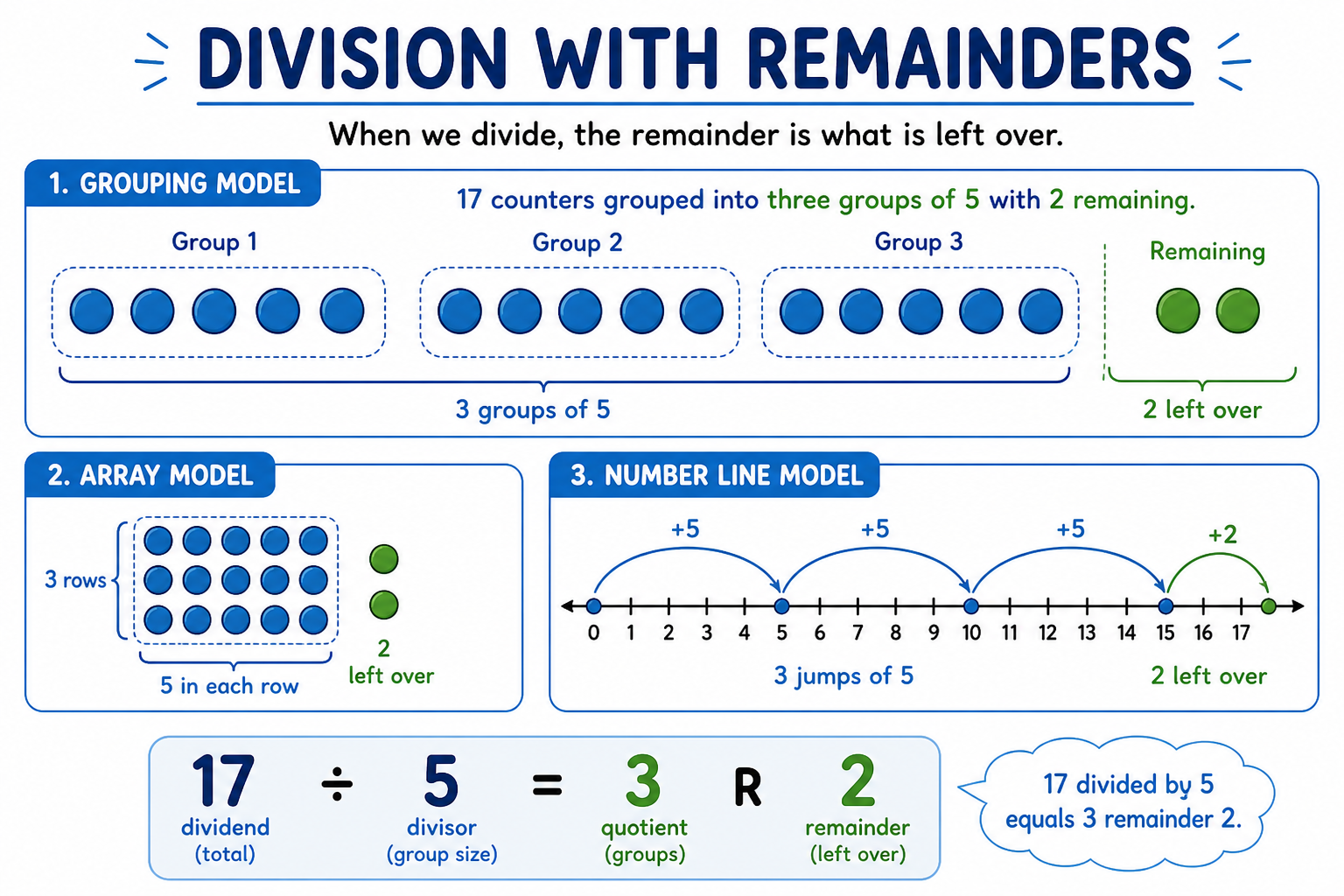
- Counter groups: Best for intro lessons. Physically move objects into equal sets.
- Arrays: Show rows of equal size; leftover items sit outside the array.
- Number line: Jump in steps of the divisor; the distance short of the target is the remainder.
- Base-ten blocks: For larger numbers, trade tens and ones before grouping. Connects to place value with base-ten blocks.
The National Council of Teachers of Mathematics emphasizes multiple representations for operations. Remainder lessons are a prime place to use more than one model for the same problem.
What Is a Five-Step Lesson Plan for Division with Remainders?
Use this sequence for any new remainder lesson. Keep the divisor small at first (2, 3, 4, 5) so grouping stays manageable.
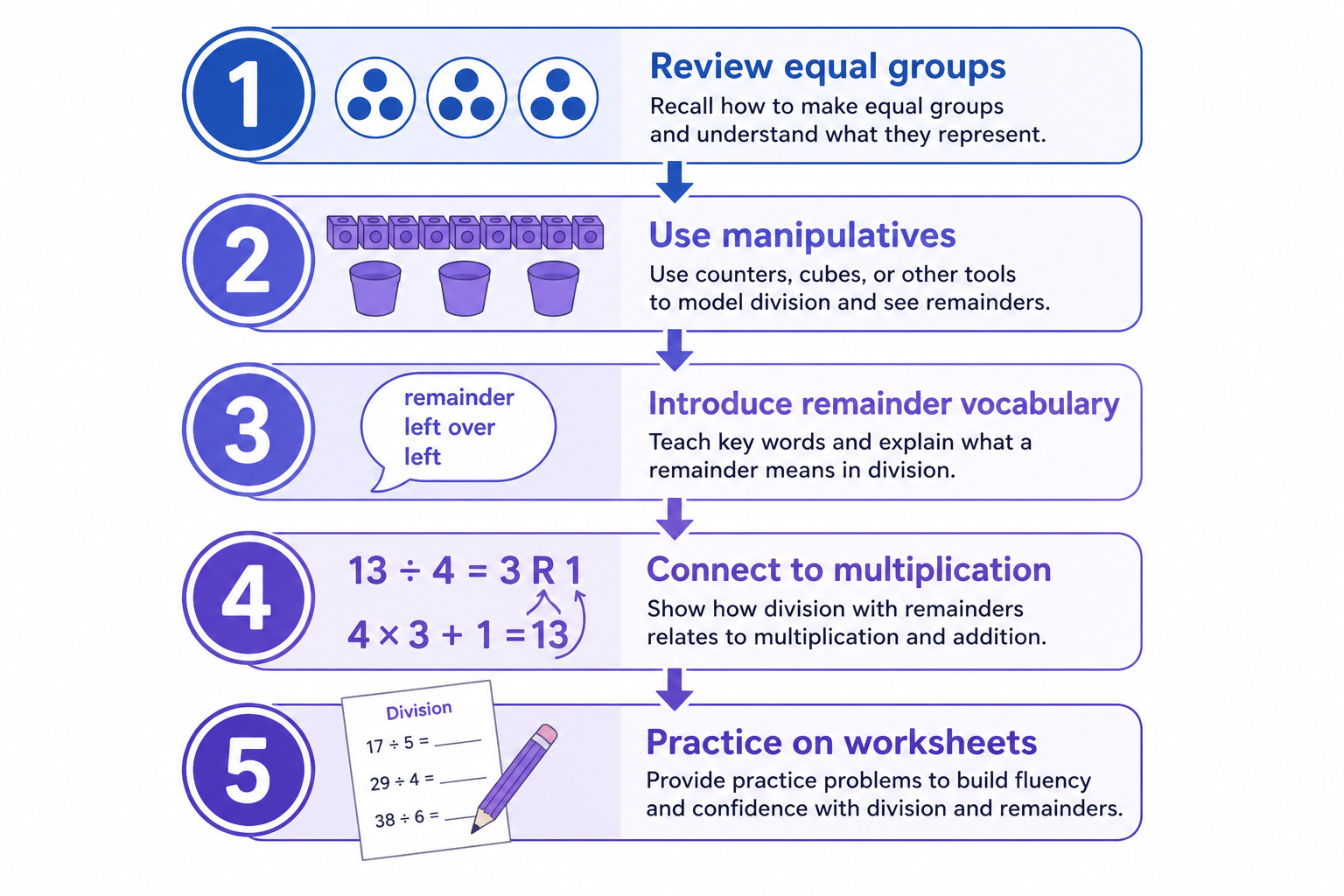
1. Review equal groups without remainders
Start with numbers that divide evenly: 12 ÷ 3 = 4. Use counters and draw groups. Students must be solid on fair sharing before leftovers enter the picture.
2. Introduce a number that does not divide evenly
Try 14 ÷ 3. Make groups of 3 until counters run out for a full group. Ask how many full groups and how many are left. Do not write R2 yet—describe in words first.
3. Name the remainder and write the answer
Introduce vocabulary: quotient (groups), divisor (size of each group), remainder (leftover). Write 14 ÷ 3 = 4 R2. Connect each symbol to the physical model.
4. Check with multiplication
Multiply divisor by quotient, add remainder: (3 × 4) + 2 = 14. This check becomes a habit that catches errors on worksheets and tests.
5. Transfer to word problems and practice
Pose real contexts: 17 cookies shared among 5 children. Discuss whether the remainder is usable (extra cookie) or needs a new group (bus seats). Then assign short practice pages.
Reinforce division facts alongside remainder work
Free division tables and custom worksheets—print in seconds.
How Do You Handle Remainder Word Problems?
The math is only half the task. Students must decide what the remainder means in the story. Three common contexts appear in elementary curricula—teach students to read the situation, not just compute.
Share the extras
Example: 17 stickers among 5 friends—how many each, how many left?
The leftover stickers may go to one person or stay unused—discuss context.
Need another group
Example: 23 students, 4 per table—how many full tables, how many students need another spot?
Remainder often means one more partial group is needed.
Discard or ignore remainder
Example: How many full boxes of 6 can you pack from 25 items?
Only full boxes count; remainder is scrap or storage.
Word problems benefit from the same scaffolding as other topics—see our math homework help guide for reading strategies. Draw a quick picture of groups before writing the equation.
What Should Each Grade Know About Remainders?
Expectations grow from concrete grouping in third grade to interpreting remainders as fractions or decimals in fifth. Do not rush fifth-grade notation before third- grade models make sense.
Grade 3
Focus: Division as equal groups; intro to remainders with small numbers
Example: 14 ÷ 3 with counters; interpret remainder in simple stories
Grade 4
Focus: Larger dividends, written notation, word problem interpretation
Example: 37 ÷ 6 = 6 R1; decide what remainder means in context
Grade 5
Focus: Connect remainders to fractions and decimals where appropriate
Example: 17 ÷ 5 = 3.4 or 3 2/5 after remainder foundation is solid
Fifth graders connecting remainders to fractions should revisit fraction visual models. A remainder of 2 when dividing by 5 is the same idea as two fifths of a whole.
What Mistakes Should Teachers Watch For?
- Remainder larger than divisor: Return to counters—another group fits.
- Swapping quotient and remainder: Label groups aloud before writing.
- Ignoring remainder in word problems: Always ask "what does the leftover represent?"
- Skipping the check step: (divisor × quotient) + remainder must equal dividend.
- Only even division practice: Mix problems with and without remainders from day one of the unit.
Spaced review helps retention—our spaced repetition guide shows how to revisit remainder problems across several weeks instead of one cram unit.
What Free Resources Support Division with Remainders?
- Division table printable — reference chart for fact support
- Math worksheet generator — custom division problem sets
- Grade 3 multiplication worksheets — strengthen inverse operations
- Quiz generator — quick checks after the unit
Key Takeaways
- A remainder is what is left after making full equal groups.
- Teach with counters and models before symbolic R notation.
- Check every answer: (divisor × quotient) + remainder = dividend.
- Word problems require interpreting what the remainder means in context.
- Use division tables and generators for fact fluency and varied practice.
Conclusion
Teaching division with remainders is manageable when students see leftovers before they write them. Build equal groups, name the remainder, check with multiplication, and discuss real stories where the leftover matters. With visual models and short practice pages, remainders become a natural part of division—not a confusing exception.
Try one lesson tomorrow: 17 ÷ 5 with counters, spoken explanation, then the written answer 3 R2 with a multiplication check. That single problem, done carefully, teaches more than a page of unexplained long division.
Print division practice for your next lesson
Free division tables and custom worksheets. No signup required.
Free Division TableRelated Articles
- How to Teach Multiplication to 3rd Graders — inverse operation foundation
- Teaching Fractions with Visual Models — connect remainders to fractions later
- Differentiate Math with Custom Worksheets — tier remainder practice by level
Frequently Asked Questions
A remainder is what is left over when a number cannot be divided into equal groups with nothing left. For example, 17 divided by 5 equals 3 groups of 5 with 2 left over, written as 17 ÷ 5 = 3 R2. The remainder must be less than the divisor. Remainders represent the part that does not fit into a full group.