
A complete guide to 4th grade math topics helps parents and teachers see the full year at once—multi-digit operations, fractions, decimals, geometry, and multi-step word problems. Fourth grade is a major step up from third: numbers get bigger, fractions become numbers on a line, and division often leaves a remainder. This article maps every major topic, suggests a quarter-by-quarter pacing view, and links to free worksheets for practice at home or in class.
Whether you are planning homeschool units, supporting homework, or previewing what comes after third grade, use this guide as a checklist. Students who keep fact fluency sharp while learning new concepts handle fourth grade far better than those who jump straight to algorithms without foundations.
What Do Fourth Graders Learn in Math?
Fourth grade math extends everything from third grade—multiplication, division, fractions—and adds larger numbers, decimal notation, and formal geometry vocabulary. The Common Core fourth grade standards organize content into operations, number sense (fractions and decimals), measurement, data, and geometry. Our K–6 standards overview shows how fourth grade fits the bigger picture.
By the end of the year, students should multiply and divide multi-digit numbers with understanding—not just memorized steps—compare and operate on fractions with the same denominator, read and write decimals to hundredths, and solve word problems that require more than one step.
What Are the Main 4th Grade Math Topics?
These eight topic areas cover most fourth grade curricula. District pacing varies, but the skills themselves appear nationwide in similar order.
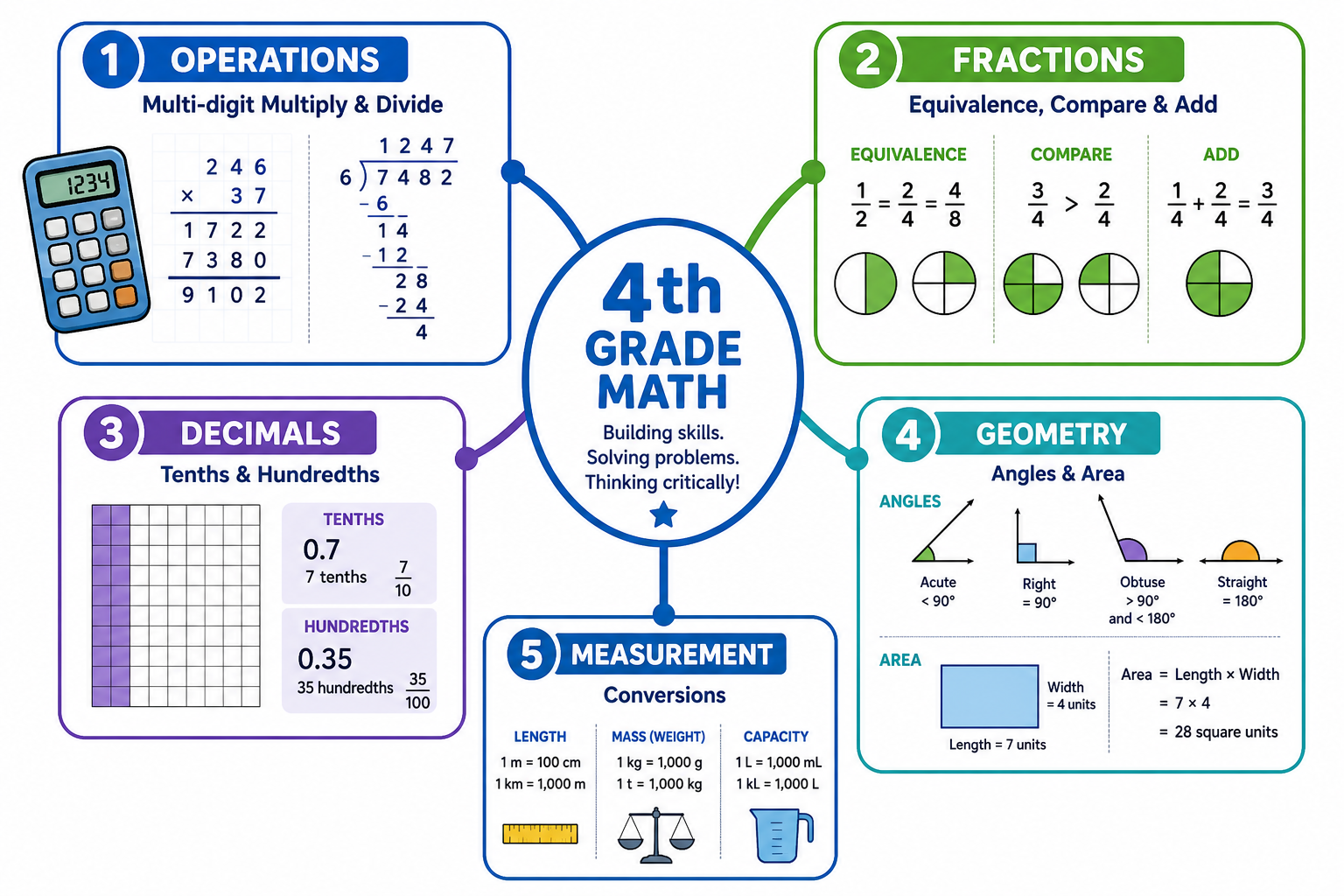
Multi-digit multiplication
Skills: Multiply up to four digits by one digit; two-digit by two-digit; estimate products
Tip: Review area models from third grade before teaching the standard algorithm.
Division with remainders
Skills: Divide up to four digits by one digit; interpret remainders in word problems
Tip: Use counters first; teach the check (divisor × quotient) + remainder.
Factors and multiples
Skills: Find factor pairs; identify prime and composite; multiples within 100
Tip: Array drawings connect factors to multiplication fluency.
Fraction equivalence & comparison
Skills: Generate equivalent fractions; compare with different denominators; number lines
Tip: See our visual models article—bars and number lines before symbols alone.
Add & subtract fractions (like denominators)
Skills: Add and subtract fractions with same denominator; decompose fractions
Tip: Keep denominators the same in fourth grade; unlike denominators come in fifth.
Decimals
Skills: Tenths and hundredths; relate fractions to decimals; compare decimals
Tip: Connect 0.4 to 4/10 using base-ten grids and place value language.
Geometry & measurement
Skills: Angles; parallel and perpendicular lines; area and perimeter; unit conversion
Tip: Measure real objects at home; area formulas make sense after counting unit squares.
Word problems
Skills: Multi-step problems with all four operations; interpret remainders and fractions
Tip: Underline the question; draw a bar model before choosing an operation.
What Does the 4th Grade Math Year Look Like?
This quarter-by-quarter view is a typical sequence. Your school may shift units by a few weeks—use it as a planning guide, not a rigid calendar.
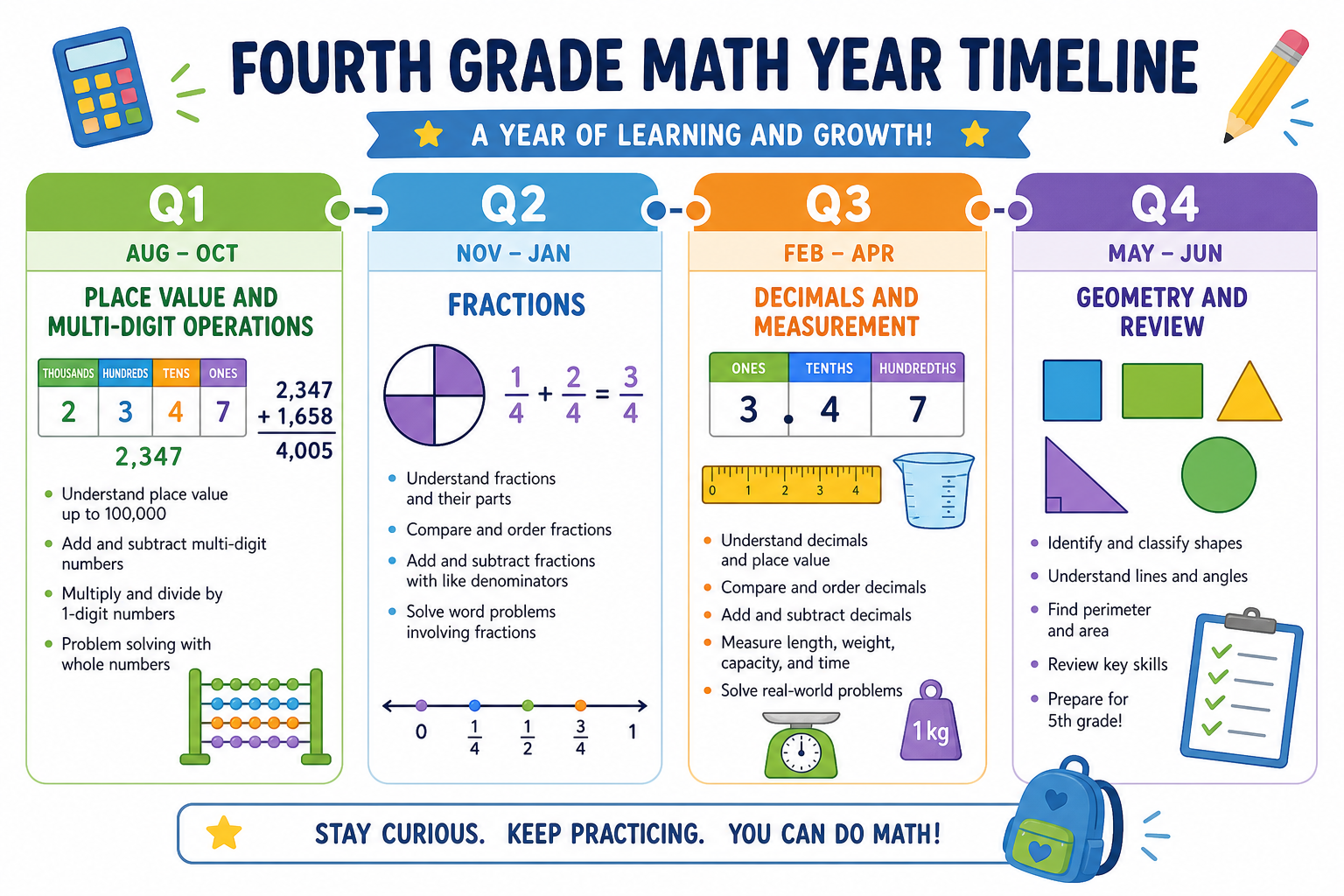
Quarter 1 — Operations & place value
Focus: Multi-digit multiplication and division; place value to millions
Home practice: Fact fluency maintenance, 2-digit multiplication, division tables
Quarter 2 — Fractions
Focus: Equivalence, comparison, addition and subtraction with like denominators
Home practice: Equivalent fraction sheets, number line activities, visual models
Quarter 3 — Decimals & measurement
Focus: Decimal notation; converting units; area and perimeter
Home practice: Place value charts, measurement projects, mixed review
Quarter 4 — Geometry & review
Focus: Angles, lines, symmetry; test prep and spiral review
Home practice: Geometry vocabulary, multi-step word problems, practice quizzes
Print 4th grade math practice for any unit
Free worksheets and custom generators—no signup required.
How Can Parents and Teachers Support 4th Grade Math?
Fourth grade homework often takes 30 to 40 minutes. Support does not mean doing the work—it means keeping skills fresh and confidence high while students tackle harder material.
- Maintain fact fluency: Five minutes daily on multiplication and division facts prevents bottlenecks during long division and fraction work.
- Use the same models as school: Area models, number lines, and fraction bars should match classroom vocabulary.
- Differentiate when needed: Use our differentiation guide to adjust problem count and difficulty.
- Space review across the year: Spiral old skills with spaced repetition instead of cramming before tests.
- Mix games with worksheets: Ideas from our math games guide keep practice engaging.
Third grade multiplication depth matters. If your child is still shaky on facts, read how to teach multiplication in third grade and fill gaps before pushing multi-digit algorithms.
What Do 4th Graders Struggle With Most?
Most struggles trace back to a missing foundation—not lack of effort. Target the root skill before assigning more pages at the current level.
Weak multiplication facts
What helps: Daily five-minute fact practice; multiplication chart as reference, not crutch
Long division steps
What helps: Return to grouping models; one-digit divisors before harder problems
Comparing unlike fractions
What helps: Common denominators with fraction bars; benchmark to 1/2
Multi-step word problems
What helps: Read twice, draw a picture, solve one step at a time
Before spring testing, use our elementary test prep guide for a low-stress review plan. Summer slide is real—our summer math review article lists skills to spiral over break.
What Free Resources Support 4th Grade Math?
- 4th grade math worksheets — mixed skills by topic
- Multiplication worksheets grade 4 — fact fluency and larger factors
- Equivalent fractions worksheets — core fourth grade fraction unit
- Division table — reference for division facts
- Math worksheet generator — custom problem sets for any unit
- Quiz generator — unit checks and spiral review
Key Takeaways
- Fourth grade adds multi-digit ops, deeper fractions, decimals, and geometry.
- Typical pacing: operations → fractions → decimals/measurement → geometry/review.
- Fact fluency and visual models from third grade are non-negotiable foundations.
- Target root skills when students struggle—do not only add harder worksheets.
- Free worksheets and generators support every major fourth grade topic.
Conclusion
A complete guide to 4th grade math topics is really a map of how elementary arithmetic grows into real number sense. Students who master multi-digit operations, fractions, and decimals this year enter fifth grade ready for unlike denominators and volume— not rebuilding shaky foundations.
Pick the unit your child is in this week, print one targeted practice page, and spend five minutes on facts. That small habit supports every topic on this list.
Explore free 4th grade math worksheets
Multiplication, fractions, and more. Unlimited prints, no signup.
4th Grade Math WorksheetsRelated Articles
- A Parent's Guide to 2nd Grade Math — earlier grade reference guide
- Teaching Fractions with Visual Models — essential for fourth grade fraction units
- Common Core Math Standards by Grade — see fourth grade in the K–6 sequence
Frequently Asked Questions
Fourth graders learn multi-digit multiplication and division, fraction equivalence and comparison, addition and subtraction of fractions with like denominators, decimal notation for tenths and hundredths, factors and multiples, angle measurement, area and perimeter, and multi-step word problems. Fact fluency from third grade supports all of these topics.