To teach equivalent fractions, start with models students can touch and compare. Show that 1/2, 2/4, and 4/8 name the same amount using fraction bars, shaded rectangles, or a number line. Once students can prove equivalence visually, introduce the rule: multiply or divide numerator and denominator by the same number.
Equivalent fractions confuse third graders because the numbers look different but the value stays the same. Students who only memorize a procedure add 1 to the top and bottom or compare numerators without looking at denominators. This guide covers what equivalence means, fraction bar proofs, a five-step lesson, when to teach the multiplication rule, common mistakes, and free printable practice.
What Are Equivalent Fractions?
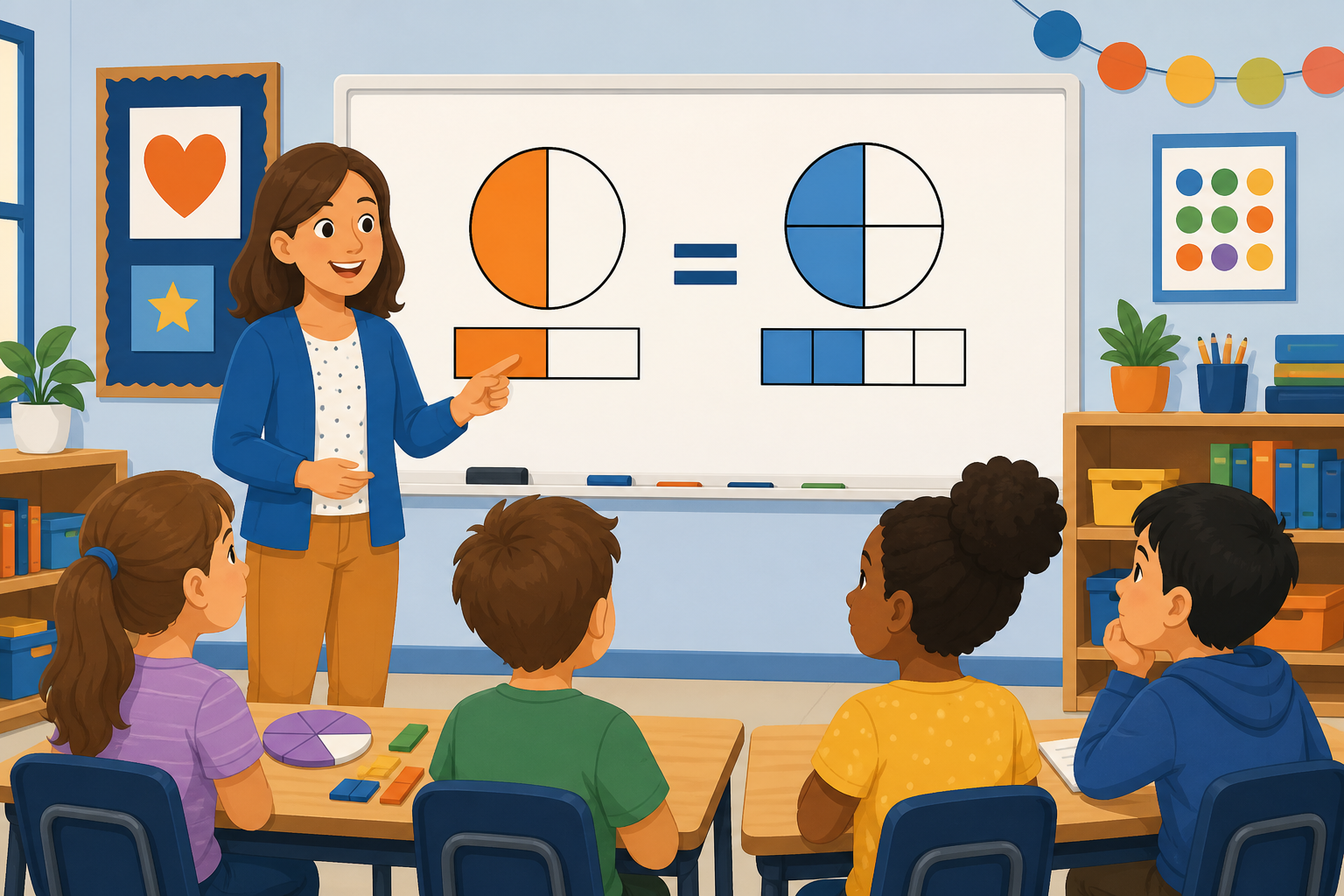
Equivalent fractions represent the same part of the same whole, even when written with different numerators and denominators. One-half of a candy bar is the same amount whether you call it 1/2, 2/4, or 4/8.
The Common Core third grade fraction standards expect students to recognize and generate simple equivalent fractions and explain why they are equivalent using visual models. Our teaching fractions with visual models guide covers the broader fraction introduction that comes first.
How Do Fraction Bars Prove Equivalence?
Fraction bars are the fastest way to show equivalence. Line up a bar showing 1/2 with a bar showing 2/4. When the shaded lengths match, students see the fractions are equal without any calculation.
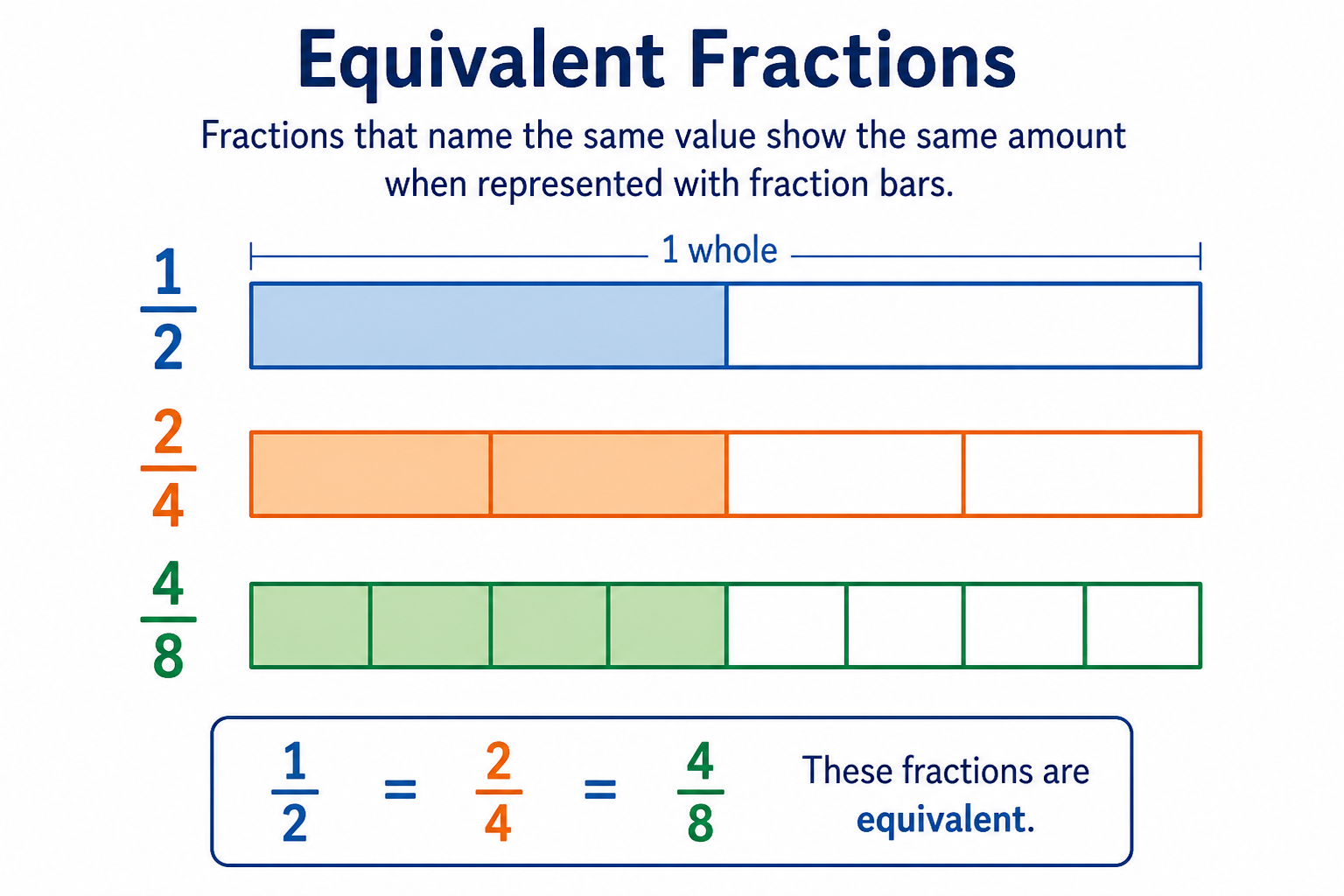
- Rectangle model: Shade 1 of 2 parts, then 2 of 4 parts on an identical shape
- Paper folding: Fold a strip in half, then fold again into fourths
- Number line: Mark 1/2 and 2/4 at the same point between 0 and 1
- Set model: 2 of 6 marbles is the same ratio as 1 of 3 marbles
What Five-Step Lesson Works?
Spread these steps across a week or more. Third graders need time to build and compare models before symbols make sense.
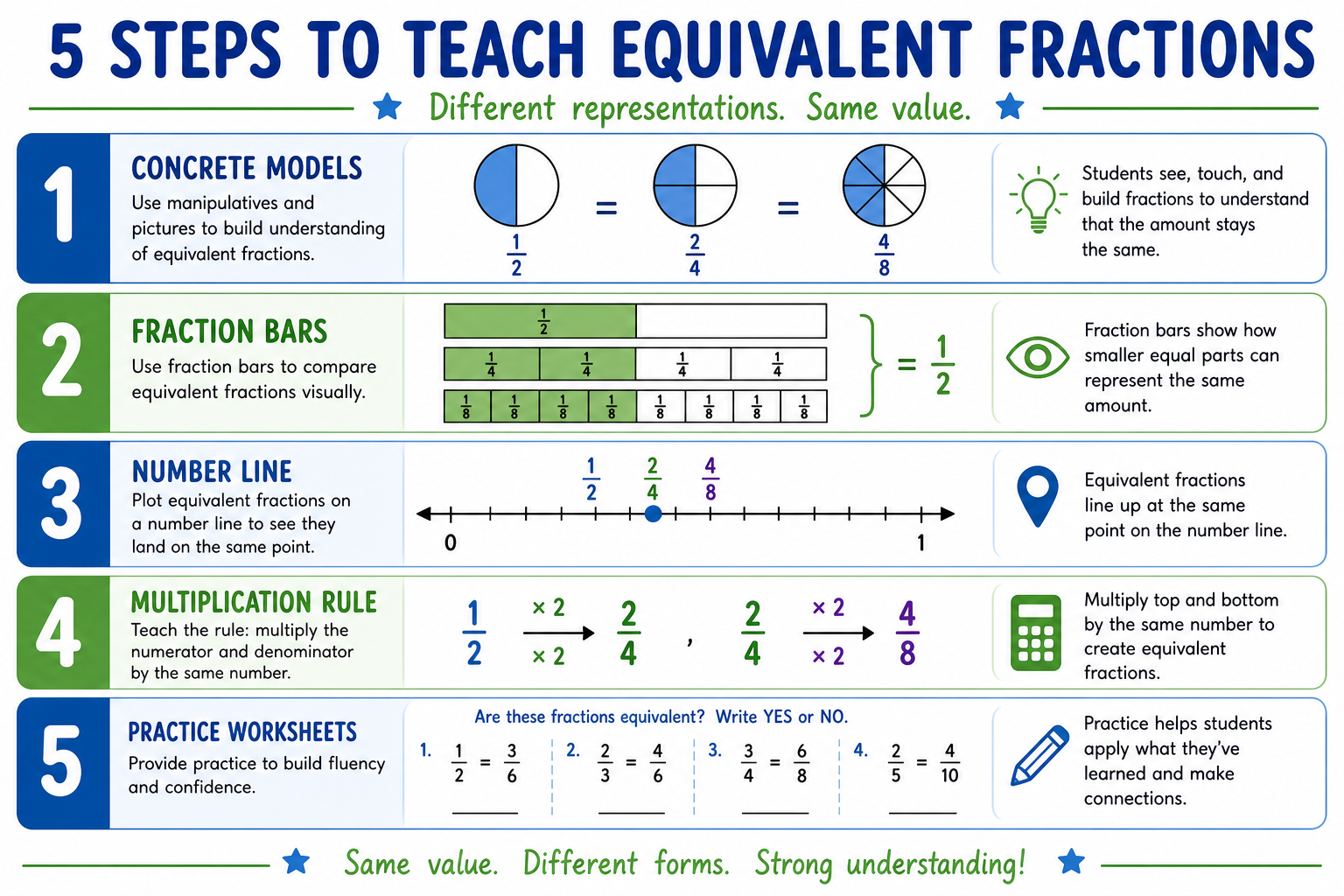
Students must know that the denominator tells how many equal parts and the numerator tells how many are selected. Use one whole pizza, bar, or rectangle before comparing fractions.
Fold paper strips into halves, then fold again into fourths. Students see that one half of the strip lines up with two fourths of the same strip.
Shade 1/2 of one rectangle and 2/4 of an identical rectangle. Ask: Which has more shaded? Students discover they are equal.
Mark 1/2, 2/4, and 4/8 on the same line. Equivalent fractions land on the same point between 0 and 1.
Once models are solid, show that multiplying top and bottom by the same number creates an equivalent fraction. Connect the rule back to splitting each part into smaller pieces.
Print equivalent fractions worksheets
Shade-and-compare problems, number line practice, and generating equivalents—free prints.
Equivalent Fractions WorksheetsWhen Do You Teach the Multiplication Rule?
Introduce the rule only after students can prove equivalence with a model. Show that multiplying 1/2 by 2/2 gives 2/4 because each half splits into two smaller pieces. The shaded area does not change.
| Start fraction | Multiply by | Equivalent |
|---|---|---|
| 1/2 | 2/2 | 2/4 |
| 1/3 | 2/2 | 2/6 |
| 2/3 | 2/2 | 4/6 |
Fourth grade students extend this to simplifying fractions by dividing numerator and denominator by the same factor. Equivalence and simplest form are two sides of the same idea.
What Mistakes Should Teachers Watch For?
- Adding the same number to numerator and denominator instead of multiplying
- Comparing fractions with different-sized wholes
- Looking only at numerators (thinking 1/4 is greater than 1/3 because 4 > 3)
- Introducing symbols before students can prove equivalence with a model
- Multiplying only the numerator or only the denominator
- Skipping number lines, which help students see equivalence as position
The addition trap (1/2 + 1/1 = 2/3) is the most persistent error. When you hear it, return to fraction bars and ask students to show what happened to the shaded area. The model exposes the mistake immediately.
How Do Worksheets Support Practice?
Worksheets follow hands-on lessons. After students fold paper strips, assign shading and matching problems. Generate fresh sets from the math worksheet generator or use premade equivalent fraction pages.
Pair with 3rd grade math worksheets for spiral review and 4th grade math worksheets when students move to comparing and ordering fractions.
Key Takeaways
- Equivalent fractions name the same amount of the same whole.
- Fraction bars, rectangles, and number lines prove equivalence before symbols.
- Use a five-step sequence: whole, concrete, bars, number line, multiplication rule.
- Multiply numerator and denominator by the same number to generate equivalents.
- Watch for the addition trap and numerator-only comparisons.
Conclusion
Teaching equivalent fractions works when students see the shaded area stay the same while the numbers change. Build with models, draw fraction bars, mark number lines, then introduce the multiplication rule. Equivalence becomes a fact students can prove, not a rule they memorize.
Free equivalent fractions worksheets
Printable shade, match, and generate problems for grades 3–4.
Equivalent Fractions WorksheetsRelated Articles
- Teaching Fractions with Visual Models — foundation before equivalence
- A Complete Guide to 4th Grade Math Topics — where fractions fit the year
- How to Introduce Decimals in 4th Grade — fraction connections to decimals
Frequently Asked Questions
Equivalent fractions are different names for the same amount of a whole. One-half (1/2), two-fourths (2/4), and four-eighths (4/8) all represent the same shaded area or the same point on a number line. The numerator and denominator change, but the value stays the same.