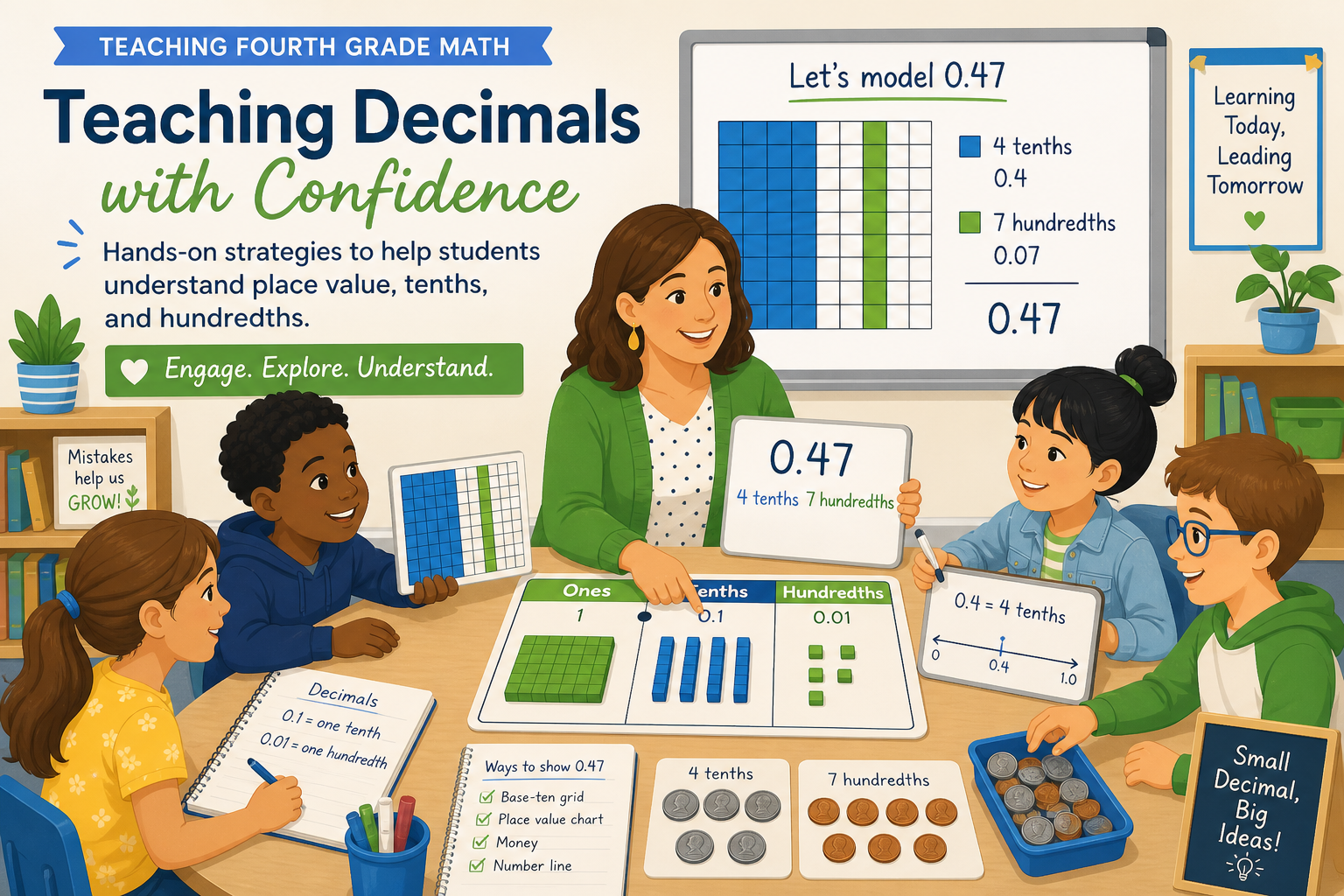
To introduce decimals in 4th grade, connect tenths and hundredths to fractions students already know, then show decimal notation as a compact way to write the same values. Use place value charts, base-ten grids, and money before abstract rules. Fourth graders read and write decimals to hundredths, compare them, and link 0.25 to 25/100. This guide covers prerequisites, a five-step lesson sequence, visual models, comparison strategies, common mistakes, and a weekly unit plan.
Decimals are not a new topic—they are a new notation for familiar fraction ideas. When you teach fractions first and decimals second, fourth graders see the decimal point as meaningful instead of mysterious.
Why Do Fourth Graders Learn Decimals?
Fourth grade is when students meet decimal notation in most state standards. They already understand fractions with denominators 10 and 100 from third and early fourth grade work. Decimals compress that idea: 0.7 means seven tenths, written without a fraction bar.
Decimals also prepare students for money, measurement, and science data in upper elementary. A student who reads 3.5 centimeters or $4.25 with confidence handles real-world math outside the classroom.
Our complete guide to 4th grade math topics places decimals in the spring pacing block after fraction equivalence. The Common Core fourth grade fraction standards expect students to express fractions with denominators 10 and 100 as decimals and compare decimal notation to hundredths.
What Prerequisites Should Be Solid First?
Pause decimal lessons if these foundations are shaky. Reteaching now saves weeks of confusion later.
- Place value to thousands: Students name the value of each digit in whole numbers. Review with base-ten blocks and a place value chart.
- Equivalent fractions: 1/2 = 5/10 = 50/100. Use fraction visual models and equivalent fraction worksheets.
- Tenths and hundredths as fractions: Shade 3/10 before writing 0.3.
- Money basics: Dimes and pennies preview decimal structure. See our money and financial literacy guide.
What Five-Step Lesson Sequence Works?
Run this sequence over one to two weeks. Each step includes a concrete model, oral language, and written notation—in that order.
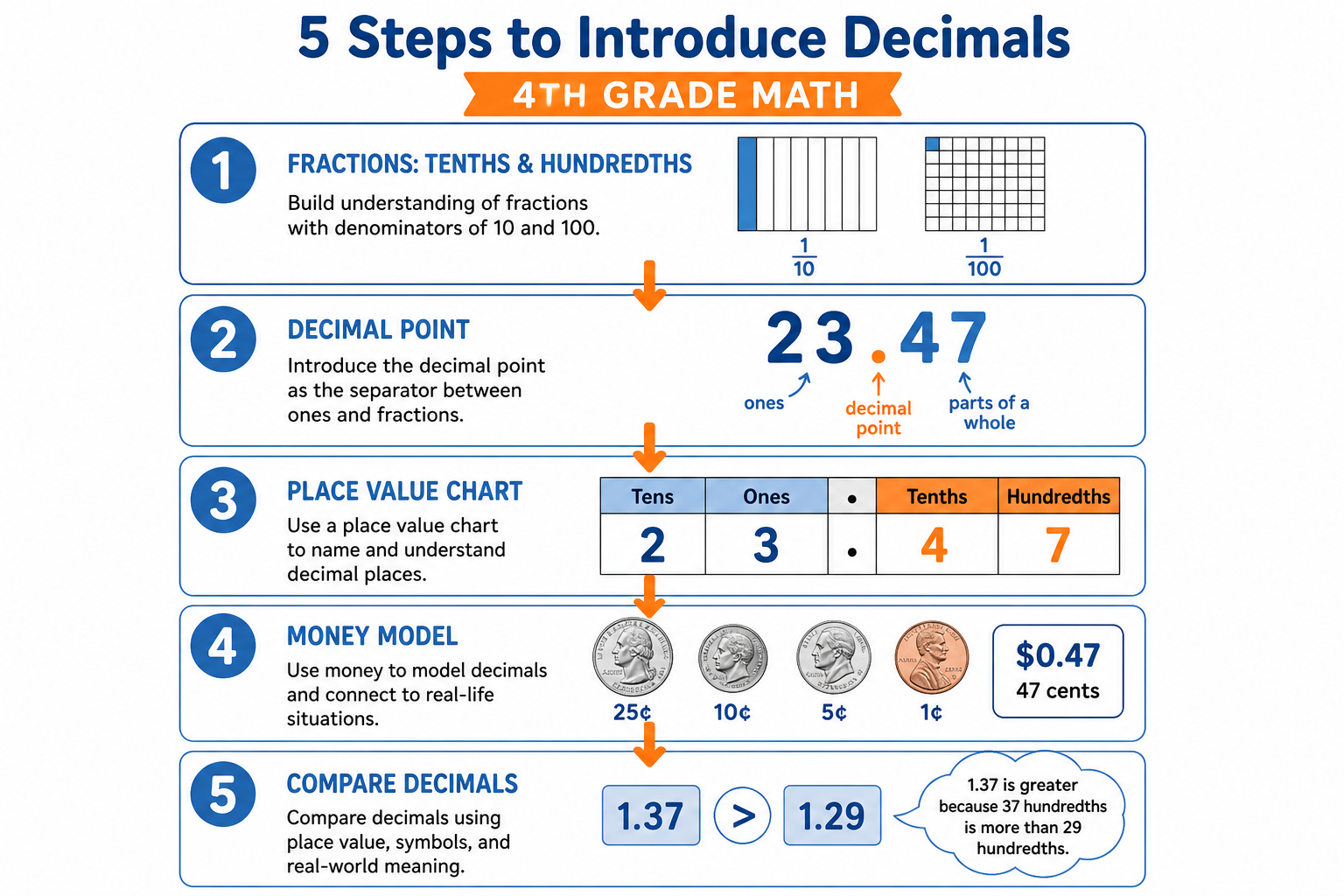
Step 1: Review tenths and hundredths as fractions
Shade 3/10 and 47/100 on grids before writing 0.3 or 0.47. Students must see that the denominator names the place value: tenths or hundredths.
Step 2: Introduce the decimal point as a separator
The point separates wholes from parts less than one. Build 1.4 with blocks: one whole and four tenths. Say "one and four tenths" aloud every time.
Step 3: Place value chart to hundredths
Extend the chart students used for whole numbers: ones, tenths, hundredths. Write 0.56 and label each digit's value. Connect to your place value chart printable.
Step 4: Money as a real-world model
Dimes are tenths of a dollar; pennies are hundredths. $1.35 is one dollar, three tenths, five hundredths. Link to classroom money activities from earlier grades.
Step 5: Compare and order decimals
Compare hundredths by lining up the decimal point. Use grids side by side: which is more shaded, 0.6 or 0.45? Justify with fraction language before symbols.
Which Visual Models Should You Use?
Every new decimal should appear on a model before it appears on a worksheet. Rotate models so students do not depend on only one representation.
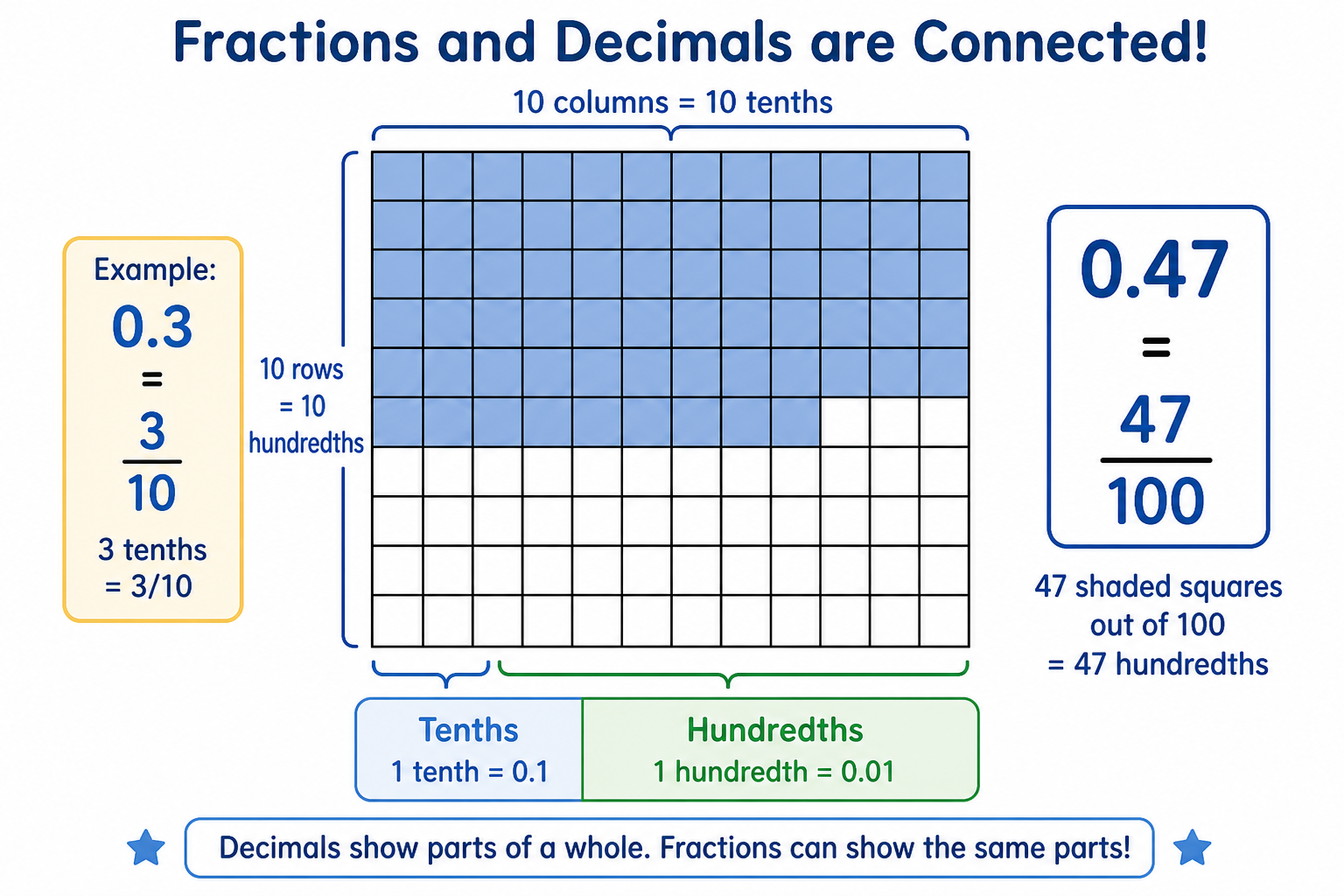
Base-ten grid (hundredths)
Shade columns to show tenths; individual squares for hundredths. One full grid equals 1.00.
Base-ten blocks
Flats = 1, rods = 0.1, units = 0.01 when you define the whole. Physically trade ten hundredths for one tenth.
Number line
Divide 0 to 1 into ten equal jumps for tenths; subdivide each tenth for hundredths.
Money
Dollars, dimes, and pennies mirror ones, tenths, and hundredths. Strong motivator for word problems.
Print place value and fraction tools for your decimal unit
Charts, equivalent fractions, and custom fourth grade math sheets—free and instant.
How Do Fractions Connect to Decimals?
Post a two-column anchor chart: fraction on the left, decimal on the right. Fill it together during the first three lessons.
| Fraction | Decimal | Words |
|---|---|---|
| 3/10 | 0.3 | three tenths |
| 47/100 | 0.47 | forty-seven hundredths |
| 1 35/100 | 1.35 | one and thirty-five hundredths |
| 50/100 | 0.50 or 0.5 | fifty hundredths = five tenths |
The National Council of Teachers of Mathematics emphasizes multiple representations for rational numbers. Switching between fraction, decimal, and model builds the flexible thinking state tests expect.
How Do You Teach Comparing Decimals?
Students compare whole numbers from left to right—decimals follow the same logic when place values align.
- Line up the decimal points vertically
- Compare the ones place first (if present)
- Move to tenths, then hundredths
- Use grids or number lines to confirm when unsure
For 0.6 vs 0.45: six tenths is sixty hundredths, which is more than forty-five hundredths. Shading both on the same grid makes the comparison visible. Students who struggle benefit from differentiated practice: tenths-only comparisons before mixed hundredths problems.
What Mistakes Should Teachers Watch For?
- Reading 0.45 as "forty-five" without place value language
- Thinking a longer decimal is always larger (0.456 vs 0.5)
- Adding a zero changes value incorrectly (confusing 0.5 and 0.50—which are equal)
- Skipping fraction models and jumping to decimal rules
- Misaligning decimal points when comparing two numbers
- Teaching decimal operations before place value understanding is secure
When a student insists 0.45 is greater than 0.6 because 45 is greater than 6, return to the grid—not the algorithm. Conceptual repair beats repeating the comparison rule.
What Does a Weekly Unit Plan Look Like?
One focused week introduces decimals; a second week spirals comparison and fraction-decimal matching into word problems and state-test-style items.
| Day | Focus | Activity |
|---|---|---|
| Monday | Tenths as fractions and 0.1–0.9 on grids | Shade-and-write tenths |
| Tuesday | Hundredths; relate 0.01 to 1/100 | Base-ten block build |
| Wednesday | Mixed decimals to hundredths; money connection | Price list word problems |
| Thursday | Compare and order decimals | Partner justify on number line |
| Friday | Mixed review; fraction-decimal matching | Short custom worksheet |
Generate Friday review sheets with the math worksheet generator. Pair decimal review with word problem strategies when you add money and measurement stories in week two.
Key Takeaways
- Decimals are fraction notation in compact form—teach fractions first.
- Use grids, blocks, number lines, and money before worksheets alone.
- Extend the place value chart to tenths and hundredths.
- Compare decimals with aligned place values and visual confirmation.
- Plan a two-week unit: introduce, then compare and apply.
Conclusion
Introducing decimals in 4th grade succeeds when students already see tenths and hundredths as fractions. The decimal point is a label, not a trick. Build each value with blocks or grids, name it in words, write the fraction, then write the decimal. When comparison problems arise, send students back to the model before the rule.
Open your decimal unit with one shaded grid and one money example tomorrow. When students explain 0.47 as forty-seven hundredths without prompting, you are ready for paper practice.
Free fourth grade decimal and place value practice
Print place value charts, fraction sheets, and custom math worksheets in seconds.
Free Math Worksheet GeneratorRelated Articles
- A Complete Guide to 4th Grade Math Topics — year-long pacing including decimals
- Teaching Fractions with Visual Models — foundation for decimal notation
- Teaching Place Value with Base-Ten Blocks — extend blocks to tenths and hundredths
Frequently Asked Questions
Most students first encounter decimal notation in fourth grade, connecting tenths and hundredths to fractions they already know. Some third grade curricula preview tenths with money. Fifth grade extends to thousandths, decimal operations, and converting between fractions and decimals. Fourth grade focuses on understanding place value and comparing decimals, not long division with decimals.