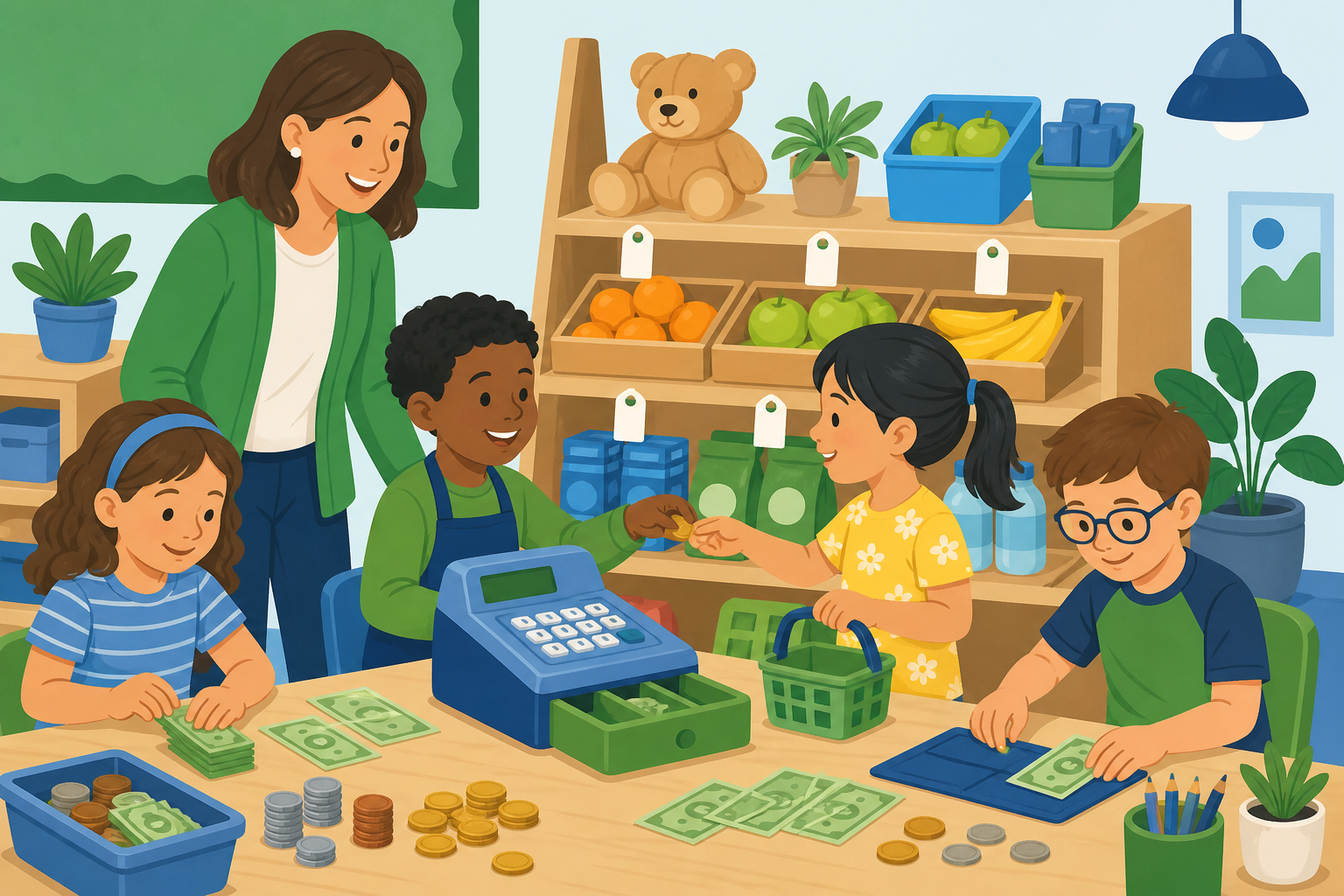
Teaching money and financial literacy in elementary school gives children skills they will use every day—counting change, comparing prices, saving for a goal, and making thoughtful spending choices. Money lessons also strengthen core math: addition, subtraction, place value, and decimals all appear when students work with dollars and cents. This guide covers grade-by-grade money skills, eight hands-on activities, and free practice tools for classroom and home.
Financial literacy in elementary grades is not about complex investing. It is about building habits and number sense through real contexts kids understand: a classroom store, an allowance jar, or a lemonade stand. When math feels useful, students engage more—and remember more.
Why Teach Money and Financial Literacy in Elementary School?
Money is one of the most practical applications of elementary math. Students who understand coins and bills can solve word problems with motivation that abstract worksheets sometimes lack. Early financial habits—waiting to buy, comparing prices, saving a portion—shape attitudes long before teenagers earn their first paycheck.
The Consumer Financial Protection Bureau provides free resources for teaching money skills at home and school. State math standards typically include money in grades 2–4 within measurement and number operations. Our standards-by-grade guide notes money in the second grade band.
Financial literacy also supports equity. Students who practice money math in safe classroom settings gain confidence before they face real transactions independently. That preparation matters for every child—not only those who already handle allowance at home.
What Money Skills Should Each Elementary Grade Learn?
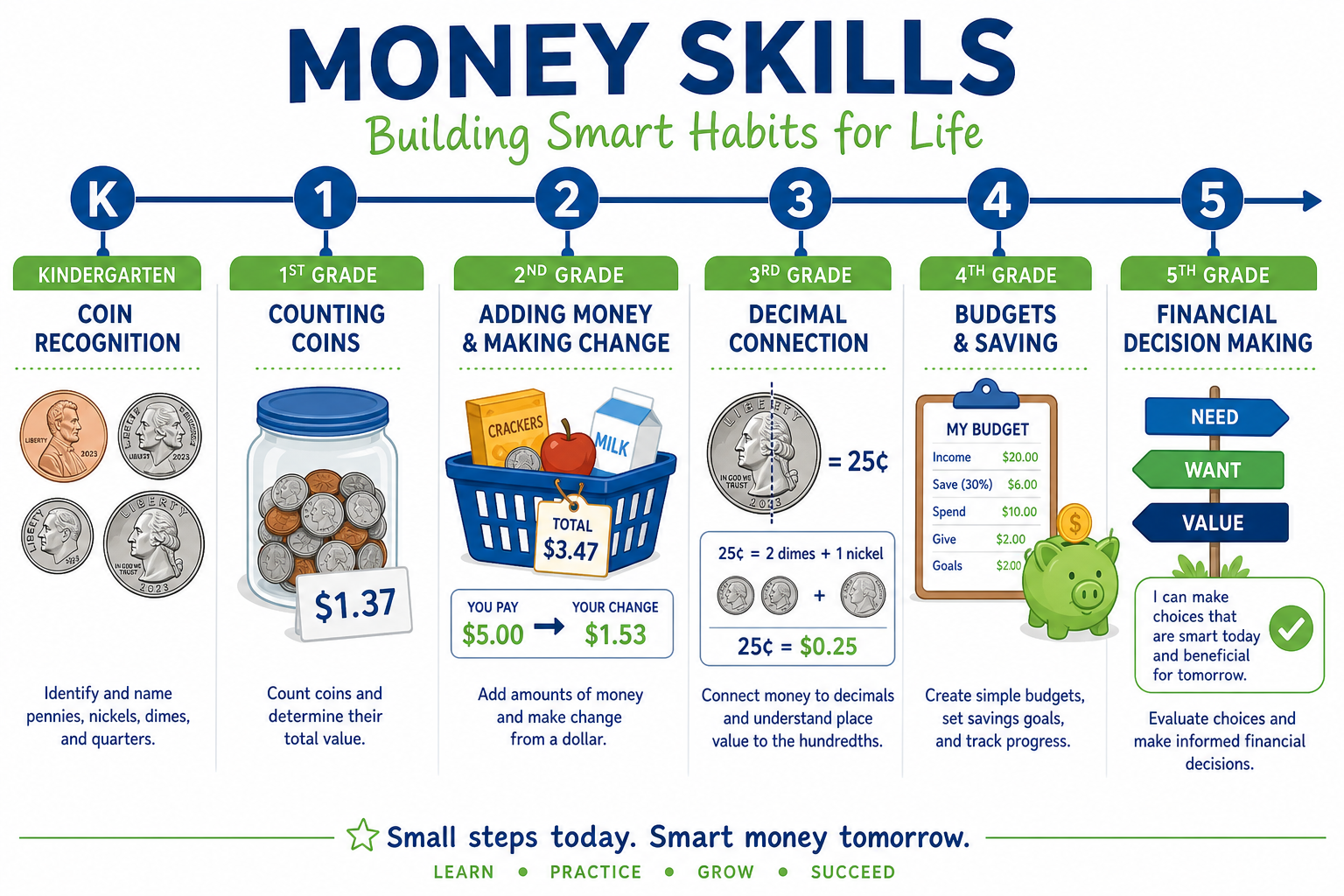
Pace varies by district, but this progression matches most U.S. elementary curricula. Build coin identification before mixed counting, and mixed counting before making change.
Kindergarten
Money math: Identify pennies, nickels, dimes, quarters; understand money is used to buy things
Financial literacy: Sort coins; simple trade games (two nickels for a dime)
Grade 1
Money math: Count collections of like coins; compare amounts; cent symbol
Financial literacy: Save coins in a jar toward a small toy; discuss waiting to buy
Grade 2
Money math: Count mixed coins; add dollar amounts; make change within $1
Financial literacy: Pretend store; needs vs. wants sorting; simple spending choices
Grade 3
Money math: Add and subtract money amounts; connect to decimals tenths
Financial literacy: Track spending on a chart; compare unit prices at a store
Grades 4–5
Money math: Decimal notation for money; multi-step money word problems
Financial literacy: Budget a class project; saving goals; charitable giving discussions
Second grade parents should read our parent guide to 2nd grade math for time and money practice tips. Fourth graders connecting dollars to decimals benefit from our fourth grade math topics guide.
What Are Eight Activities for Teaching Money and Financial Literacy?
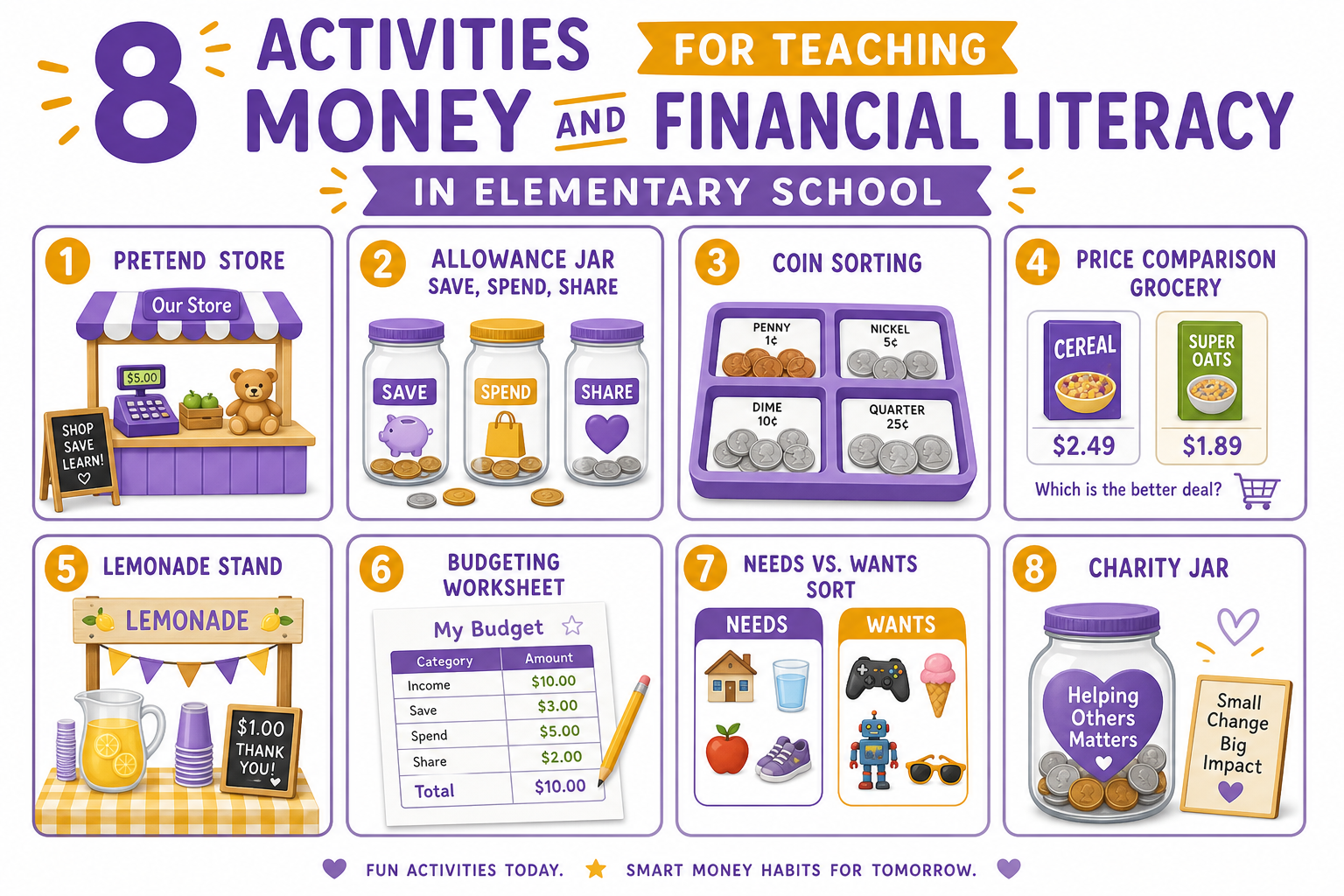
Rotate these activities across the year. Each one targets math skills and financial thinking at the same time.
Classroom pretend store
Label items with prices. Give students play money and a budget. They add purchases, make change, and decide what they can afford—core math and financial choice in one.
Save–spend–share jars
Divide allowance or earned coins into three jars. Set a savings goal on the save jar. Discuss what each jar is for every week.
Coin sorting and counting races
Sort a pile of mixed coins, then count each stack. Time optional—accuracy first. Builds fluency before word problems.
Grocery price comparison
At the store or with ads, compare two brands of the same item. Which costs less per unit? Elementary version of smart shopping.
Lemonade stand or bake sale math
Track costs, prices, and profit on paper. Real motivation to get the math right.
Needs vs. wants sort
Cut pictures from magazines. Sort into needs and wants. Discuss why food is a need and toys are usually wants.
Making change practice
Customer pays $1.00 for a 67¢ item—how much change? Start with play money, then worksheets with drawn coins.
Class charity goal
Collect coins for a cause. Chart progress toward a dollar goal. Connects math to community and giving.
The pretend store appears in our math games guide as Pretend Store—pair the game with a short money word-problem sheet afterward. Summer lemonade stands fit our summer math review approach to real-world practice.
How Does Money Connect to Other Math Standards?
Money is not a standalone topic—it threads through the curriculum. Use these connections so students see one coherent math story.
- Place value: Dollars and cents mirror ones and tenths. Use base-ten blocks and place value charts alongside coin trading.
- Addition and subtraction: Total a receipt; subtract to find change. Print problems from the math worksheet generator.
- Decimals: $2.35 is two and thirty-five hundredths—link to fourth grade decimal units.
- Multiplication: Three packs at $4 each—introduce in third or fourth grade store problems.
Kindergarten and first grade number sense from our number sense guide supports counting coins accurately before money word problems enter the picture.
Print money math practice for your unit
Custom addition and subtraction worksheets—free, no signup.
How Do You Teach Saving and Smart Spending?
Financial literacy includes attitudes and decisions—not only counting coins. Keep conversations age-appropriate and non-judgmental.
- Save–spend–share model: Three jars with clear labels. Decide percentages together (e.g., 50% save, 40% spend, 10% share).
- Goal setting: Post a picture of the item they are saving for with a progress bar.
- Delayed gratification: Offer a choice: one small treat now or a larger one after two weeks of saving.
- Transparent talk: Explain that families budget for needs first. No need to share stressful details—keep the lesson structural.
- Celebrate choices: Praise thoughtful decisions, not only math accuracy.
Struggling students may avoid money tasks from anxiety, not inability. Our confidence-building guide applies to money word problems too—start with play money and low stakes.
What Worksheets and Tools Support Money Lessons?
Worksheets follow hands-on practice—they should not replace coins and conversations. Use short pages that mirror store scenarios students already acted out.
- 2nd grade math worksheets — money and change practice
- Math worksheet generator — custom addition and subtraction for price totals
- Place value worksheets — connect cents to tenths and hundredths
- Quiz generator — quick coin ID or change checks
For more real-life math at home, see making math practice fun at home—cooking, shopping, and budgeting fit naturally there.
Key Takeaways
- Teach coin ID early; counting and change peak in second grade in most schools.
- Use pretend stores, jars, and real shopping to build financial habits.
- Connect money to place value, operations, and decimals across grades.
- Teach needs vs. wants and saving goals—not only computation.
- Follow hands-on play with short worksheets from grade-level or custom generators.
Conclusion
Teaching money and financial literacy in elementary school prepares students for math and for life. When children count coins confidently, make change at a classroom store, and save toward a goal, they learn that numbers have meaning outside the textbook. Start with play money this week—even fifteen minutes in a pretend store teaches more than a lecture about budgeting ever could.
Print math practice for your money unit
Free 2nd grade worksheets and custom generators. No signup required.
2nd Grade Math WorksheetsRelated Articles
- A Parent's Guide to 2nd Grade Math — time and money in second grade
- 10 Fun Math Games for Kids — pretend store and money games
- Teaching Place Value with Base-Ten Blocks — connect dollars and cents to place value
Frequently Asked Questions
Children can begin identifying coins in kindergarten and counting small amounts in first grade. Second grade is the main year for adding money and making change in most curricula. Financial literacy habits—saving, spending choices, needs vs. wants—can start as early as first or second grade through simple routines like allowance jars.