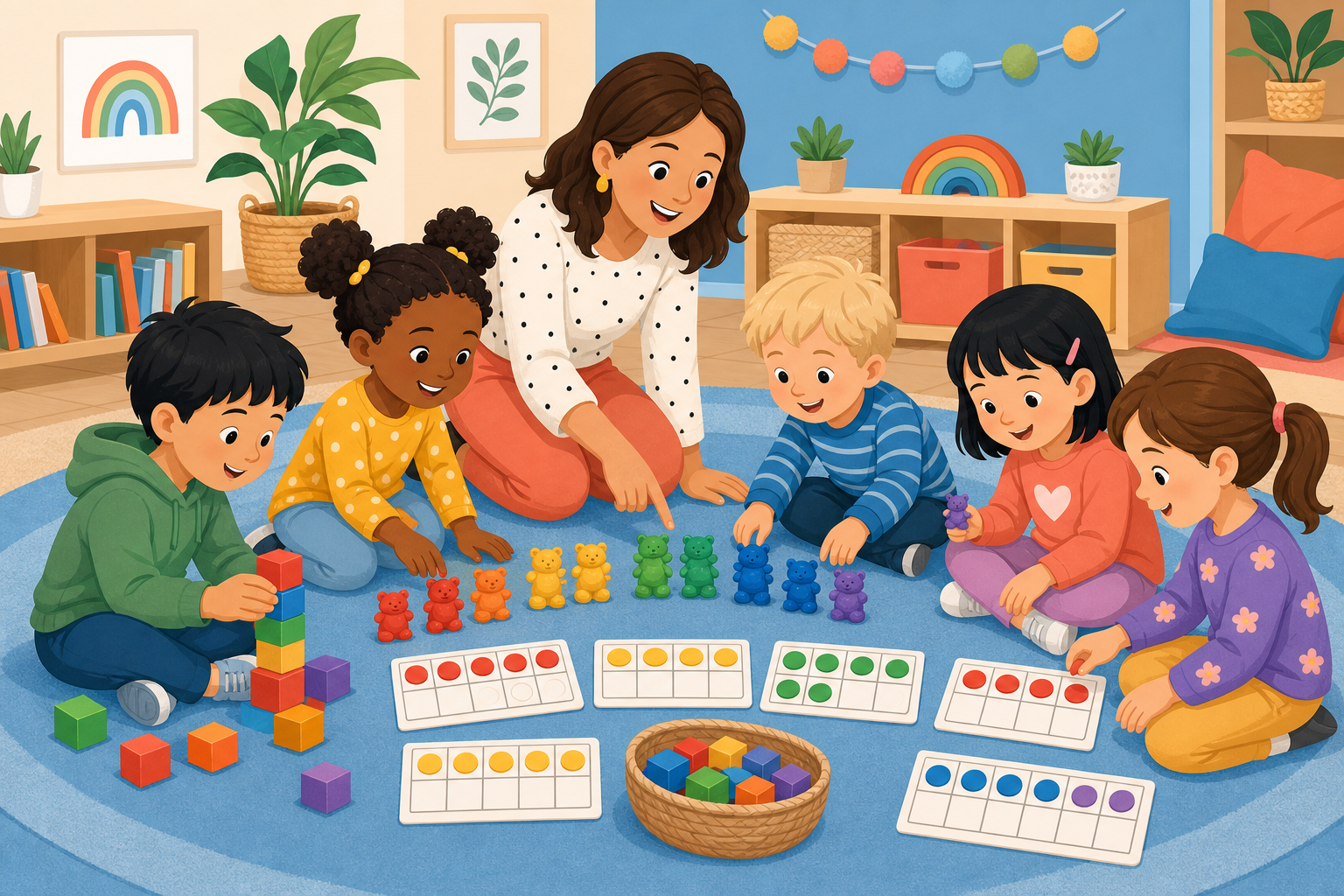
Building number sense in kindergarten means helping children understand what numbers represent—not just recite counting words. When five-year-olds connect the word "four" to a group of four bears, compare which pile has more, and see 7 as five and two on a ten frame, they build the foundation for every math skill that follows. This guide explains the five pillars of kindergarten number sense, eight hands-on activities, a simple daily routine, and free worksheets for practice.
Number sense develops through talk, play, and repeated experiences with real quantities. Worksheets support the work when they match what children did with objects first. Rushing to paper before meaning is set often creates students who can write numerals but do not know what they stand for.
What Is Number Sense in Kindergarten?
Number sense is flexible thinking about numbers—their size, relationships, and how they combine. In kindergarten it is not algebra or long division. It is whether a child knows that 8 is more than 5, that counting eight blocks means the eighth word names the total, and that 6 can be thought of as 5 and 1 more.
The Common Core kindergarten counting standards emphasize counting, cardinality, and comparing numbers within 10 before extending to 20 and beyond. Our standards-by-grade guide shows how kindergarten fits the K–6 sequence.
Children who enter first grade with weak number sense often struggle with addition facts and place value—not because those topics are too hard, but because the underlying ideas about quantity were never solid. Kindergarten is the highest-leverage year to invest in hands-on number work.
What Are the Five Pillars of Kindergarten Number Sense?
Use these five pillars as a planning lens. If a child is weak in one area, add activities for that pillar before pushing ahead to bigger numbers or written equations.
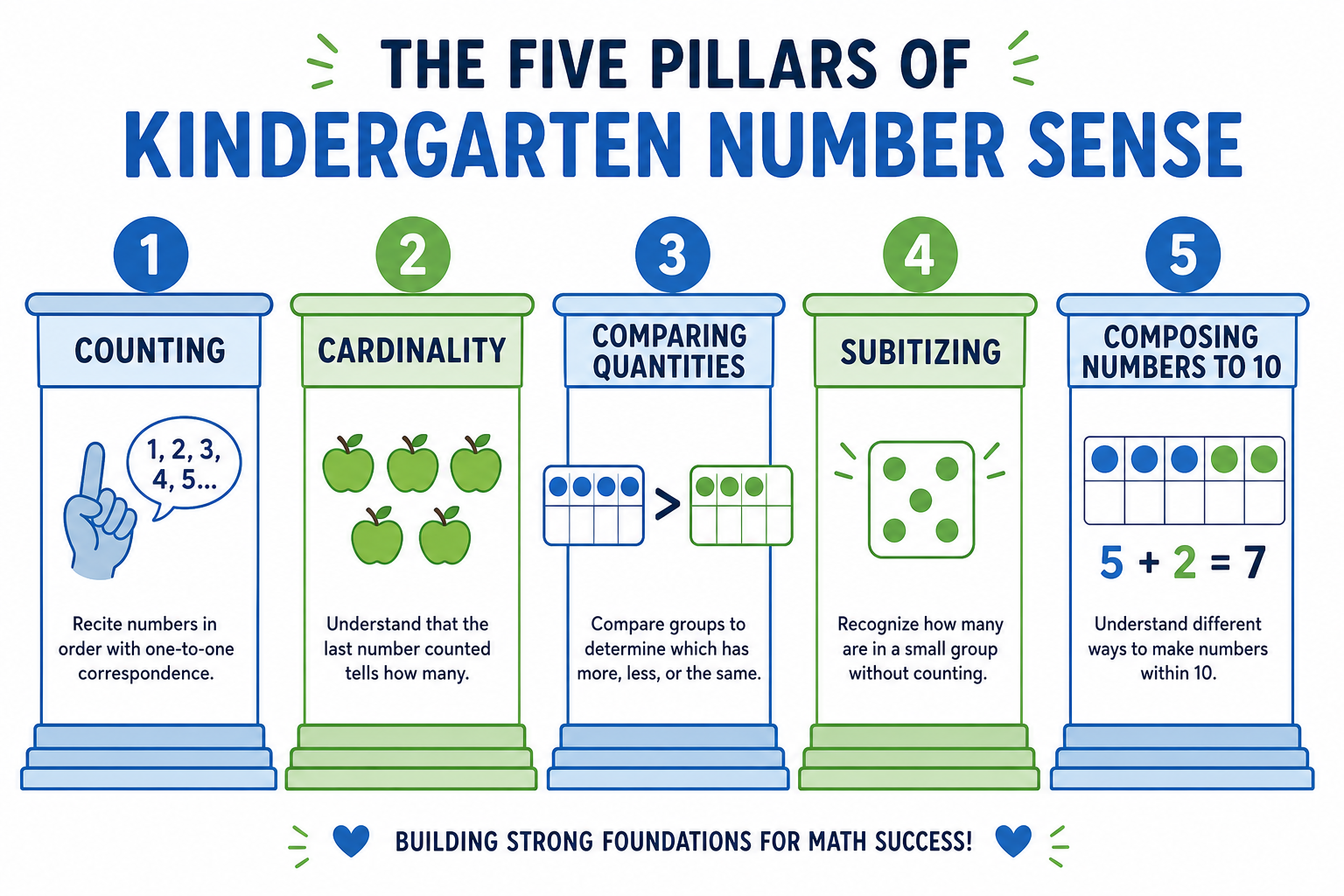
Counting and cardinality
Children say number words in order and understand the last number tells how many objects are in a set. One-to-one correspondence—touching each object once—comes before speed.
Comparing quantities
More, less, and equal are vocabulary and visual skills. Compare two piles of blocks before introducing greater-than symbols. Kindergarten stays concrete.
Subitizing
Recognizing small groups (1–5) instantly without counting. Dot cards and dice faces build this. Subitizing supports later fact fluency.
Composing and decomposing to 10
Seeing 6 as 5 and 1, or 3 and 3. Ten frames and number bonds make these splits visible. This is the bridge to addition and subtraction.
Connecting numerals to quantities
The symbol 4 matches a group of four. Writing numerals, reading numbers on a line, and matching sets to digits belong together—not as isolated tracing drills.
Composing numbers to 10 connects directly to place value with base-ten blocks in first grade. Kindergarten ten-frame work is early place value thinking: tens and ones in a visual, child-sized package.
What Are Eight Activities That Build Number Sense?
These activities need minimal prep and work in classrooms, homeschool, or tutoring. Rotate them across the week so children encounter numbers in many contexts.
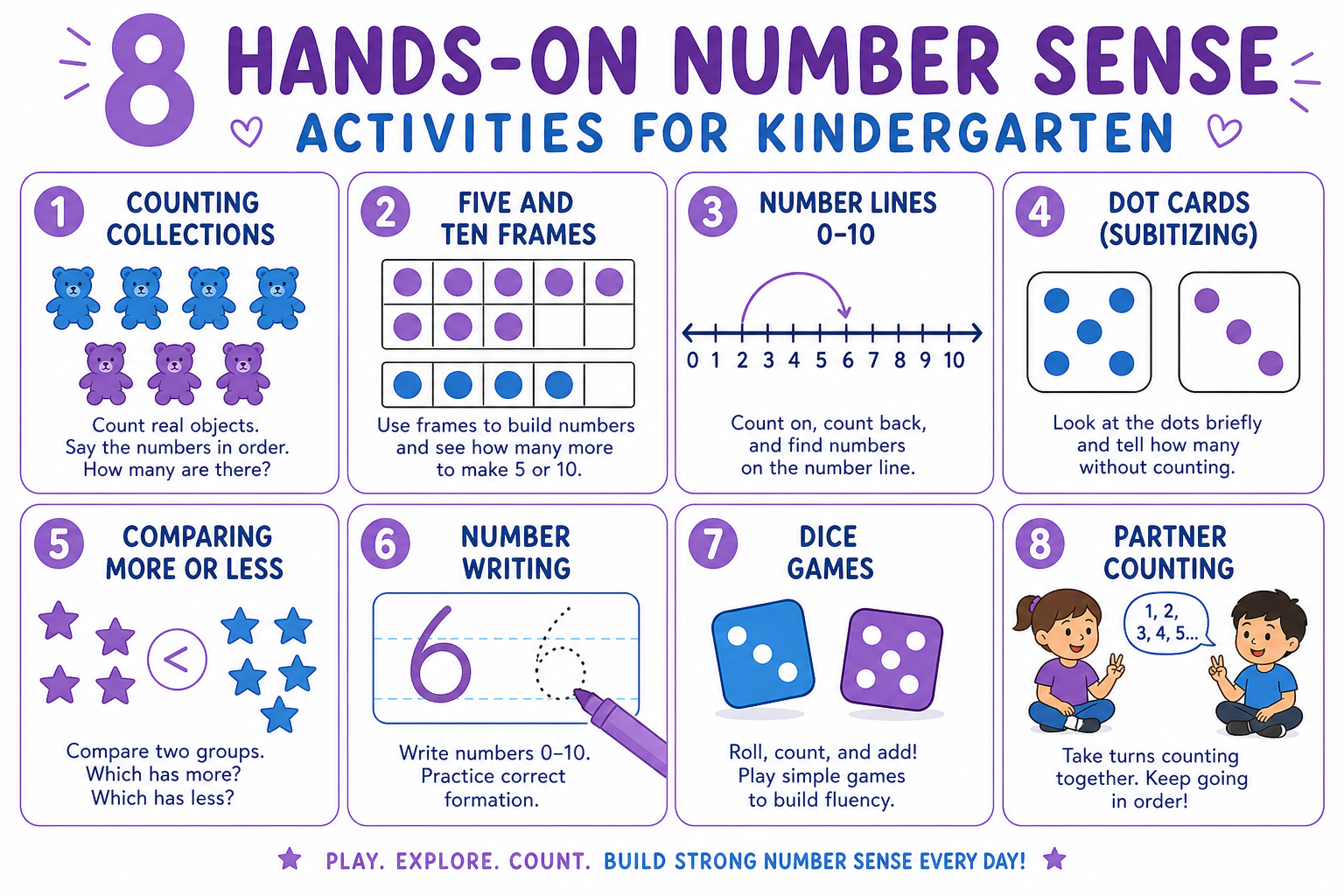
Counting collections
Give each child a bag of 10–20 mixed objects. Count together, then alone. Change collections weekly—buttons, shells, blocks—to keep interest high.
Five and ten frames
Fill frames with two-color counters. Ask how many and how many more to make 10. Quick daily warm-up on the rug.
Dot card flash
Show dot patterns briefly; children say how many without counting one by one. Start with 1–3, extend to 5.
Number line walks
Tape a 0–10 line on the floor. Hop forward and back: start at 4, jump 2 more. Connect movement to addition language.
More and less games
Each partner rolls a die; whoever has more takes a counter. Discuss ties. Builds comparison without worksheets.
Number writing with meaning
After counting a set, write the numeral. Use trace-then-write sheets for 0–10. Connect writing to the quantity just counted.
Dice and dot games
Roll two dice, count total, or compare rolls. Games from our math games guide adapt well for kindergarten tables.
Calendar and classroom routines
Count days in school, students present, or steps to lunch. Routines embed numbers in real context all day.
For game ideas that scale to older siblings, browse our fun math games guide. Many kindergarten teachers adapt simple dice and card games from that list for center time.
What Does a Daily Number Sense Routine Look Like?
Fifteen minutes total is enough for most kindergarten classes. Split the time into short segments so attention stays high. This sample block fits morning meeting or a math warm-up before a longer lesson.
| Time | Activity | Skill focus |
|---|---|---|
| 5 min | Counting collection or ten-frame warm-up | Cardinality and composing to 10 |
| 5 min | One quick game (dice, dot cards, number line) | Subitizing and comparison |
| 5 min | Optional worksheet: trace numeral or match quantity | Symbol-quantity connection |
Morning routines that include a quick counting task pair well with literacy sign-in. See our morning work routine guide for scheduling tips. Preschoolers moving into kindergarten may already know letter routines from name writing activities—add a number line or counting jar to the same structure.
Print kindergarten math practice today
Free counting, matching, and number tracing worksheets—no signup required.
How Do Worksheets Support Kindergarten Number Sense?
Worksheets play a supporting role. They help children connect quantities to written numerals, practice formation, and show what they know in a format parents and teachers can keep. They should not replace manipulatives and conversation.
- After hands-on work: Count objects first, then complete a matching or tracing page with the same number.
- Short pages only: Five to eight items per sheet matches kindergarten attention spans.
- Mix formats: Circle the group with 6, trace the numeral 6, draw 6 dots—one skill, three representations.
- Use generators for variety: Fresh problems keep practice from feeling repetitive.
The National Council of Teachers of Mathematics recommends developing understanding through problem solving and reasoning. Kindergarten worksheets work best when they extend a lesson children already explored with objects.
How Do You Know Kindergarten Number Sense Is Growing?
Look for these signs across the year. Progress is uneven—some children master subitizing early and need more time on writing numerals, or the reverse.
- Counts a set of up to 20 objects with one-to-one correspondence
- Says how many without recounting when asked after counting
- Compares two groups and uses more, less, or equal correctly
- Recognizes dot patterns up to 5 quickly
- Shows two ways to make 6 or 7 on a ten frame
- Writes numerals 0–10 with recognizable formation
- Counts forward from a given number within 20 (not always from 1)
If several skills lag after consistent practice, add more hands-on time before more paper. Fine motor delays can slow numeral writing—our fine motor skills guide offers parallel support for pencil control.
What Free Resources Support Kindergarten Number Sense?
- Kindergarten math worksheets — counting, comparing, and early operations
- Trace numbers worksheets — dotted-line numerals 0–10 and beyond
- Math worksheet generator — custom problem sets as skills grow
- Place value worksheets — bridge toward first grade tens and ones
Key Takeaways
- Number sense is understanding quantity, comparison, and relationships—not just counting aloud.
- Build five pillars: cardinality, compare, subitize, compose to 10, link numerals.
- Use eight hands-on activities daily in short bursts; worksheets follow objects.
- A fifteen-minute routine covers warm-up, game, and optional paper practice.
- Strong kindergarten number sense sets up first grade addition and place value.
Conclusion
Building number sense in kindergarten is one of the most important jobs in early math education. Children who count with meaning, compare with confidence, and see numbers on ten frames enter first grade ready for real arithmetic—not just memorized steps. Keep practice playful, hands-on, and brief; let worksheets reinforce what fingers and counters already taught.
Tomorrow, try one ten-frame talk: show 7 counters and ask how many more make 10. That two-minute conversation builds more lasting number sense than a full page of unexplained numerals.
Free kindergarten math and number tracing sheets
Print counting and tracing practice. No signup required.
Kindergarten Math WorksheetsRelated Articles
- Teaching Place Value with Base-Ten Blocks — what comes after kindergarten number sense
- Name Writing Activities for Preschoolers — literacy routines that pair with math warm-ups
- A Parent's Guide to 2nd Grade Math — see the long-term path from K to grade 2
Frequently Asked Questions
Number sense is understanding what numbers mean and how they relate. In kindergarten, it includes counting objects accurately, knowing the last number counted tells how many, comparing more and less, recognizing small quantities without counting (subitizing), and composing numbers to 10. Strong number sense supports addition, subtraction, and place value in first grade.