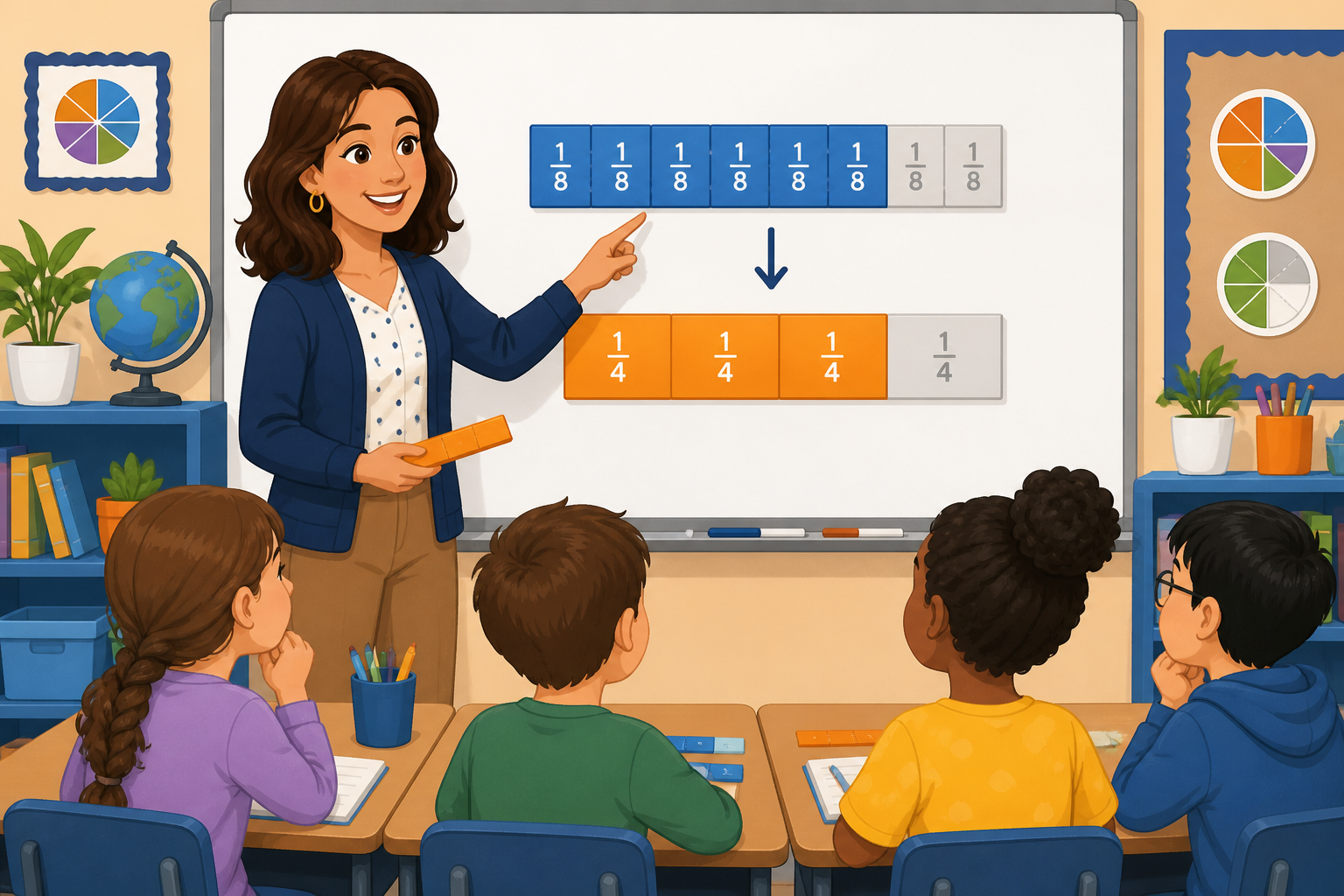
To teach simplifying fractions, start with fraction strips that show the same shaded amount written with fewer, larger pieces. Students see that 6/8 and 3/4 cover the same length before they divide by a common factor. Then introduce the GCF method: divide numerator and denominator by their greatest common factor until only 1 is shared.
Simplifying fractions is the bridge between equivalent fractions and fluent fraction arithmetic. Students who only memorize division steps often divide incorrectly or think they are changing the value. This guide covers what simplest form means, fraction strip models, a five-step lesson, the GCF method, common mistakes, and free printable practice.
What Does Simplifying a Fraction Mean?
Simplifying means rewriting a fraction in lowest terms with the smallest possible numerator and denominator that still name the same value. Six-eighths and three-fourths are equivalent, but 3/4 is the simplest form because 3 and 4 share no factor other than 1.
The Common Core fourth grade fraction standards expect students to explain why fractions are equivalent and express them in simplest form. Our guide to teaching equivalent fractions covers the foundation that comes first.
How Do Fraction Strips Show Simplification?
Fraction strips make simplification concrete. Lay out six one-eighth pieces shaded. Then trade pairs of eighths for fourths. Students end with three one-fourth pieces covering the exact same length.
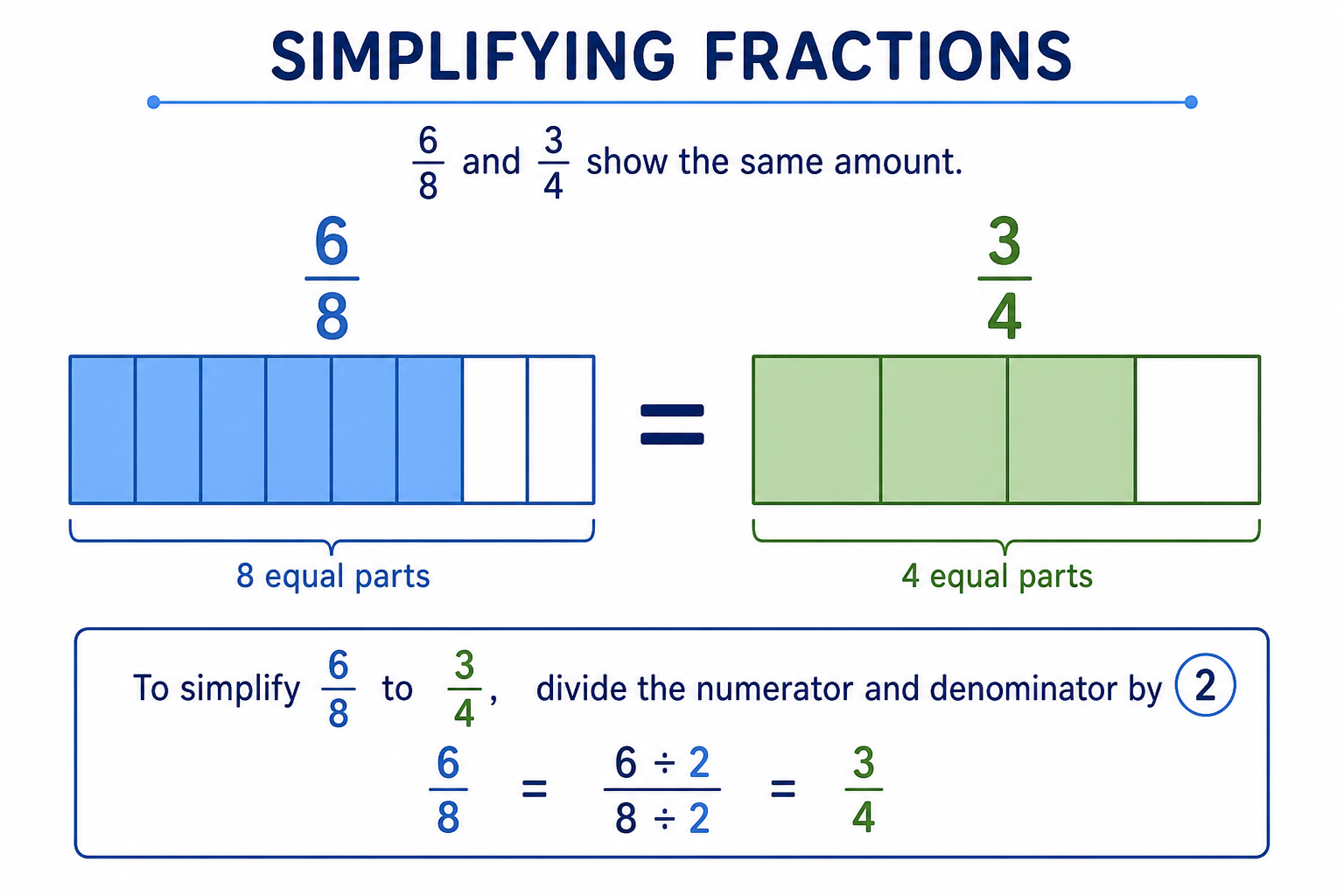
- 6/8 → 3/4: Group every 2 eighths into 1 fourth
- 8/12 → 2/3: Group every 4 twelfths into 1 third
- 10/15 → 2/3: Divide both by 5 (the GCF)
- Already simplest: 5/7 cannot be simplified further
What Five-Step Lesson Works?
Spread these steps across a week. Fourth graders need visual proof before the division algorithm feels meaningful.
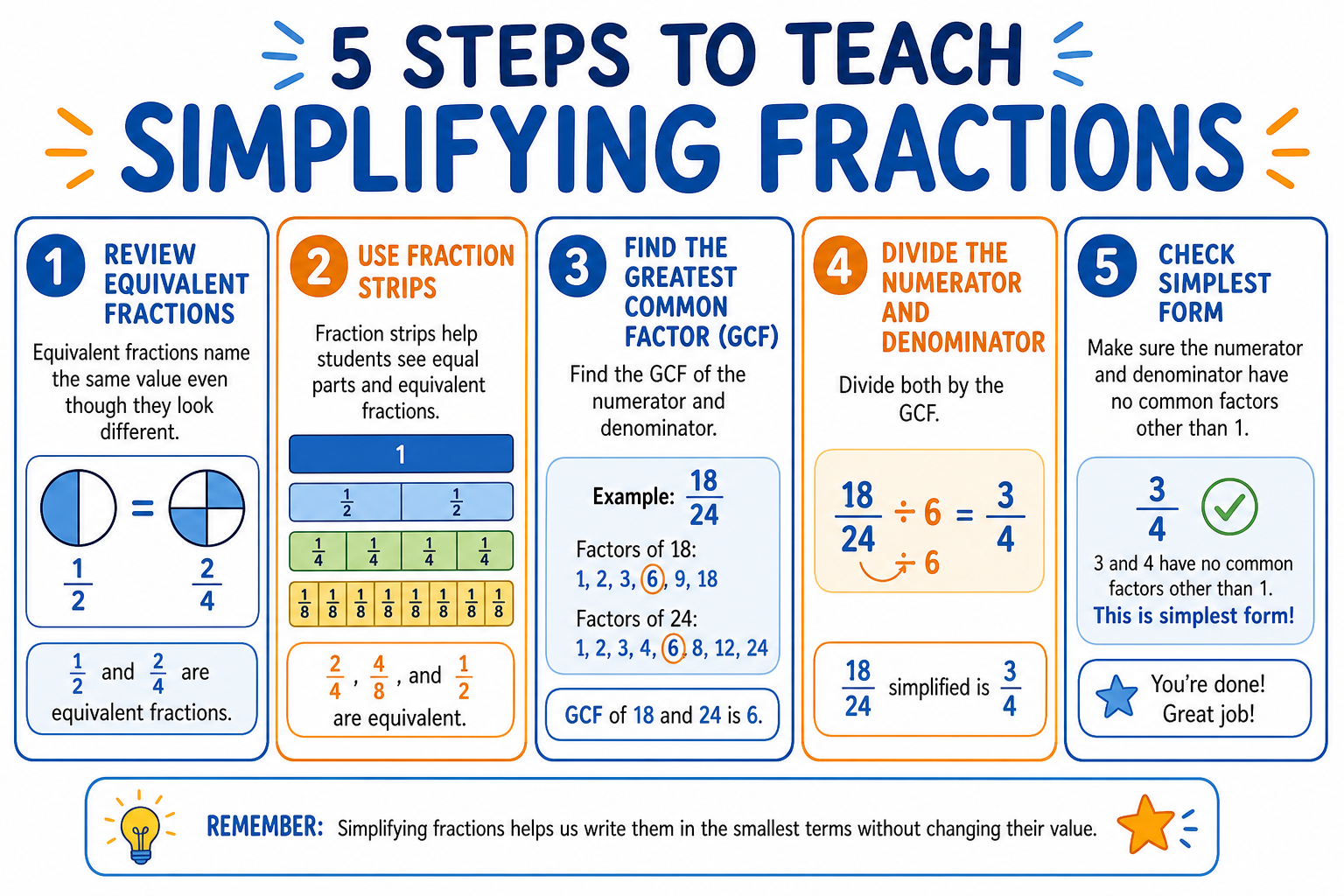
Students must know that different fractions can name the same amount. Use fraction bars to show 1/2 = 2/4 = 4/8 before introducing simplest form.
Build 6/8 with eighth strips, then rearrange into fourths to show 3/4. The shaded length stays the same but the pieces get larger.
List factors of numerator and denominator. For 6/8, both share 2. Divide top and bottom by 2 to get 3/4.
Find the largest shared factor to simplify in one step. For 12/16, the GCF is 4, so 12/16 = 3/4.
Ask: Can I divide both numbers by anything other than 1? If not, the fraction is in lowest terms. Build the habit after every fraction answer.
Print simplifying fractions worksheets
Visual models, GCF practice, and simplest-form problems—free printable pages.
Simplifying Fractions WorksheetsHow Do You Use the GCF Method?
Once students understand the visual model, teach the GCF shortcut. Find the largest number that divides both numerator and denominator, then divide both by that number.
| Fraction | GCF | Simplest form |
|---|---|---|
| 6/8 | 2 | 3/4 |
| 12/16 | 4 | 3/4 |
| 10/15 | 5 | 2/3 |
| 5/7 | 1 | 5/7 (already simplest) |
Students who struggle with factors can use a multiplication chart to list multiples. Connect to teaching fractions with visual models when reteaching is needed.
What Mistakes Should Teachers Watch For?
- Dividing only the numerator or only the denominator
- Subtracting the same number from top and bottom instead of dividing
- Stopping at a partially simplified form (6/8 to 3/8 instead of 3/4)
- Thinking simplifying makes the fraction smaller in value
- Skipping visual models and jumping straight to the GCF algorithm
- Forgetting to simplify final answers in addition and multiplication problems
Emphasize that simplifying does not shrink the value. The fraction bar shaded length stays identical. Only the way we write the fraction changes.
How Do Worksheets Support Practice?
Worksheets follow hands-on lessons. After students rearrange fraction strips, assign shading and GCF problems. Generate fresh sets from the math worksheet generator or use premade simplifying fraction pages.
Pair with equivalent fractions worksheets and 4th grade math worksheets for mixed review across the fraction unit.
Key Takeaways
- Simplifying rewrites a fraction in lowest terms without changing its value.
- Fraction strips prove that fewer, larger pieces name the same amount.
- Divide numerator and denominator by the GCF to simplify in one step.
- A fraction is simplest when the only common factor is 1.
- Check simplest form after every fraction answer.
Conclusion
Teaching simplifying fractions works when students see the strips before the division rule. Group smaller pieces into larger ones, find the GCF, divide both parts, and check that only 1 remains. Simplest form becomes a habit, not an afterthought.
Free simplifying fractions worksheets
Printable visual models and GCF practice for grades 4–5.
Simplifying Fractions WorksheetsRelated Articles
- How to Teach Equivalent Fractions — foundation before simplifying
- Teaching Fractions with Visual Models — fraction introduction and models
- A Complete Guide to 4th Grade Math Topics — where fractions fit the year
Frequently Asked Questions
Simplifying a fraction (also called reducing to lowest terms) means rewriting it with smaller numerator and denominator while keeping the same value. Six-eighths (6/8) simplifies to three-fourths (3/4) because both name the same shaded amount. A fraction is in simplest form when the only common factor of numerator and denominator is 1.