To teach subtraction with regrouping, start with place value and base-ten blocks before any stacked algorithm. Students learn when a trade is needed—when the top digit is smaller than the bottom digit—then move from manipulatives to drawings, expanded form, and finally the standard written method. Mix regrouping and non-regrouping problems so students check each column before they borrow.
Regrouping is one of the hardest second grade skills because it combines place value, subtraction facts, and multi-step procedure. When taught as a chant without models, students borrow from the wrong column or forget to adjust the tens digit. This guide covers when regrouping is needed, a five-step lesson sequence, two-digit versus three-digit pacing, common mistakes, and free printable practice.
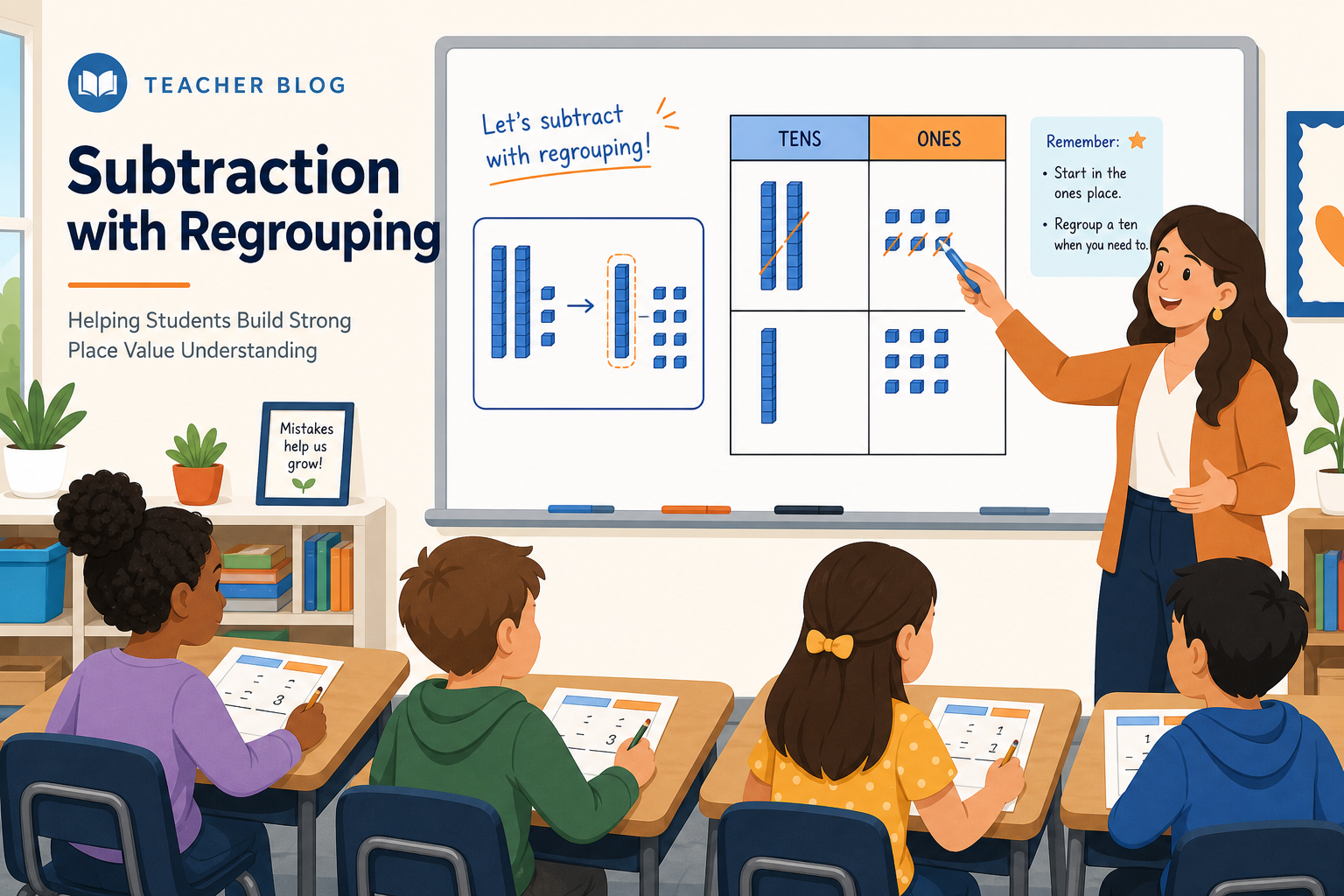
What Is Subtraction with Regrouping?
Regrouping means trading one unit from a larger place value for ten units in the next smaller place—one ten becomes ten ones, or one hundred becomes ten tens—so you can subtract in every column. The total value of the number does not change; only how it is grouped changes.
The Common Core second grade number standards expect fluency with two-digit subtraction including regrouping. Foundation work lives in our place value with base-ten blocks guide and parent's guide to 2nd grade math.
When Is Regrouping Needed?
Teach students to ask one question per column: Is the top digit greater than or equal to the bottom digit? If yes, subtract directly. If no, regroup before subtracting.
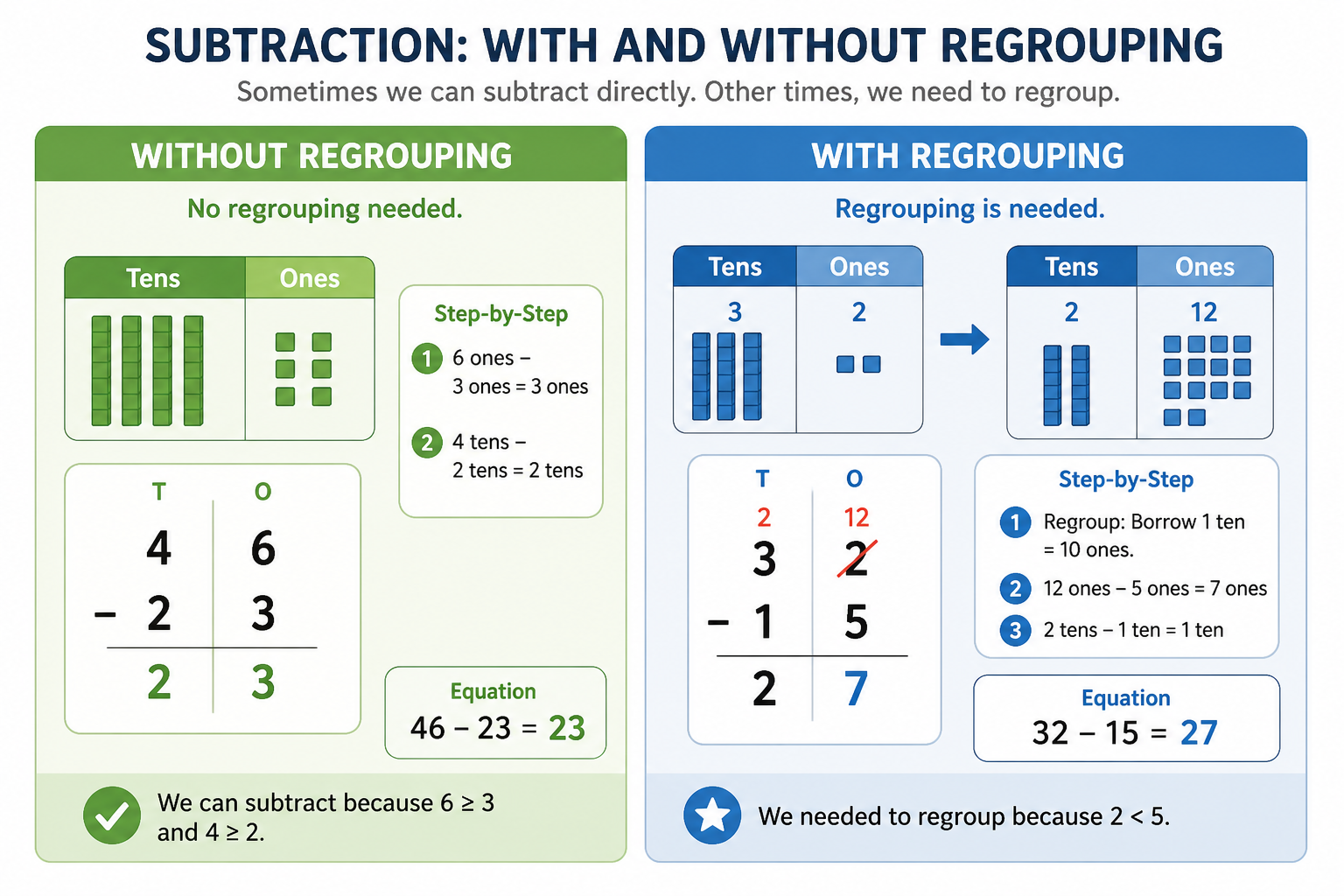
- No regrouping: 58 − 23 (8 ≥ 3 and 5 ≥ 2)
- Regroup ones: 52 − 27 (2 < 7, trade one ten for ten ones)
- Regroup tens: 425 − 168 (2 < 6 in tens after ones are solved)
- Regroup twice: 503 − 267 (zeros often trip students—use blocks)
What Five-Step Lesson Works?
Spread these steps across multiple days. Second graders need repetition at each stage before the next layer.
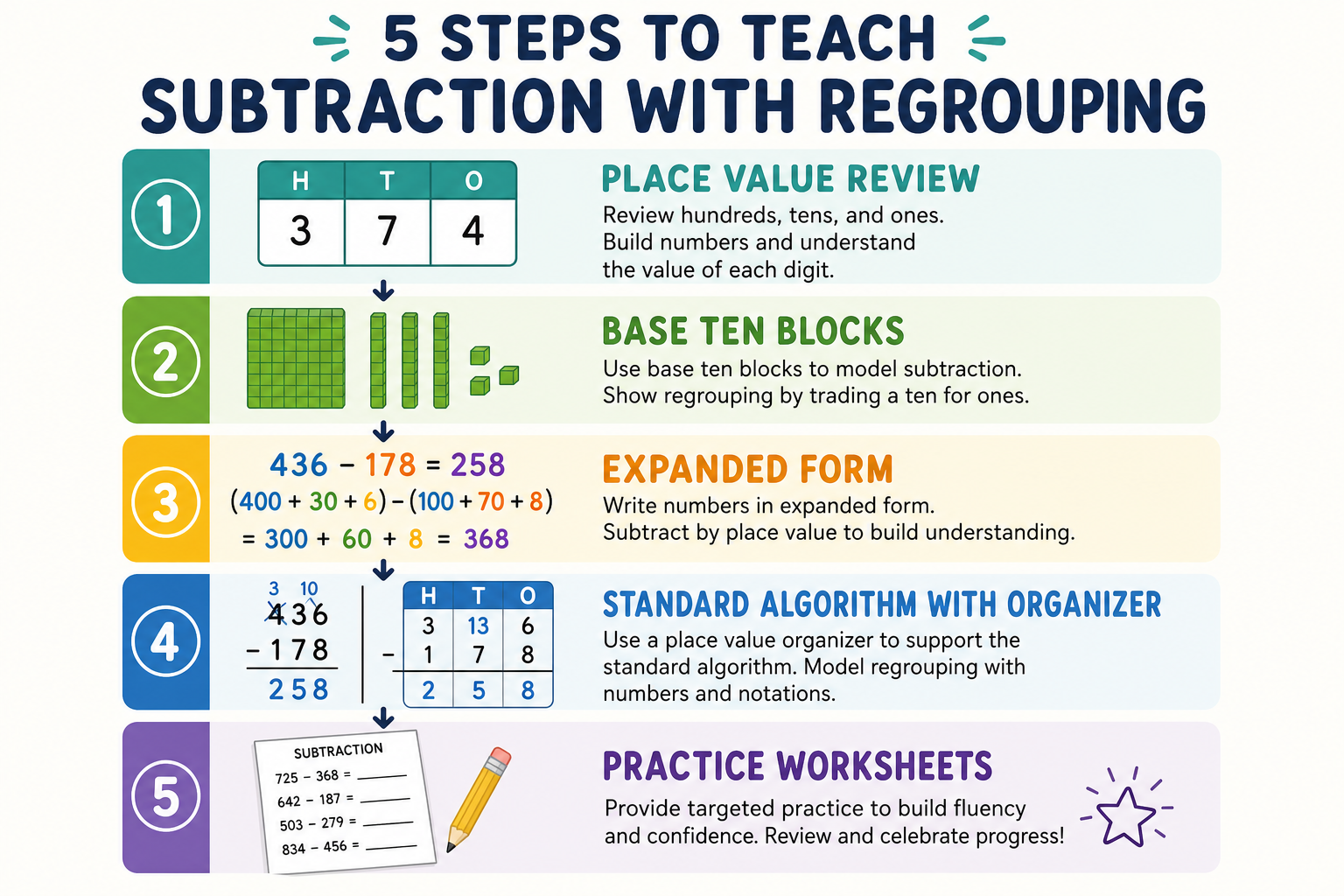
Students name tens and ones in two-digit numbers and build them with base-ten blocks. No regrouping until place value is automatic.
Practice problems like 58 − 23 where each column subtracts directly. Students learn the column layout before trades enter the picture.
For 52 − 27, build 52, trade one ten for ten ones, remove 7 ones and 2 tens. Connect the physical trade to why borrowing works.
Sketch the trade on paper or write 52 as 40 + 12 before subtracting. This bridge sits between blocks and the stacked algorithm.
Introduce the vertical format with a graphic organizer showing each regroup. Fade the organizer once students explain the trade in their own words.
After students subtract with models, have them check answers with addition—if 52 − 27 = 25, then 25 + 27 should equal 52. That habit catches errors on subtraction with regrouping worksheets.
Print regrouping practice by grade
Two-digit and three-digit subtraction with borrowing—custom problem counts, unlimited prints.
Subtraction with Regrouping WorksheetsHow Do 2-Digit and 3-Digit Subtraction Differ?
Master two-digit regrouping before adding a hundreds column. The trade logic is identical; only the number of places grows.
| Level | Example | Focus |
|---|---|---|
| 2-digit | 52 − 27 | Trade one ten for ten ones; grade 2 |
| 3-digit | 425 − 168 | Regroup across tens and hundreds; grade 3 |
| Across zeros | 503 − 267 | Chain regrouping through zero; reteach with blocks |
Third grade teachers can pair this with 3rd grade math worksheets for mixed review. Students who struggle may need addition with regrouping review too—trades work in both directions.
What Mistakes Should Teachers Watch For?
- Borrowing when subtraction works without regrouping
- Forgetting to reduce the tens digit after trading a ten
- Subtracting the smaller digit from the larger regardless of position
- Skipping the concrete and pictorial stages
- Only assigning problems that require regrouping—students stop checking first
- Calling it borrowing without explaining the trade conserves value
Struggling learners benefit from the same concrete sequence described in our special education worksheet guide: shorter pages, more models, slower pacing.
How Do Worksheets Support Practice?
Worksheets follow instruction—they do not teach regrouping alone. After a block lesson, assign five to eight problems: half requiring regrouping, half not. Generate fresh sets from the math worksheet generator or use premade 2nd grade math worksheets for spiral review.
Connect to word problems using routines from teaching word problems step by step once the written procedure is stable.
Key Takeaways
- Place value and base-ten blocks come before the stacked algorithm.
- Students check each column—regroup only when the top digit is too small.
- Use a five-step sequence: value, no-regroup, blocks, drawings, algorithm.
- Master two digits before three; zeros need extra modeling.
- Mix problem types and keep practice sessions short.
Conclusion
Teaching subtraction with regrouping works when students see the trade before they memorize the steps. Build with blocks, draw the trade, write expanded form, then introduce the algorithm with an organizer. Regrouping stops being magic and starts being place value—which is exactly what second and third graders need.
Free subtraction with regrouping worksheets
Printable 2-digit and 3-digit practice—custom or premade pages.
Subtraction with Regrouping WorksheetsRelated Articles
- Teaching Place Value with Base-Ten Blocks — foundation before regrouping
- A Parent's Guide to 2nd Grade Math — when regrouping fits the year
- How to Teach Word Problems Step by Step — apply regrouping in stories
Frequently Asked Questions
Subtraction with regrouping (sometimes called borrowing) happens when the top digit in a place value column is smaller than the bottom digit. You trade one ten for ten ones—or one hundred for ten tens—so you can subtract. Example: in 52 − 27, you cannot take 7 ones from 2 ones, so you regroup one ten into ten ones and solve as 12 − 7.