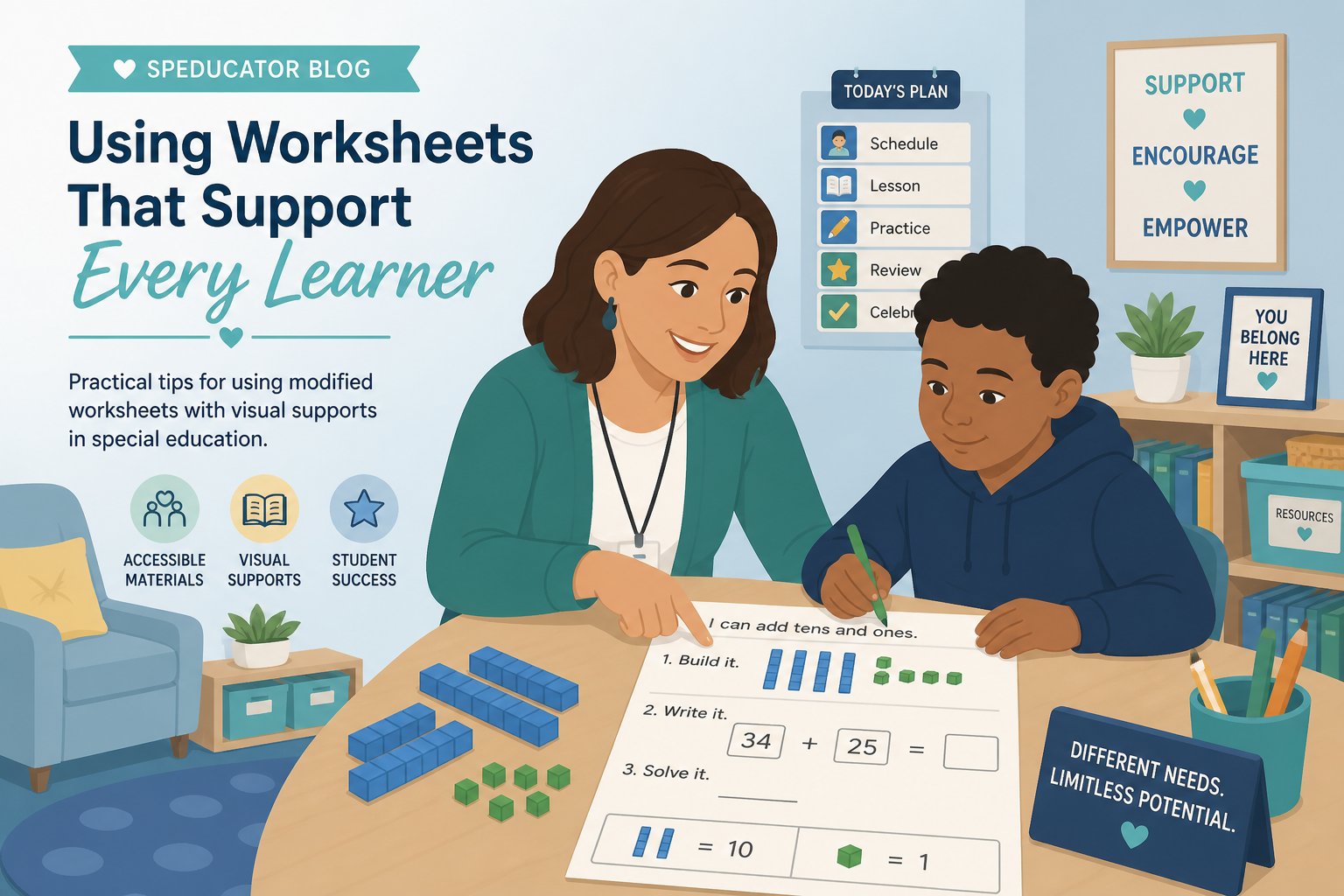
Using worksheets for special education students works when assignments are short, leveled, and matched to IEP goals—not copied from the general education packet. Accommodations like fewer problems, larger print, visual supports, and alternate response modes turn paper practice into accessible practice. This guide covers when worksheets help, IEP alignment, eight key modifications, math and tracing uses, mistakes to avoid, a weekly routine, and data collection tips.
Special educators juggle legal requirements, progress monitoring, and student engagement. Custom generators make leveled practice fast so your time goes to teaching—not reformatting every page by hand.
When Do Worksheets Help Special Education Students?
Worksheets are tools—not the curriculum. They work when the format matches the purpose: focused practice, documentation, or independent work on a mastered sub-skill.
| Use case | Example |
|---|---|
| Repeated skill practice toward an IEP goal | Five addition problems with visuals until 80% accuracy three sessions in a row |
| Documentation for progress monitoring | Dated worksheet filed in student portfolio for quarterly review |
| Independent workstation time | Known skill at a familiar format while teacher runs small group |
| Fine motor and handwriting goals | Large-font name tracing with three repetitions, not a full alphabet page |
Universal Design for Learning encourages multiple means of representation and expression. The CAST UDL Guidelines support offering paper, digital, and hands-on options for the same goal. Worksheets are one lane—not the only road.
How Do You Align Worksheets with IEP Goals?
Every worksheet should trace back to a measurable IEP objective. Before printing, ask: "Which goal does this practice?" and "Which accommodation does this student require?"
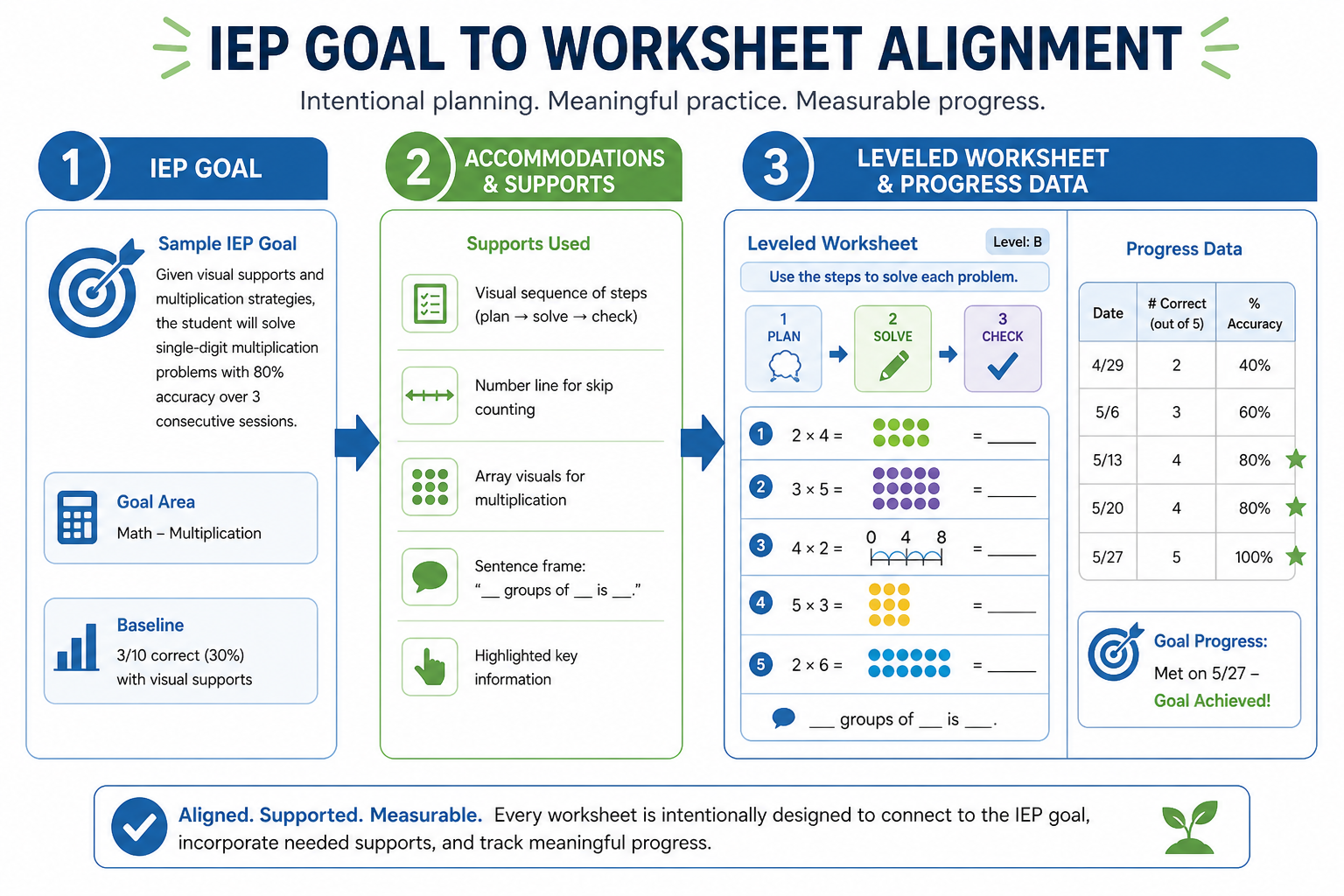
- Pull the current math or literacy goal from the IEP (e.g., add within 20 with models)
- List required accommodations (extended time, reduced items, scribe, visual supports)
- Generate or select a sheet at the student's instructional level—not grade level by default
- Apply modifications before copying—never hand a student a page and modify in the moment under pressure
- Record results against the goal, not against general education standards alone
For tiered classroom models that complement resource-room work, see our differentiation with custom worksheets guide. SPED alignment adds legal documentation on top of instructional tiers.
What Accommodations Make Worksheets Accessible?
Most modifications take two minutes when you use generators and templates. Keep a master accommodation list per student on a clipboard or digital note.
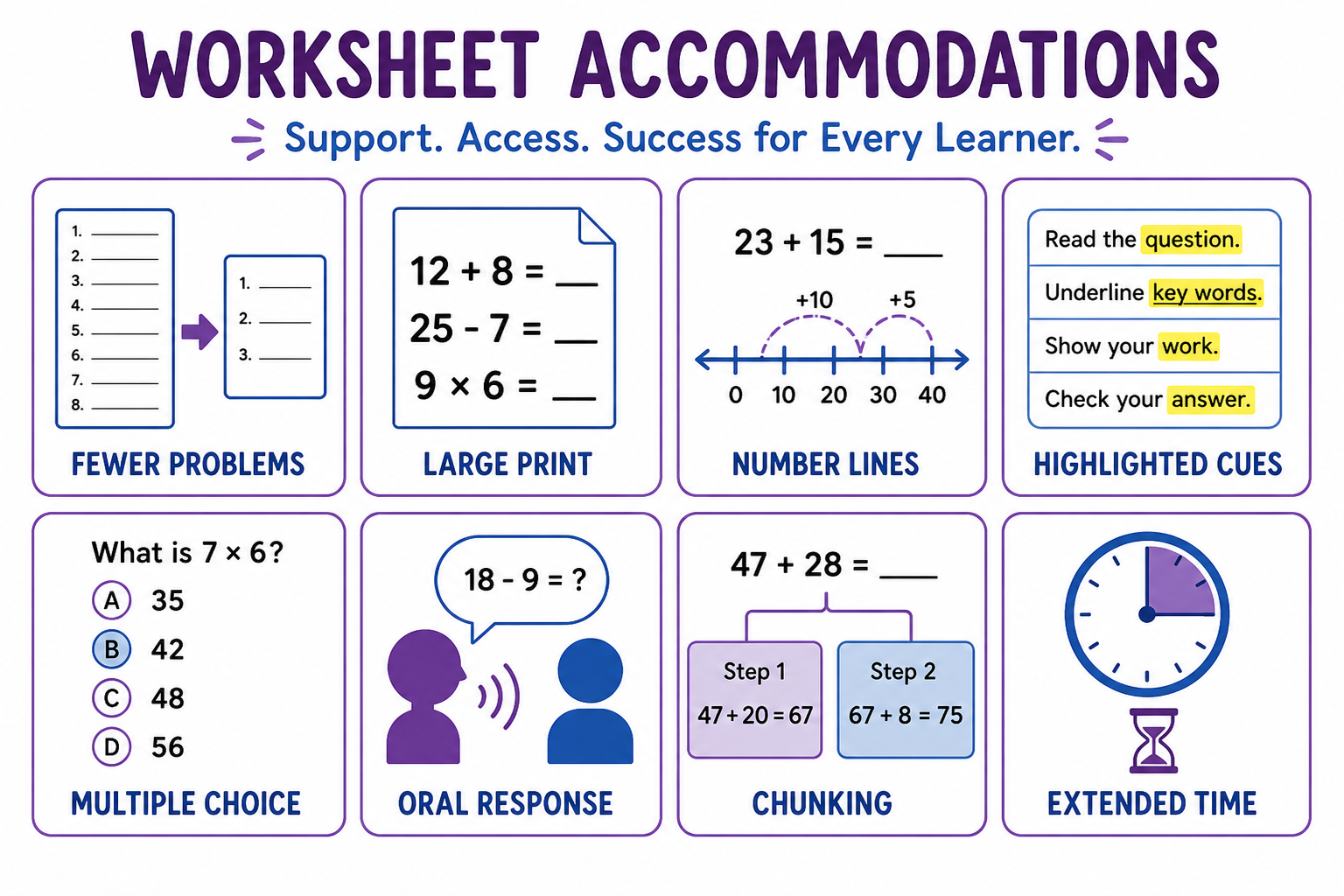
Reduce quantity
3–8 problems instead of a full page. Circle the problems the student will complete.
Increase visual supports
Embed number lines, ten frames, or fraction bars directly on the sheet.
Enlarge print and spacing
Use 14–18 pt fonts and extra line space for tracking and motor needs.
Highlight cues
Color-code operation signs, box key words in word problems, or bold the question.
Offer response choices
Multiple choice or bank of answers reduces writing load while testing reasoning.
Alternate response modes
Student points, stamps, dictates, or uses a scribe—note on IEP that mode is allowed.
Break into chunks
Cover half the page with a blank index card; reveal the next section after a break.
Extend time
No public timer. Use a visual schedule showing how many problems remain.
Students with math anxiety need the same low-pressure design described in our math anxiety guide: no public timers, private feedback, and reachable problem counts.
How Do Math and Tracing Worksheets Fit SPED?
Math worksheets support computation, word problem, and fact fluency goals when leveled correctly. Generate five problems at a student's instructional level instead of trimming a thirty-problem gen-ed sheet by hand.
Tracing worksheets support fine motor and early literacy IEP goals. Large dotted fonts, custom name or sight-word lists, and short sessions align with fine motor development research. Use the tracing generator for personalized words and the name tracing pages for ready-made options.
Create leveled SPED practice in minutes
Custom math and tracing worksheets—adjust quantity, operation, and words per student.
For kindergarten-level foundational skills, pull from kindergarten math worksheets and adapt downward rather than starting at grade-level texts that assume skills not yet secure.
What Should You Avoid?
- Identical grade-level packets for all students regardless of IEP level
- Using worksheets as the only modality for an entire block
- Grading handwriting when the IEP goal is math computation
- Public correction or reading scores aloud in front of peers
- Long sessions without movement or sensory breaks
- Introducing new content on a worksheet never previewed in instruction
The five rules in using worksheets effectively apply doubly in SPED: purposeful, short, differentiated, paired with instruction, never the only activity.
What Does a Weekly SPED Practice Routine Look Like?
Rotate modalities to maintain attention and hit multiple goals. This sample balances math computation and tracing/fine motor without worksheet overload.
| Day | Math | Tracing / motor |
|---|---|---|
| Monday | Custom 5-problem sheet at IEP level | Optional: 3 name traces |
| Tuesday | Manipulatives + 2 problems on paper | Letter of the week |
| Wednesday | Game or partner activity | Sand tray or playdough letters |
| Thursday | Word problems with visual model on page | Sight word tracing |
| Friday | Review quiz (3–5 items) for data | Student choice station |
Build confidence with strategies from helping struggling students build confidence. Celebrate completed chunks, not perfect pages.
How Do You Collect Data from Worksheet Practice?
IEP teams need trend data, not paper piles. Use worksheets as one data source among observations, quizzes, and work samples.
- Record accuracy by problem type, not just total score
- Note accommodations used each session for fidelity
- Track trends across 5–10 sessions before changing the goal
- File one sample per week—do not keep every paper
- Pair worksheet data with observation during hands-on tasks
The Individuals with Disabilities Education Act (IDEA) requires progress toward IEP goals be measured and reported. Short, dated worksheets with clear scoring keys make quarterly documentation faster.
Key Takeaways
- Worksheets work in SPED when modified and goal-aligned—not mass-distributed.
- Match accommodations to the IEP: quantity, visuals, response mode, time.
- Use custom generators for leveled math and tracing without manual reformatting.
- Rotate worksheets with manipulatives, games, and motor activities.
- Collect lean data tied to specific objectives.
Conclusion
Using worksheets for special education students is about access, not exclusion. When problems are few, supports are built in, and goals drive selection, paper practice becomes a reliable part of your toolkit. When worksheets are unchanged gen-ed copies, they frustrate students and waste instructional time.
Pick one student, pull their math goal and accommodations, and generate a five-problem sheet this week. File the result. That single cycle is the habit that makes worksheet use defensible and effective in SPED.
Free leveled worksheets for your resource room
Math and tracing generators—customize per student, print unlimited copies.
Free Math Worksheet GeneratorRelated Articles
- Differentiate Math with Custom Worksheets — three-tier model for mixed classrooms
- How to Use Worksheets Effectively — five rules for purposeful practice
- Fine Motor Skills in Early Writing — motor goals paired with tracing
Frequently Asked Questions
Worksheets can support special education when they are modified for access—not used as busy work. Short, leveled assignments with visual supports, reduced problem counts, and clear layouts help students practice IEP goals. Pair paper practice with manipulatives, oral responses, and movement breaks. Avoid long packets that overwhelm focus or fine motor stamina.