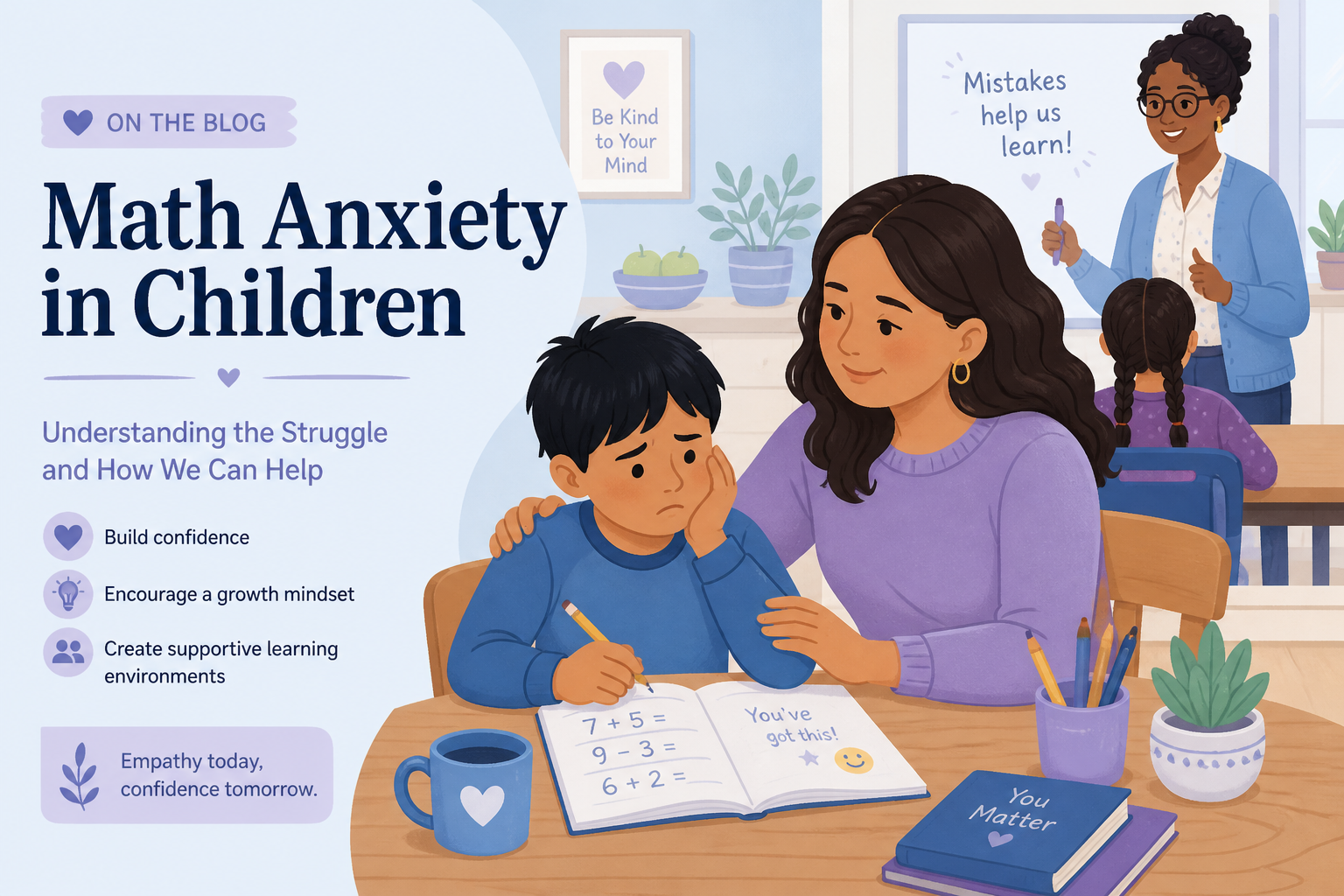
Math anxiety in children is an emotional response to numbers—not low ability. Kids with math anxiety may know skills but freeze during tests, cry over homework, or call themselves "bad at math" before trying. Common causes include timed pressure, public comparison, skill gaps, and fixed-mindset language. This guide covers signs, root causes, seven parent solutions, classroom strategies, language shifts, and when to seek professional support.
Anxiety and ability are different problems. Fixing anxiety often starts with lower pressure and targeted skill repair—not more worksheets piled on an already stressed child.
What Is Math Anxiety in Children?
Math anxiety is a feeling of tension and fear that interferes with solving math problems. Researchers describe it as separate from general anxiety and sometimes separate from actual math skill—a child can understand a concept at the kitchen table and blank on the same problem during a test.
The American Psychological Association notes that performance anxiety activates stress responses that reduce working memory—the mental scratch pad needed for multi-step math. That is why anxious children look like they "forgot everything" under pressure even when they knew it yesterday.
Math anxiety is not a character flaw. It is a learned response to repeated negative experiences. With the right environment, most elementary students can rebuild confidence over weeks and months.
What Causes Math Anxiety?
Pinpointing causes helps you remove triggers instead of only treating symptoms. Often several factors stack together.
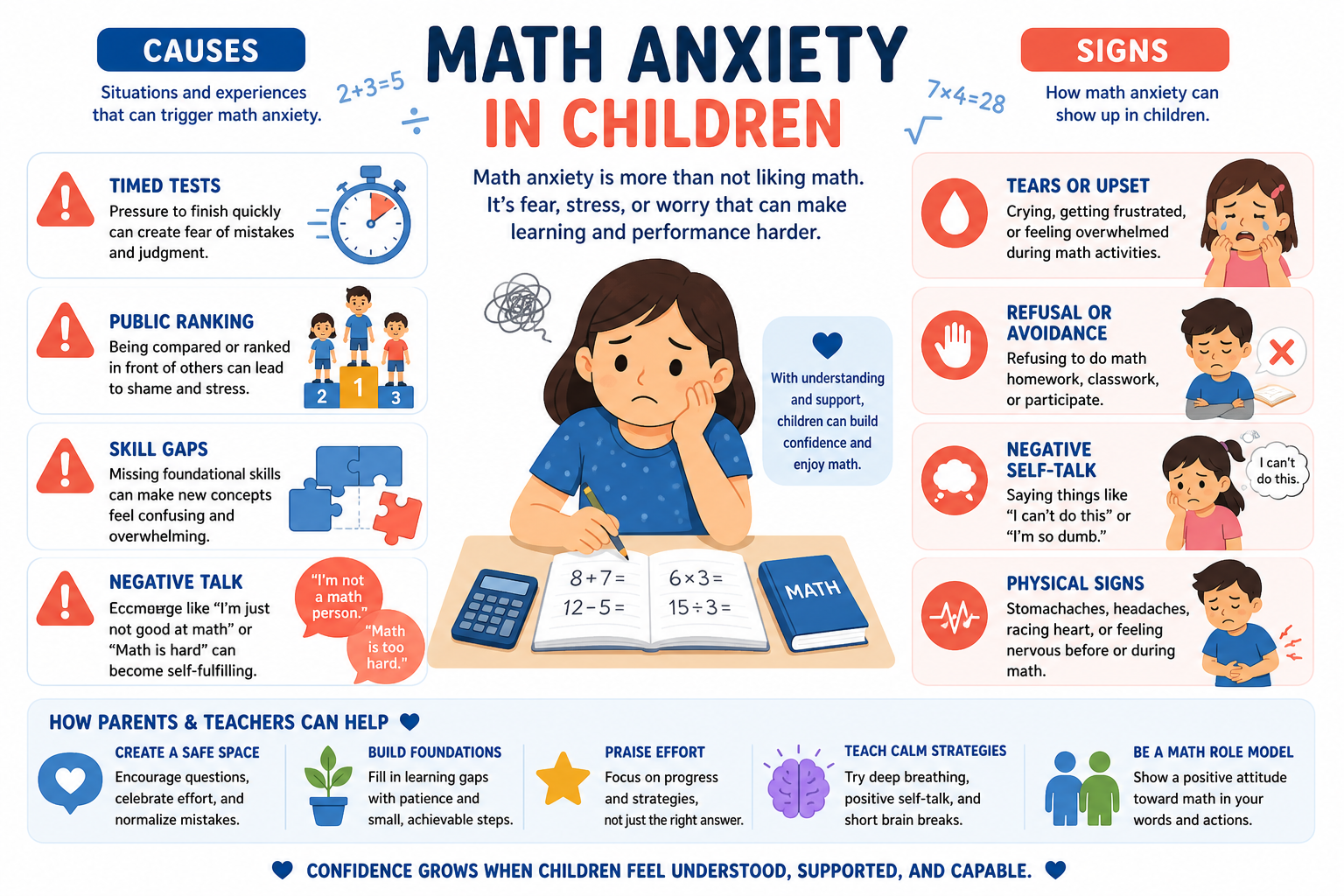
Timed tests without skill readiness
Speed drills before facts are solid teach children that math is a race—and they are losing.
Public comparison
Reading scores aloud, star charts, or sibling comparisons link math performance to shame.
Skill gaps left unaddressed
A student shaky on addition cannot relax during multiplication. Gaps feel like personal failure.
Fixed-mindset messages
"I'm not a math person" from adults gives children permission to quit before trying.
High-stakes testing pressure
Weeks of test talk without coping strategies turn assessments into threats.
Embarrassing public moments
Being stuck at the board or corrected harshly in front of peers can create lasting avoidance.
Test season amplifies existing anxiety. Our elementary test prep guide and state assessment prep plan emphasize format familiarity and calm routines—not fear-based cramming.
What Signs Should Parents and Teachers Watch For?
Some children say they hate math outright. Others go quiet. Watch for patterns across home and school—not one bad night after a hard lesson.
- Physical symptoms before math: headaches, stomach aches, tears
- Refusing homework or claiming there is no math assignment
- Shutdown during class—blank stare, won't raise hand
- Negative self-talk: "I'm stupid at math" or "I can't do this"
- Sudden anger or meltdowns when a parent tries to help
- Strong performance in reading or art but sharp math decline
Teachers: note whether the student participates in small groups but freezes whole class. That pattern suggests anxiety, not lack of knowledge. Pair observation with private conferences before assuming laziness.
What Can Parents Do at Home?
Home is where many children feel safe enough to rebuild. These seven approaches reduce pressure while skills catch up.
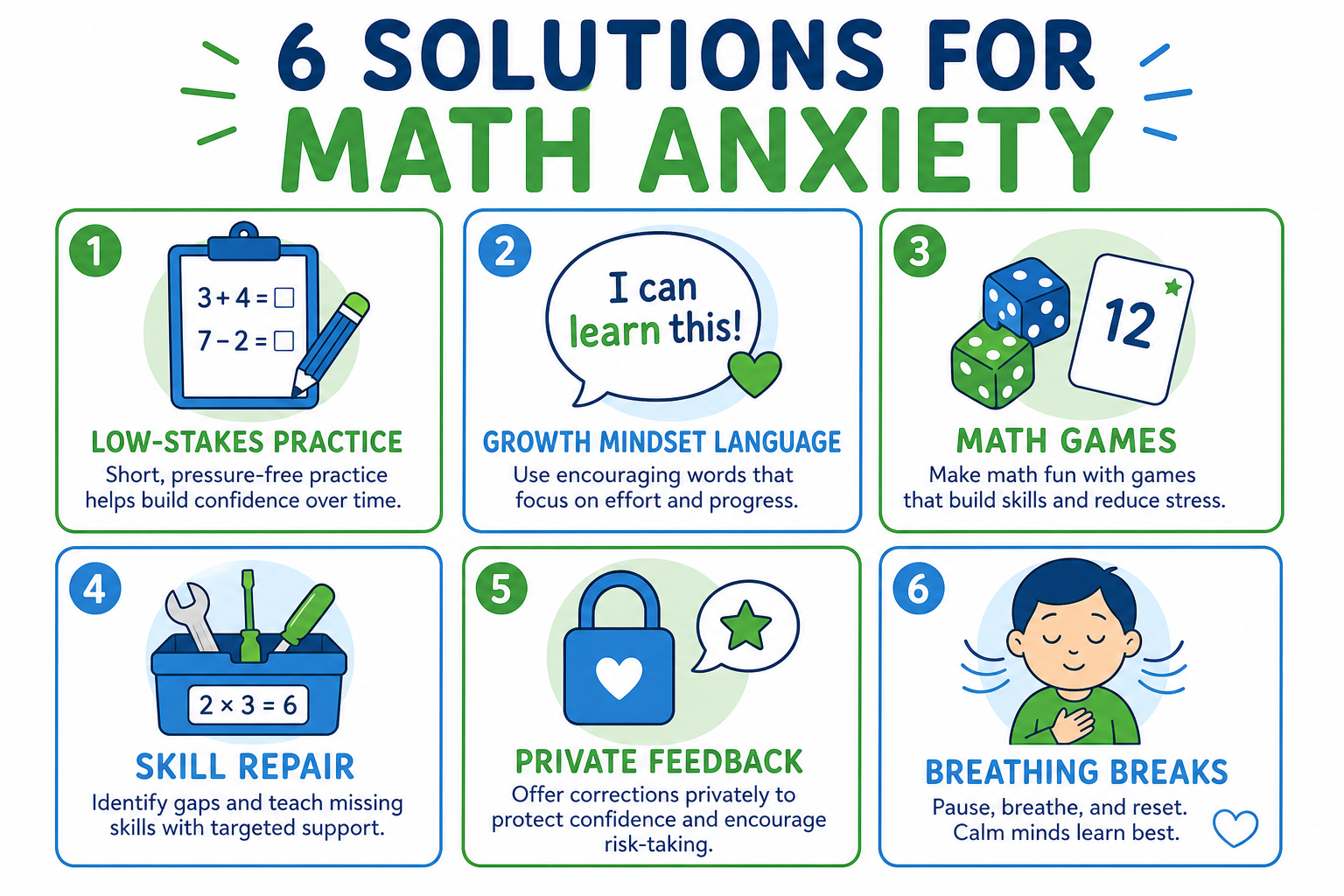
1. Lower the stakes at home
Practice with no timer, no grade, and no audience. A kitchen table session is not a test.
2. Use the coaching method
Ask "What is the problem asking?" and "What do you already know?" instead of fixing answers.
Read our math homework coaching guide.
3. Repair one skill at a time
Identify the gap—facts, place value, word problems—and practice only that until confidence returns.
4. Gamify practice
Dice, cards, and movement games reduce fear. Pair play with optional short worksheets.
Read our fun math practice at home.
5. Build fact fluency gently
Ten minutes of daily facts with flash cards or charts beats one traumatic timed test.
Read our daily math fact routine.
6. Name the feeling, not the label
Say "This feels hard right now" instead of "You're anxious." Feelings pass; labels stick.
7. Celebrate strategy, not speed
Praise a good diagram, a corrected mistake, or explaining aloud—even when the final answer is wrong.
Low-stakes practice tools for anxious learners
Generate short, leveled worksheets and quizzes—no timer required.
What Strategies Work in the Classroom?
Classroom culture either feeds or reduces math anxiety. Small routine changes help every student—not only those who speak up about fear.
- Start class with a low-stakes warm-up—not a graded quiz
- Offer private response options: whiteboards, sticky notes, or digital polls
- Use growth-minded feedback: "Your strategy improved" not "Wrong again"
- Differentiate practice so anxious students get reachable problems
- Teach breathing or stretch breaks before tests
- Never rank scores publicly; track growth in private conferences
- Pair anxious students with patient partners for games, not timed races
For deeper intervention strategies, see helping struggling math students build confidence and differentiated math worksheets. Anxious students need reachable entry points, not harder problems to "push" them.
The National Council of Teachers of Mathematics promotes productive struggle in supportive environments—challenge without humiliation.
How Should You Change Math Talk?
Children absorb adult attitudes. One offhand "I was never good at math" can license years of avoidance. Swap fixed labels for process praise.
| Try this | Avoid this |
|---|---|
| Say: "Let's figure this out together" | Avoid: "This is easy—you should know this" |
| Say: "Mistakes help your brain grow" | Avoid: "I can't believe you missed that again" |
| Say: "You're working hard on this skill" | Avoid: "You're just not a math kid" |
| Say: "What strategy could you try next?" | Avoid: "Why don't you get it?" |
Model curiosity: "I am not sure—let's look it up together." That teaches problem solving better than pretending adults never struggle with numbers.
When Should You Seek Professional Help?
Most math anxiety improves with consistent low-pressure support. Contact your school counselor or pediatrician if you notice:
- Sleep loss or frequent nightmares about school or tests
- Refusal to attend school on math test days
- Physical symptoms that persist beyond math time
- Withdrawal from activities the child used to enjoy
- Self-harm comments or severe mood changes
A counselor can teach coping strategies while you continue skill practice at home. Math tutoring alone rarely fixes anxiety if emotional barriers stay unaddressed.
Align home practice with your school's homework policy expectations so anxious children are not doing double the assigned load at the kitchen table.
Key Takeaways
- Math anxiety is emotional, not a permanent ability limit.
- Timed tests, public ranking, and negative talk are common triggers.
- Lower stakes, repair skill gaps, and praise strategy at home and school.
- Change math language—growth mindset reduces fear over time.
- Seek counseling if anxiety affects health, attendance, or mood.
Conclusion
Math anxiety in children grows from experience, not destiny. When adults remove shame, assign reachable practice, and celebrate effort, most students attempt math again instead of avoiding it. Start with one low-stakes game this week and one language shift at the dinner table—you do not need a perfect plan to make math feel safer.
If your child melted down over homework last night, pause the worksheet. Ask what felt hard, fix one small skill together tomorrow, and try again without a timer. Safety comes before speed.
Gentle practice for building math confidence
Short custom worksheets and quizzes—leveled, printable, no signup required.
Free Math Worksheet GeneratorRelated Articles
- Helping Struggling Math Students Build Confidence — seven classroom and home strategies
- How to Help Your Child with Math Homework — coach without doing the work
- Test Prep Strategies for Elementary Students — reduce test-day panic
Frequently Asked Questions
Common signs include refusing to start math homework, tears or anger during math class, saying "I'm bad at math," rapid heartbeat or stomach aches before tests, and avoiding participation even when they know answers. Younger children may hide worksheets or claim they have no math homework. Watch for sudden drops in math grades paired with emotional distress.