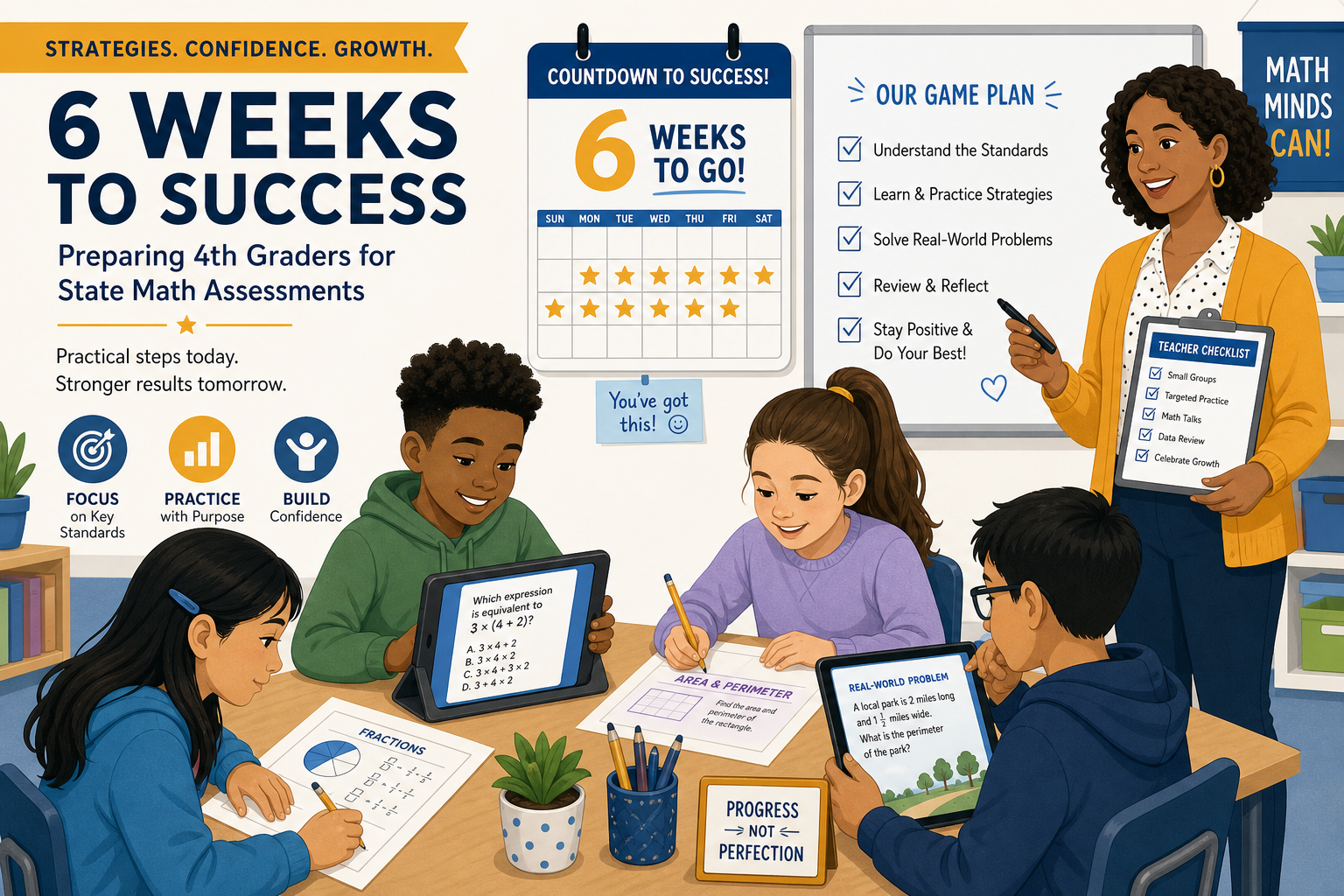
Preparing for state math assessments works best with a six-week countdown: map standards to gaps, reteach weak strands, practice test formats, build pacing stamina, then ease into test week with light review and confidence routines. State tests measure breadth across the year, not just the current unit. This guide covers what assessments typically include, a week-by-week plan, grade-level skill priorities, teacher and parent roles, and free practice tools.
State math assessments differ by state, but elementary tests share the same goal: can students apply grade-level math in mixed contexts? Smart prep reviews old skills on a schedule instead of cramming the week before.
What Do State Math Assessments Cover?
Most state math tests align with college- and career-ready standards. Third through fifth graders see a mix of computation, reasoning, and applied problems—not isolated fact drills. Typical strands include operations, fractions and decimals, measurement, geometry, and data.
Word problems and multi-step items carry heavy weight. Students who only practice naked equations often struggle on state tests even when their classwork grades are strong. Pair computation review with word problem routines so story context does not surprise them on test day.
Download your state's assessment blueprint or released items when available. The Common Core math standards provide a useful cross-state map if your district follows them. Our grade-by-grade standards guide translates those expectations into parent-friendly language.
What Does a Six-Week Countdown Plan Look Like?
A six-week plan gives you time to reteach without panic. It extends the four-week model from our elementary test prep strategies article with two extra weeks for gap analysis and format introduction.
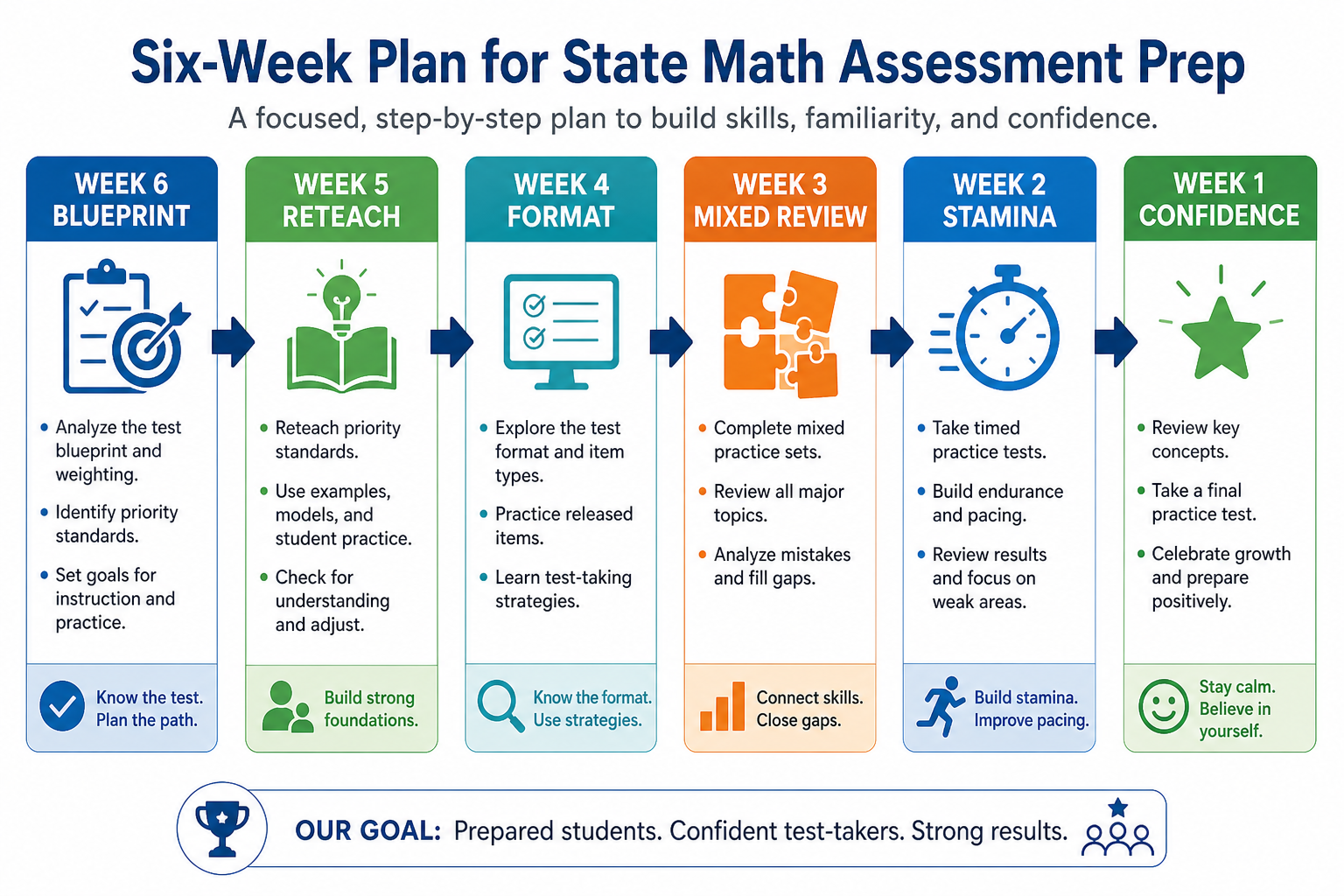
| Week | Focus | Action |
|---|---|---|
| Week 6 — Blueprint review | Map standards to units taught; list gaps from winter data | Assign one spiral worksheet per strand; note class-wide weak spots |
| Week 5 — Targeted reteach | Reteach top two gap areas with visual models | Small groups for fractions, word problems, or multi-digit ops as needed |
| Week 4 — Format introduction | Multiple-choice, drag-and-drop, or open response layouts | One practice quiz; review directions aloud as a class |
| Week 3 — Mixed review | Interleaved problems across all strands | Custom worksheets by tier; games for fact fluency |
| Week 2 — Timed stamina | Pacing, skip-and-return, show-your-work habits | Half-length practice set; partner error analysis |
| Week 1 — Confidence and rest | Light review only; routines and mindset | Two short warm-ups; no new content; normal sleep reminders |
Space review across strands using spaced repetition principles. Revisit addition and fractions in the same week so memory stays fresh for mixed state test forms.
Which Skills Should Each Grade Prioritize?
Not every standard gets equal weight on state tests. Focus prep time on high-impact skills that appear often and connect to multiple strands.
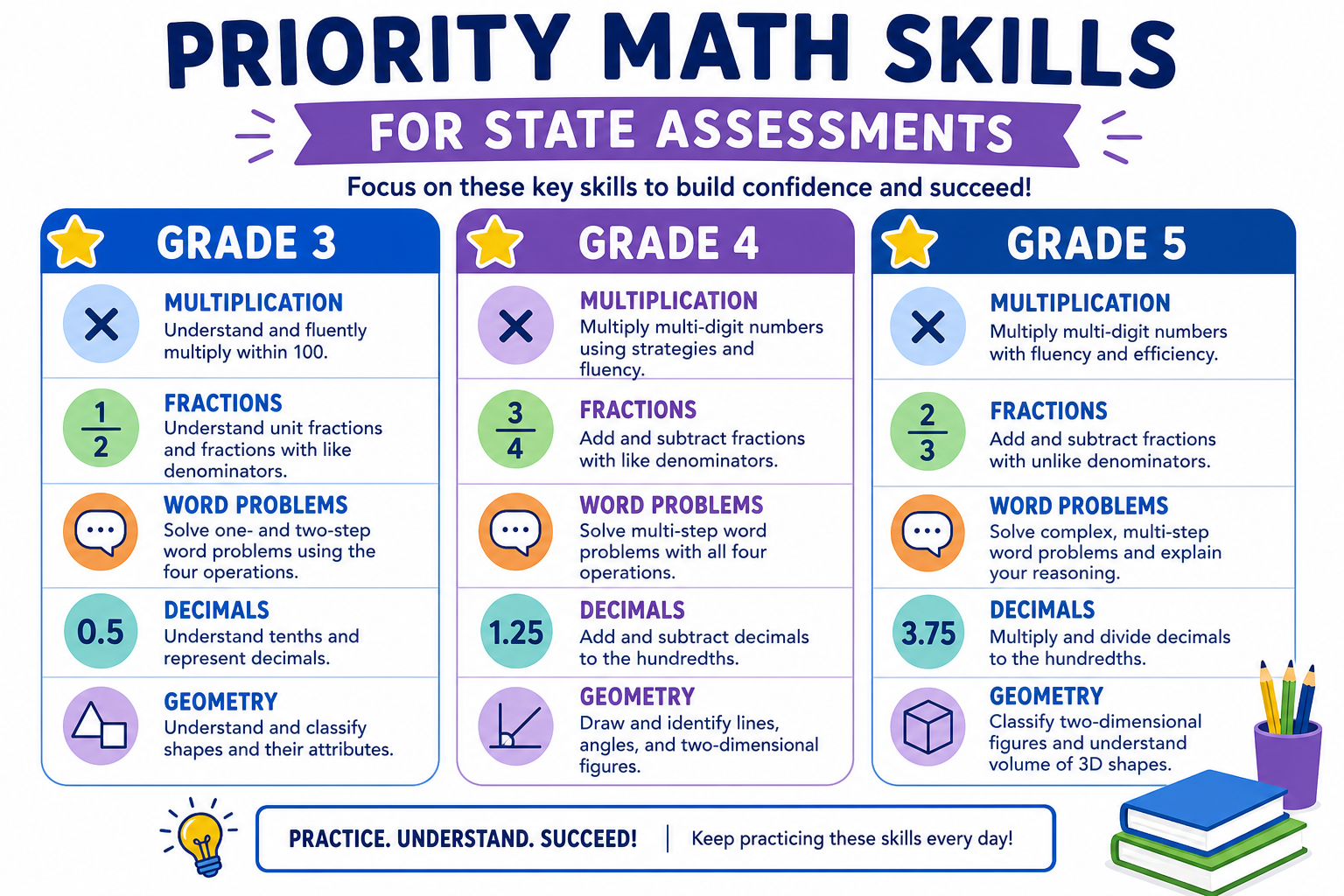
Grade 3
Multiplication/division facts, area, fractions on number line, two-step word problems
3rd grade math worksheets — free printables aligned to common state expectations
Grade 4
Multi-digit multiplication, equivalent fractions, decimals intro, angles, measurement conversion
4th grade math worksheets — free printables aligned to common state expectations
Grade 5
Fraction operations, decimal place value, volume, coordinate grids, multi-step reasoning
5th grade math worksheets — free printables aligned to common state expectations
Grade 4 students should also review fourth grade math topics for year-long pacing. Grade 3 classes benefit from multiplication worksheets and flash cards for fact fluency under time pressure.
Build state-test practice sets by grade and operation
Generate mixed review worksheets and auto-graded quizzes in minutes.
How Do You Practice Format and Pacing?
State tests use layouts students may not see in daily homework: longer passages, technology-enhanced items, or strict time blocks. Introduce those formats in week 4 so content review and layout practice happen together.
- Multiple-choice: Teach elimination and estimation before calculating every option.
- Show your work: Require scratch-paper models on practice sets even when answers are bubbled.
- Multi-step items: Label part A and part B answers clearly; state tests often chain questions.
- Pacing: In week 2, students note the time at question 5, 10, and 15 to learn their rhythm.
The National Council of Teachers of Mathematics recommends balancing procedural fluency with reasoning. State tests reward both—students need fast facts and the ability to explain why an answer makes sense.
What Should Teachers Do Before Test Week?
Logistics reduce stress as much as content review. Use this checklist in the two weeks before your state window opens.
- Print or bookmark released state items for your grade (if available)
- Post a one-page test-day schedule: bathroom, snacks, breaks
- Prepare accommodation packets for IEP/504 students
- Send a calm parent letter with dates, sleep tips, and what not to drill
- Plan a normal lesson after testing each day—avoid all-day test talk
- Schedule one fun math activity for the week after testing ends
Differentiate last-minute review with tiered custom worksheets so advanced students get challenge sets while others close specific gaps. Track private growth data for students who need confidence-building support.
How Can Parents Support at Home?
Parents do not need to reteach the curriculum. Short, calm practice and normal routines matter more than extra hours of drilling.
- Run 15-minute sessions three times per week in the month before testing
- Ask "how did you know?" instead of only checking the final number
- Use free quizzes for format practice; use worksheets for show-your-work items
- Keep bedtimes steady the week of the test
- Avoid comparing scores to classmates or siblings
Daily fact practice at home supports state test stamina. See benefits of daily math fact practice for a simple 10-minute routine that fits busy evenings.
What Helps on Test Day?
Share these student-facing tips the morning of each math session. Post them in the classroom during the final week of practice so language feels familiar.
- Eat breakfast and bring a water bottle if allowed
- Read every question stem before looking at answer choices
- Show work on scratch paper even for multiple-choice items
- Skip hard questions and return with time left
- Check that the answer fits the units in the story problem
- Take a quiet breath if you feel stuck—one problem at a time
Key Takeaways
- Start a six-week countdown with gap analysis, not last-minute cramming.
- State tests mix strands—spiral review beats single-topic marathons.
- Practice test formats and pacing in weeks 4 and 2.
- Prioritize grade-level skills: operations, fractions, measurement, word problems.
- Protect confidence, sleep, and normal routines in the final week.
Conclusion
Preparing for state math assessments is a pacing problem as much as a content problem. Map standards to gaps early, reteach with models, introduce test formats before you add time pressure, and end with light review and steady routines. When students have seen mixed skills, story problems, and realistic layouts before test week, they walk in ready to show what they already know.
Block six weeks on your calendar today, print one spiral review set for next Monday, and bookmark released state items for your grade. Small consistent steps beat a stressful final sprint every time.
Free practice for state math test season
Custom worksheets and quizzes by grade. Print or assign unlimited copies.
Free Math Worksheet GeneratorRelated Articles
- Test Prep Strategies for Elementary Students — four-week plan and test-taking skills
- How to Teach Word Problems Step by Step — story problems on every state test
- A Complete Guide to 4th Grade Math Topics — year-long skills map for grade 4
Frequently Asked Questions
Begin structured review six weeks before the test window, with light spiral practice starting earlier in the spring. The final four weeks should focus on format practice, pacing, and targeted skill gaps. Avoid cramming new content in the last week—use that time for confidence-building review and rest.