To use a multiplication chart effectively, teach students to find products by matching a row and column, then practice recall with blank charts and cover-and-check drills. Charts are learning tools, not permanent answer keys. The look-say-recall loop builds fluency: find the fact, say the full equation aloud, cover the chart, and repeat from memory.
Multiplication charts hang in almost every elementary classroom, but many students use them only as a lookup table. That misses the real value. Charts reveal patterns, support self-checking, and bridge the gap between counting and memorized facts. This guide covers how to read a chart, five classroom activities, filled versus blank charts, common mistakes, and free printable resources.
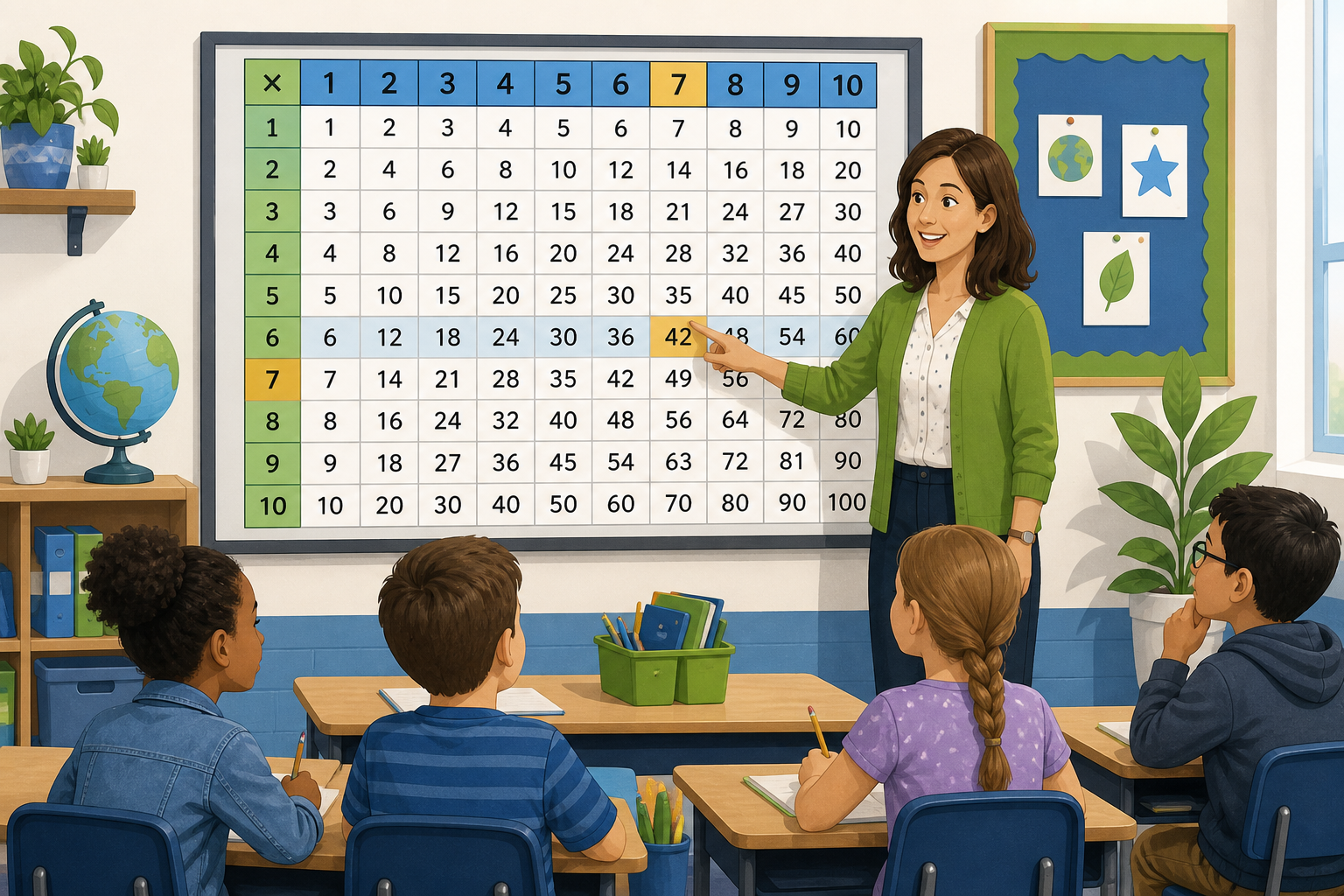
What Is a Multiplication Chart?
A multiplication chart is a grid showing products from 1 x 1 through 10 x 10 or 12 x 12. One factor runs along the top row, another down the left column, and each cell shows what you get when you multiply them.
The National Council of Teachers of Mathematics emphasizes that multiplication fluency grows from understanding patterns and relationships between numbers. Charts make those patterns visible. Our guide to when kids learn times tables covers grade-level timing for chart use.
How Do You Read a Multiplication Chart?
Reading a chart takes three steps: find the first factor, find the second factor, read the intersection. Because multiplication is commutative, order does not matter. 6 x 7 and 7 x 6 both land on 42.
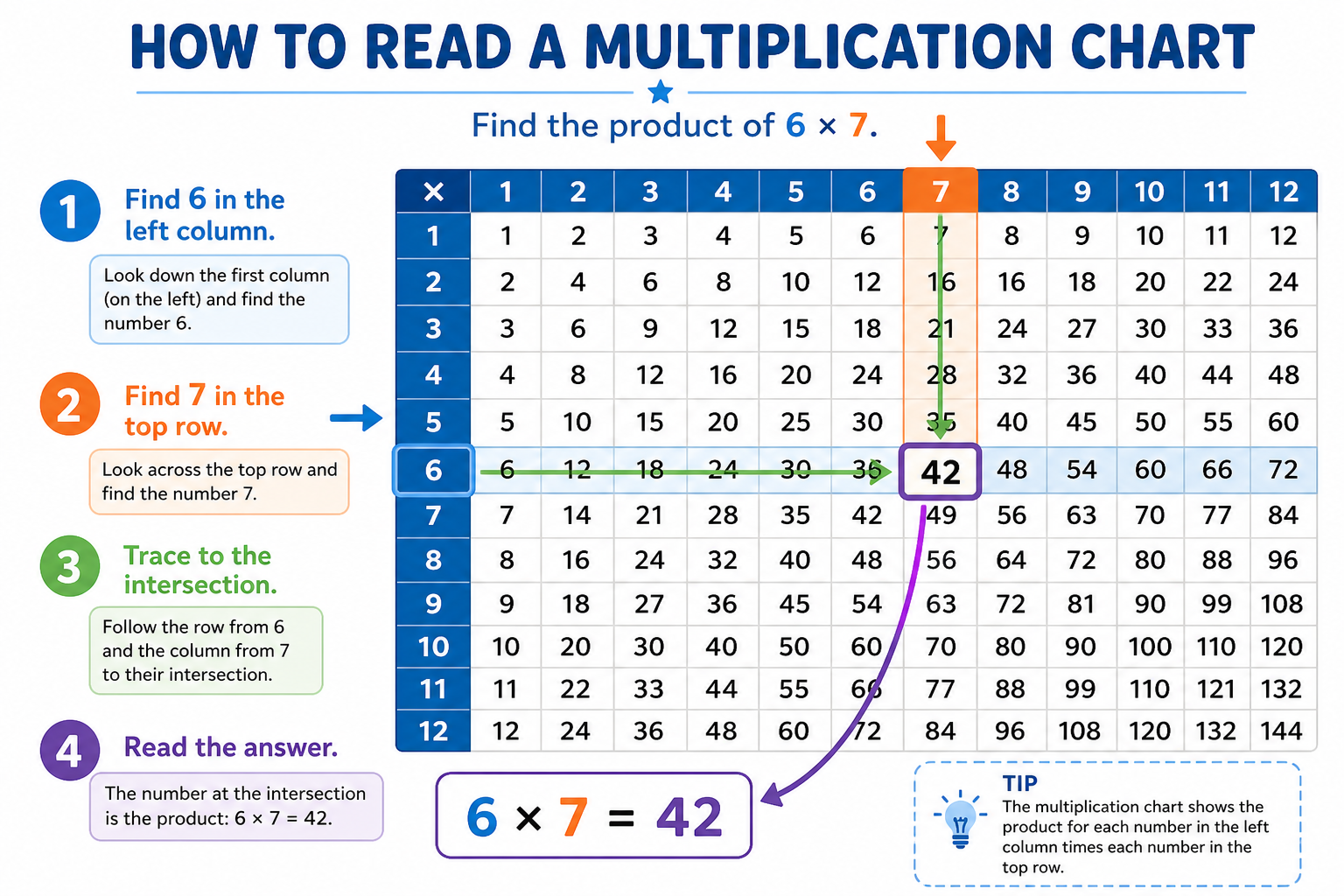
- Find the first number in the left column (or top row)
- Find the second number in the top row (or left column)
- Trace across and down to the cell where they meet
- Say the full equation: "Six times seven equals forty-two"
What Five Activities Build Fluency?
Move beyond passive lookup. These activities use the chart as a teaching tool that builds toward memory.
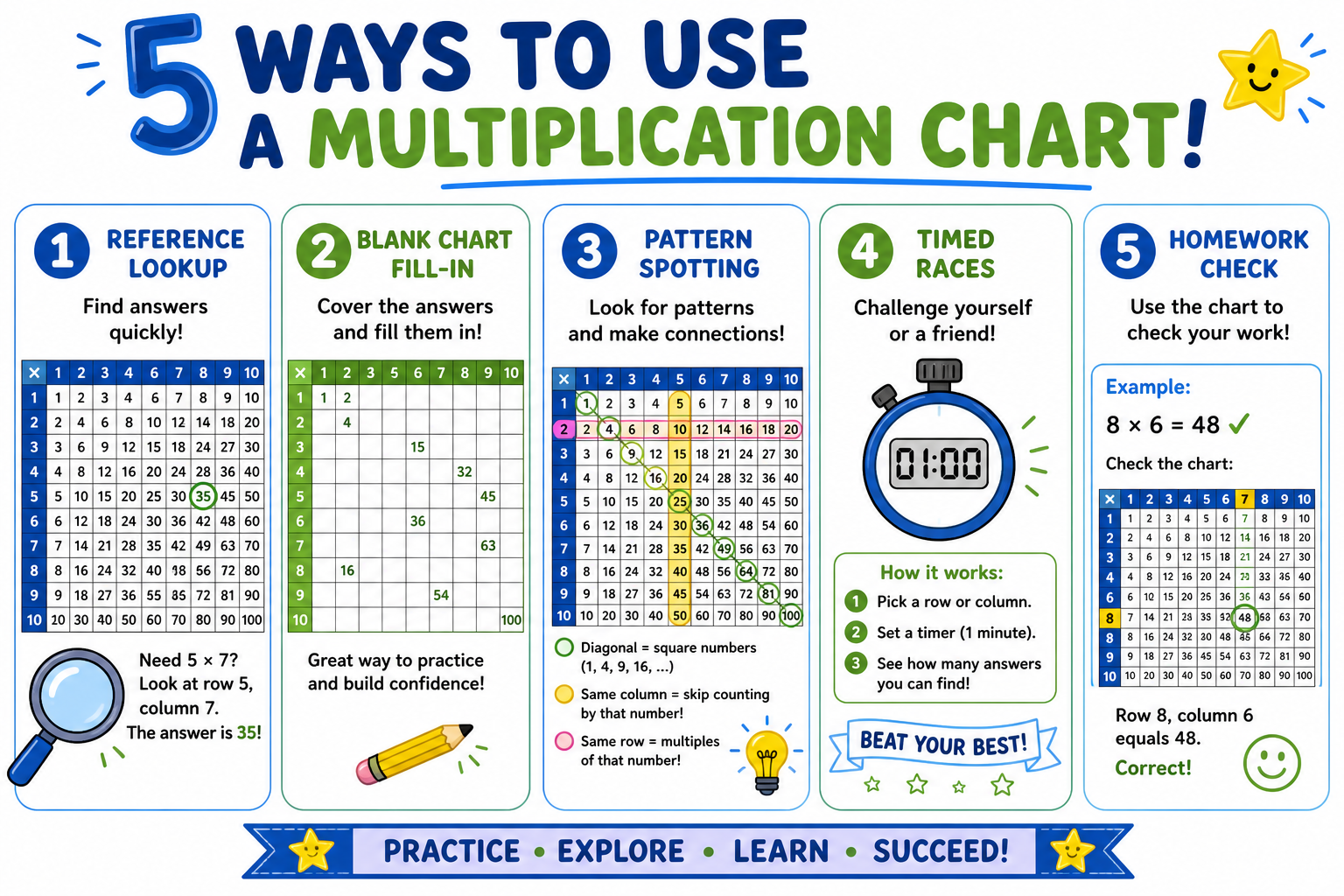
Student finds 6 x 7 on the chart, says 'six times seven equals forty-two,' then covers the chart and repeats from memory. Check immediately.
Print a chart with headers but empty cells. Set a five-minute timer. Students fill in as many products as they can, then check against a filled chart.
Shade all multiples of 2, 5, or 10 on the chart. Students notice that products of 5 end in 0 or 5 and products of 10 always end in 0.
Hide the 8 times row with paper. Students write all eight products from memory, then uncover to check. Focus tomorrow on missed facts.
Students attempt every problem first. Only after trying do they use the chart to verify. No lookup before effort.
Print free multiplication charts
Filled reference charts and blank practice grids—1–12 and 1–100 formats.
Printable Multiplication ChartWhen Use Filled vs Blank Charts?
Filled charts are reference tools for learning and checking. Blank charts are practice tools for building memory. Use both at different stages.
| Chart type | Best for | When to use |
|---|---|---|
| Filled 10x10 | Grades 2–3, core facts | Wall reference, pattern exploration |
| Filled 12x12 | Grades 3–4, full tables | Homework desk reference |
| Blank chart | Recall practice | Daily five-minute fill-in drills |
| 1–100 chart | Advanced pattern work | Grades 4–5 extension |
Print a multiplication chart 1–100 for older students or a blank multiplication chart for daily recall practice.
What Mistakes Should Teachers Watch For?
- Letting students use the chart as a permanent crutch without recall practice
- Looking up answers before attempting from memory
- Only reading the product without saying the full equation aloud
- Skipping pattern activities that build number sense
- Using a 12x12 chart before students master 1-10 facts
- Not posting a chart where students can self-check during independent work
Pair chart work with teaching multiplication to 3rd graders so students understand what the numbers mean, not just where to find them.
How Do Worksheets Support Practice?
Charts and worksheets work together. Post a filled chart for reference, then assign fact practice from 3rd grade multiplication worksheets or multiplication flash cards. Generate custom drills from the math worksheet generator.
Run classroom challenges using ideas from creating a math facts challenge once students can fill a blank chart with reasonable speed.
Key Takeaways
- Read products at row-column intersections on the chart grid.
- Use look-say-recall: find, say the equation, cover, repeat from memory.
- Blank charts build recall; filled charts support checking and patterns.
- Shade multiples to spot patterns in 2s, 5s, and 10s.
- Fade chart use as fluency grows—attempt before lookup.
Conclusion
A multiplication chart is more than a cheat sheet. It teaches patterns, supports self-checking, and bridges the path to memorized facts. Use filled charts for reference, blank charts for practice, and the look-say-recall loop daily. Students who learn to use the chart well eventually outgrow it.
Free printable multiplication charts
Filled and blank charts in 1–12 and 1–100 formats—ready to print.
Free Printable Multiplication ChartRelated Articles
- When Should Kids Learn Their Times Tables? — grade-level timing for chart use
- How to Teach Multiplication to 3rd Graders — meaning before chart lookup
- The Benefits of Daily Math Fact Practice — build a daily facts routine
Frequently Asked Questions
A multiplication chart (also called a times table grid) is a table that shows products of numbers from 1 to 10 or 1 to 12. Find one factor in the top row and one in the left column, then read the answer where the row and column meet. For example, row 6 and column 7 intersect at 42.