A math facts challenge gives daily fluency practice a clear goal, visible progress, and a fun finish line. Pick facts by grade, run the challenge for two to four weeks, track personal growth instead of public rankings, and use quizzes, games, and worksheets for five- to ten-minute daily sessions. End with a team celebration when the class hits its shared goal.
Fact drills alone can feel boring. A challenge adds structure without turning math into a stress event. This guide covers why challenges work, four setup steps, four engaging formats, a ready-to-use four-week plan, differentiation tips, tools, and mistakes to avoid.

Why Do Math Facts Challenges Work?
Challenges turn repetition into a shared mission. Students know what they are working toward, see progress on a chart, and get a defined end date. That structure boosts engagement more than an open-ended directive to practice facts every day.
Fluency still requires short, consistent practice—the benefits are explained in our daily math fact practice guide. A challenge wraps that routine in goals and celebration. The NCTM Principles and Standards support fluency built on conceptual understanding—teach what multiplication means before the challenge week, not after.
What Four Steps Set Up a Challenge?
You can launch a classroom challenge in one planning period. Follow these four steps in order.
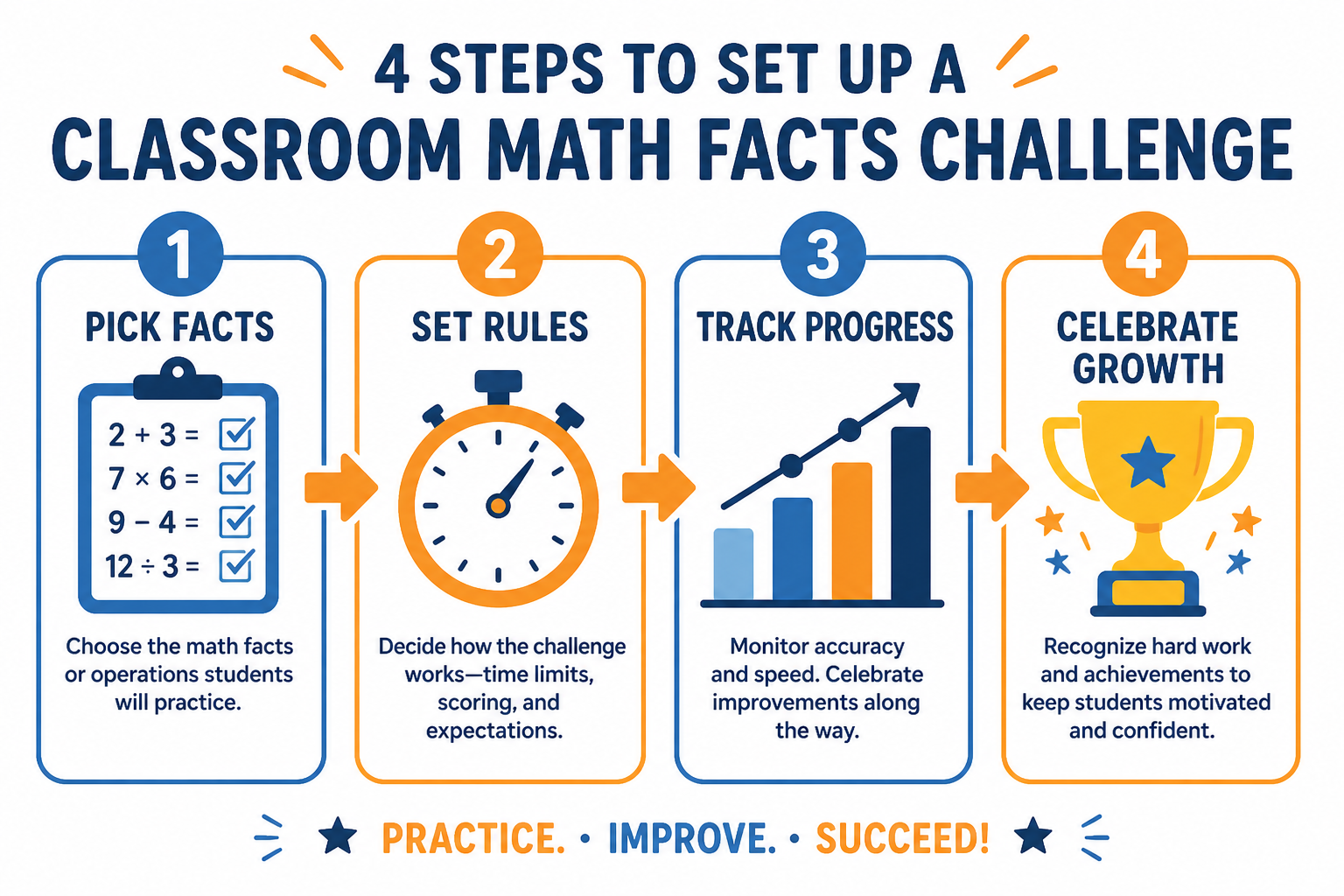
Choose one operation per week or a mixed review in week four. Match facts to grade: addition within 20 for grade 1–2, multiplication through 10 × 10 for grade 3.
Define daily time (5–10 min), how progress is tracked, and what counts as mastery (e.g., 18/20 correct twice in a row). Post rules on the board day one.
Use individual sticker charts, team thermometers, or digital tallies. Update every Friday. Emphasize growth from personal baseline, not speed rankings.
End with a class celebration when the team goal is met. Hand out certificates for most improved, perfect attendance, and fact mastery—not only top scores.
Which Challenge Formats Engage Students?
Pick one format and stay consistent for the full challenge. Rotate formats next quarter to keep novelty high.
Each week climbs a new set: week 1 doubles, week 2 fives, week 3 nines, week 4 mixed. Students earn a rung on a hallway chart for each passed quiz.
Best for: Grade 2–3 multiplication launch
Desks in teams of four. Each student answers one card before passing to the next. Teams earn points for accuracy, not only speed.
Best for: Friday finales; builds classroom community
Day 1 diagnostic sets a personal starting score. Students try to improve by 2–5 facts each week. Private tracking cards only.
Best for: Mixed ability classes; reduces anxiety
Printable badges for mastering fact families: +10 Master, ×7 Expert, Division Dynamo. Students collect badges on a lanyard or folder.
Best for: Grades 1–4; high visual motivation
Pair any format with games from our 10 fun math games for kids article for Wednesday station rotations.
Generate weekly challenge quizzes
Create a fresh 10-question fact quiz every Friday—multiplication, division, or mixed operations.
Free Quiz GeneratorWhat Does a Four-Week Plan Look Like?
This sample plan targets grade 3 multiplication. Adjust operations for grade 1–2 (addition/subtraction) or grade 4–5 (mixed review).
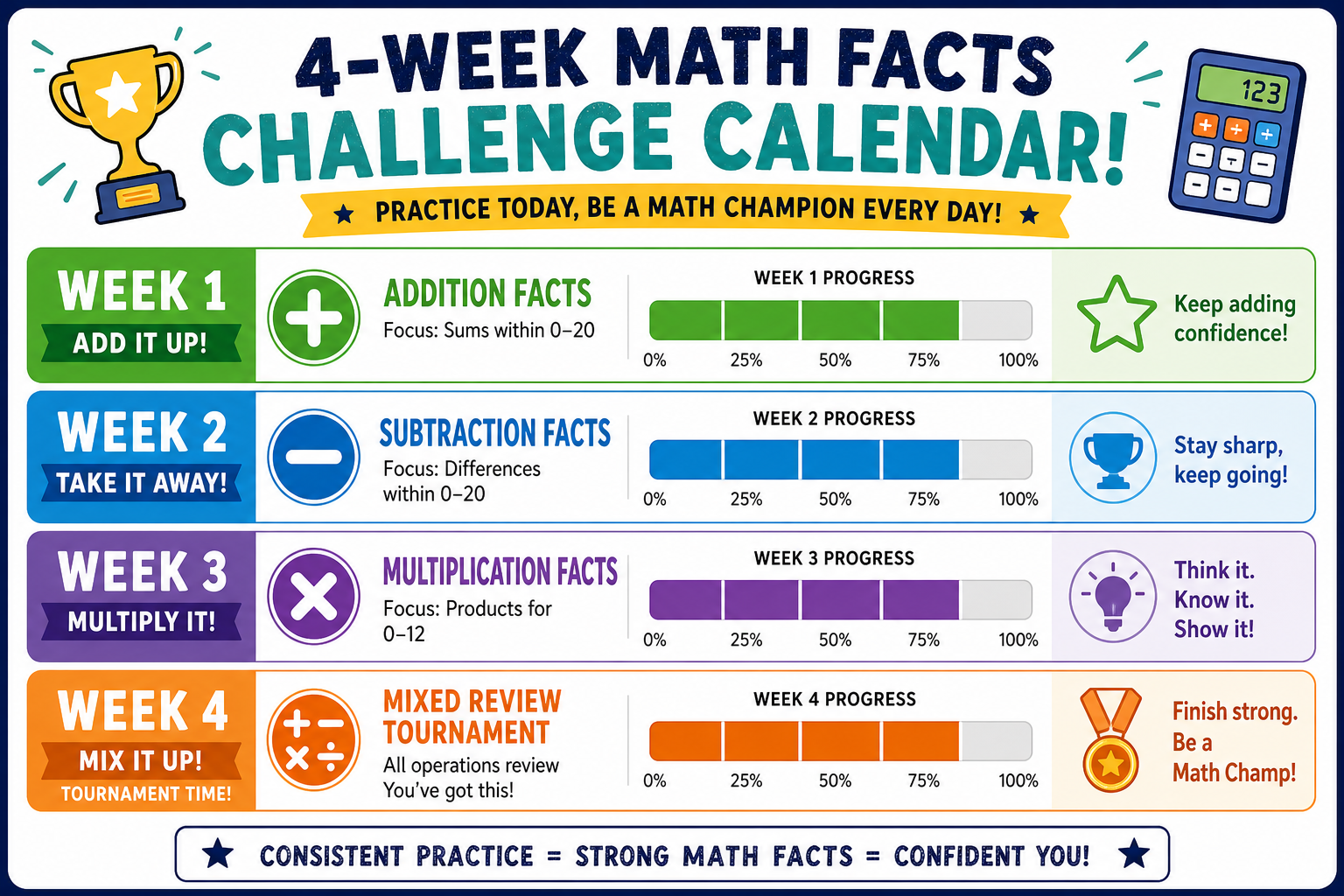
| Week | Focus | Daily (5–10 min) | Friday |
|---|---|---|---|
| Week 1 | Addition or multiplication fact family A (e.g., ×2 and ×5) | 5-min oral drill + 10-problem sheet | 10-question quiz; sticker for 80%+ |
| Week 2 | Fact family B (e.g., ×3 and ×4); spiral family A | Flash card pairs; generator sheet with mixed review | Beat-your-score quiz vs. week 1 baseline |
| Week 3 | Fact family C (e.g., ×6–×9); spiral all prior | Partner quiz game; 2-min timed optional for volunteers | Team relay tournament |
| Week 4 | Mixed operations review | Student choice station: games, cards, or worksheets | Challenge finale + certificates + class reward |
Third grade teachers launching multiplication can align week one with our multiplication teaching guide. Post a blank multiplication chart for reference in weeks one and two, then remove it in week three for most students.
How Do You Differentiate a Challenge?
Every student participates in the same challenge theme, but problem sets and goals can differ.
- Tiered sheets: Print level A (facts within 10), B (within 20), C (through 12 × 12) from the math worksheet generator.
- Personal goals: Beat-your-baseline cards track individual growth, not class rank.
- Optional timing: Timed rounds for volunteers only; untimed default for everyone else.
- Support tools: Multiplication flash cards and charts for students still building recall.
Students with math anxiety need extra care—read math anxiety causes and solutions and building math confidence before running high-pressure timed events.
What Tools and Materials Do You Need?
- Posted challenge rules and weekly fact list
- Progress tracker (team chart or individual cards)
- Daily practice: flash cards, oral drills, or short worksheets
- Weekly quiz from the quiz generator or a printed fact sheet
- Reference chart for early weeks (fade as fluency grows)
- Certificates or badges for the finale
The U.S. Department of Education emphasizes consistent practice and positive learning environments. Low-stakes challenges with clear rules fit that model better than surprise timed tests.
What Mistakes Should Teachers Avoid?
- Public leaderboards that shame slow recall
- Challenges longer than four weeks without a fresh theme
- Timed tests every day instead of mostly untimed practice
- Same worksheet copied for every ability level
- Skipping conceptual lessons and only drilling facts
- No celebration for most improved students
- Punishing the class when individuals struggle—differentiate instead
Key Takeaways
- Run challenges two to four weeks with a clear finale.
- Practice daily for 5–10 minutes; quiz weekly.
- Track personal growth and team goals—not public last-place rankings.
- Differentiate problem sets while keeping one shared theme.
- Celebrate most improved alongside mastery badges.
Conclusion
Creating a math facts challenge for your classroom turns fluency practice into a mission students want to finish. Pick facts, post rules, track growth, and end with a celebration. Keep sessions short, differentiate freely, and pair drills with games so facts become automatic—not feared.
Draft your four-week fact list tonight, print Monday's practice sheet from the generator, and hang a team progress chart before students arrive. That trio launches a challenge worth running every quarter.
Free fact practice and quiz tools
Custom math worksheets and quizzes for your classroom challenge—unlimited prints.
Related Articles
- The Benefits of Daily Math Fact Practice — why daily fluency matters
- 10 Fun Math Games for Kids — challenge station ideas
- How to Teach Multiplication to 3rd Graders — teach concepts before the challenge
Frequently Asked Questions
A math facts challenge is a structured, time-limited classroom event where students practice addition, subtraction, multiplication, or division facts with clear goals and progress tracking. Challenges can run one week or a full month, use teams or individual badges, and end with a celebration—not a public ranking of slowest students. The goal is fluency and motivation, not stress.