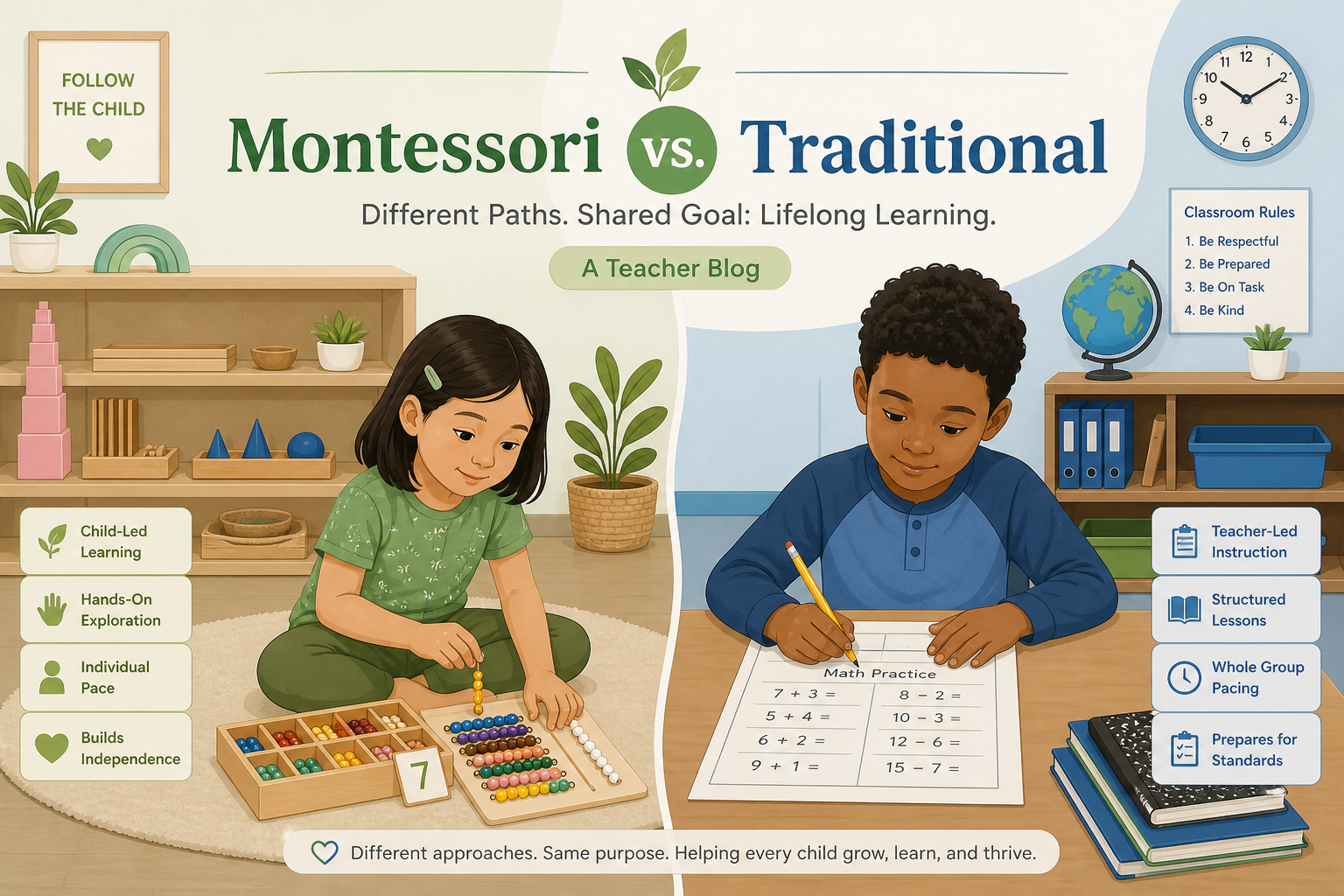
Montessori vs. traditional worksheet approaches is not a winner-take-all choice. Montessori prioritizes hands-on, self-paced exploration with concrete materials. Traditional programs often use worksheets for structured practice, review, and assessment. Many teachers and homeschool parents blend both: manipulatives for understanding first, short paper practice second. This guide compares philosophies, strengths, when each tool fits, and a hybrid weekly model you can use tomorrow.
If you have heard that worksheets and Montessori cannot coexist, the real question is timing and purpose—not ideology. Paper practice after concrete learning looks very different from a worksheet packet with no prior exploration.
What Do Montessori and Traditional Approaches Emphasize?
Montessori education, developed by Dr. Maria Montessori, treats the child as an active learner who builds knowledge through sensory experience and choice within a prepared environment. Math might start with golden beads, spindle boxes, and number rods before a child ever writes equations on paper.
Traditional worksheet-based instruction—common in many public schools—follows a teacher-led sequence: introduce a skill, model examples, assign written practice, then assess. Worksheets bundle repetition into a format that is easy to grade and send home.
The American Montessori Society describes Montessori as child-centered and discovery-driven. Traditional classrooms can still be engaging—they simply default to paper practice more often. Understanding both models helps you borrow the best from each.
How Do They Compare Side by Side?
Use this table to clarify differences when choosing resources for your child or classroom. Neither column is "right" for every situation.
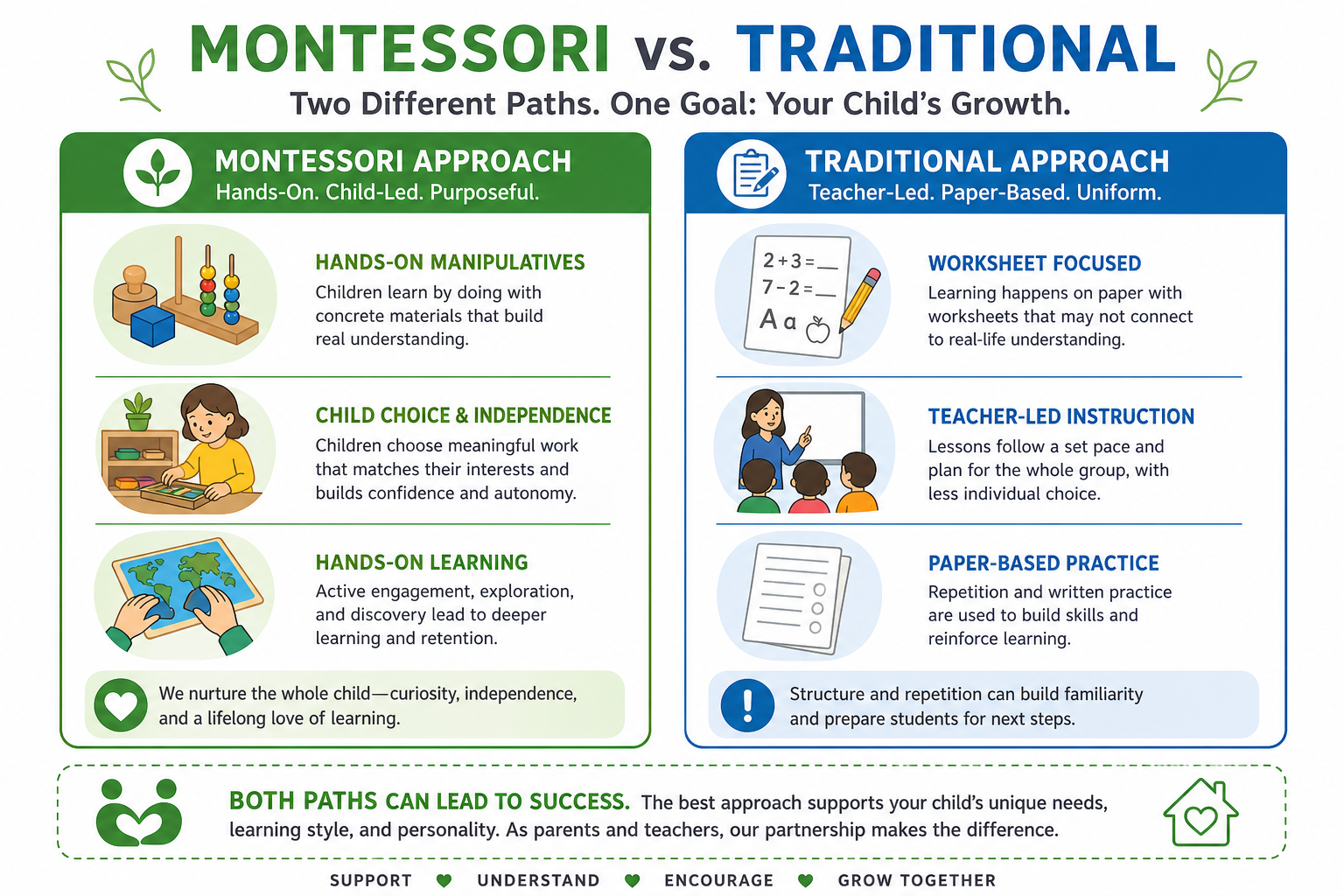
| Aspect | Montessori-style | Traditional worksheets |
|---|---|---|
| Primary tools | Manipulatives, sensory materials, self-correcting items | Textbooks, whiteboards, printed worksheets |
| Pacing | Child-led; advance when ready | Curriculum calendar; whole-class pacing |
| Teacher role | Guide; observes and introduces materials | Instructor; models and assigns practice |
| Practice format | Repeated use of physical materials | Written problems on paper |
| Assessment | Observation, portfolios, demonstrations | Quizzes, tests, graded worksheets |
| Best for | Deep conceptual exploration, independence | Skill fluency, standardized prep, large groups |
What Are Montessori Strengths?
Hands-on math builds understanding that lasts. Children who partition fraction circles physically often explain equivalent fractions more clearly than students who only memorized a rule on paper.
- Concrete learning before symbols—children touch and move objects first
- Self-paced progression reduces comparison pressure among peers
- Long uninterrupted work cycles build focus and independence
- Multi-sensory materials support diverse learners and fine motor growth
- Intrinsic motivation when children choose activities that match interest
These strengths align with how young brains develop. Our guide to building number sense in kindergarten and teaching place value with base-ten blocks shows how concrete tools support early math—even outside a formal Montessori program.
What Are Worksheet Strengths?
Worksheets earn criticism when overused, but they solve real problems: quick review, homework portability, and clear records for parents and teachers. A custom five-problem sheet targets one skill without a 30-minute drill session.
- Efficient review of many problems in a short time
- Easy documentation for parents, teachers, and homeschool portfolios
- Familiar format for state tests and standardized assessments
- Portable practice for homework, travel, and tutoring sessions
- Customizable difficulty through generators and tiered assignments
Used well, worksheets follow the five rules in our classroom worksheet guide: purposeful, short, differentiated, paired with instruction, and never the only activity in a lesson block.
When Can Worksheets Fit Montessori Learning?
Pure Montessori classrooms limit worksheets, but Montessori-inspired homeschoolers and hybrid teachers often add paper tools at specific moments:
- After concrete mastery: Child sorts fraction tiles, then shades equivalent fractions on one page.
- Handwriting and tracing: Sandpaper letters and moveable alphabet pair with tracing worksheets for pencil control—not drill for drill's sake.
- Portfolio documentation: A dated worksheet shows progress for homeschool reviews or parent conferences.
- Assessment snapshots: A short quiz confirms readiness before moving to the next material sequence.
The National Association for the Education of Young Children supports developmentally appropriate practice: activities should match age, ability, and culture. A two-minute tracing sheet for a four-year-old differs from a 40-problem timed test for a seven-year-old.
Short, purposeful worksheets after hands-on lessons
Generate custom math and tracing pages—print only what you need.
What Does a Hybrid Weekly Model Look Like?
Homeschool families often ask for a concrete schedule. This sample week balances Montessori-style exploration with minimal paper practice—about 15 minutes total worksheet time across five days.
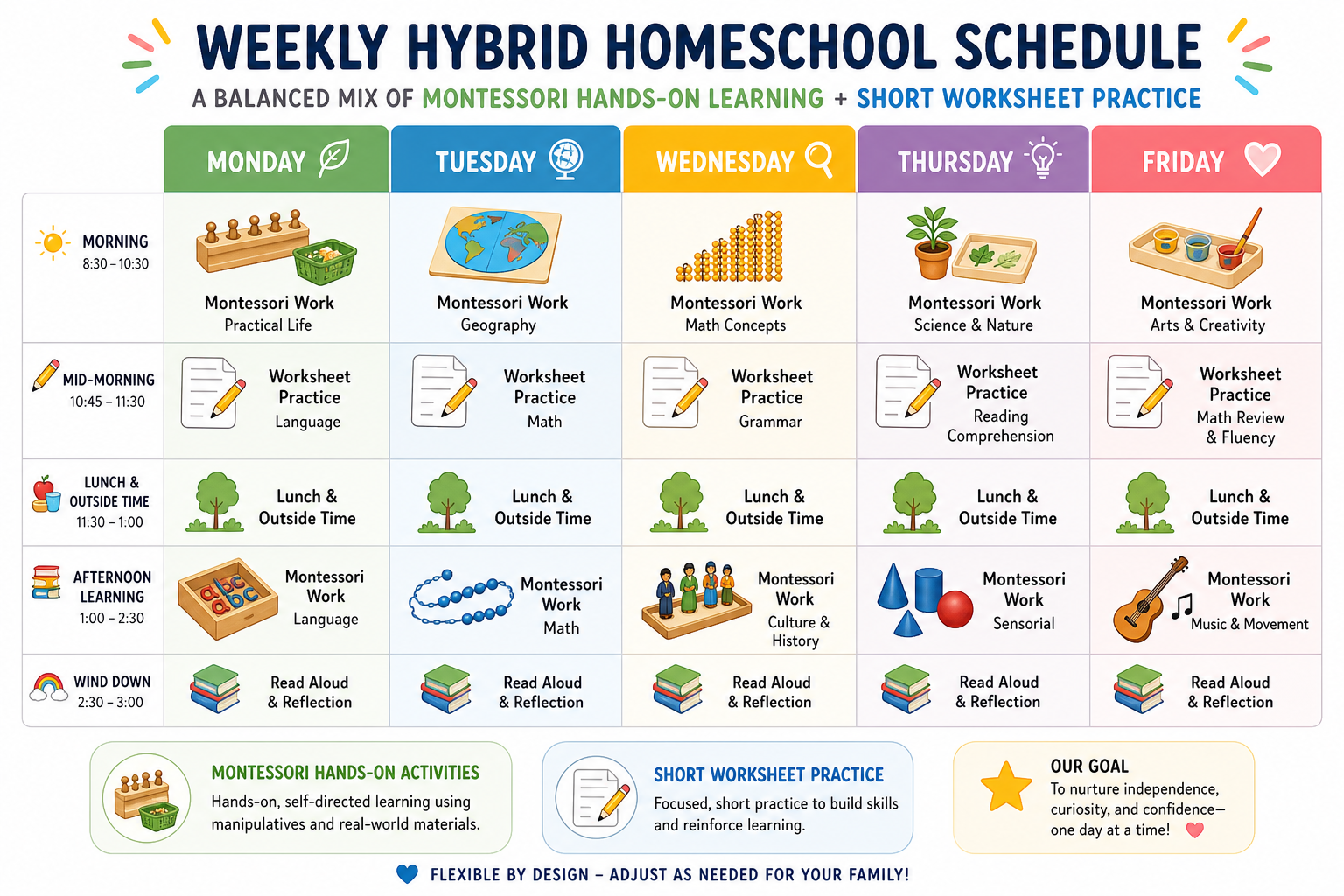
| Day | Hands-on focus | Worksheet role |
|---|---|---|
| Monday | Manipulatives: base-ten blocks for place value | Optional: trace numbers 1–20 |
| Tuesday | Hands-on fractions with fraction tiles | None—record in math journal |
| Wednesday | Counting collections or bead chains | 5-problem custom math sheet |
| Thursday | Student choice: revisit favorite material | None |
| Friday | Game or real-life math (cooking, shopping) | Short quiz or 10-minute review page |
Adapt the ratio to your child. Some need more paper repetition for fluency; others need more manipulative time. Our homeschool worksheets guide covers planning and grade-level resources. Pull free pages from kindergarten math worksheets when you want ready-made options without building from scratch.
What Myths Should Parents and Teachers Avoid?
Myth: Montessori means no structure
Reality: Montessori classrooms are highly structured—through prepared environments and sequenced materials, not lecture-style lessons.
Myth: Worksheets always kill creativity
Reality: A five-minute targeted worksheet after exploration can reinforce a skill without replacing imagination or play.
Myth: You must pick one philosophy forever
Reality: Most effective programs blend methods. Grade level, class size, and child temperament matter more than labels.
Myth: Traditional classrooms never use manipulatives
Reality: Strong traditional teachers use counters, base-ten blocks, and games—the worksheet is one tool among many.
For writing development, Montessori sand trays and traditional name writing activities both build fine motor skills—the medium changes, the goal does not.
Key Takeaways
- Montessori and worksheets serve different but complementary roles.
- Lead with hands-on materials; add paper for practice, records, or assessment.
- Keep worksheets short, purposeful, and matched to readiness.
- Hybrid schedules work for homeschool and traditional classrooms alike.
- Choose tools based on the child, not philosophy labels alone.
Conclusion
Montessori vs. traditional worksheet approaches reflects a real tension in elementary education: exploration versus efficiency. The practical answer for most families is both—manipulatives and choice when building new concepts, targeted worksheets when reinforcing or documenting skills. Judge each activity by whether it helps the child understand, practice, or demonstrate learning—not by whether it fits a single label.
Try one hybrid week: three hands-on lessons, one tracing or math sheet, one low-stakes quiz. Adjust from there based on what your child actually needs—not what a debate online told you to use.
Build a balanced practice toolkit
Free math and tracing generators for short, purposeful worksheets after hands-on lessons.
Free Math Worksheet GeneratorRelated Articles
- How to Use Worksheets Effectively in the Classroom — five rules for purposeful paper practice
- Free Printable Worksheets for Homeschool — planning a blended homeschool week
- Building Number Sense in Kindergarten — hands-on foundations before worksheets
Frequently Asked Questions
Authentic Montessori classrooms rely primarily on hands-on materials and student choice, not daily paper-and-pencil drill. Some Montessori-inspired programs use occasional recording sheets, math journals, or tracing practice for handwriting development. The key difference is purpose: worksheets support documentation or a specific skill, not replace manipulative exploration.