You can build a homeschool math curriculum on a budget by choosing a free scope and sequence, teaching new skills with library books or online lessons, and printing daily practice from grade-level worksheets or a custom generator. Add household manipulatives, follow a simple four-day or five-day weekly plan, and track progress with dated work samples instead of expensive testing packages.
A strong plan does not require a $150 boxed program. It requires knowing what to teach each month, how to practice it, and how to tell when your child is ready to move on. This guide walks through the four pillars of budget math homeschooling, free resources, grade-level scope, a weekly schedule, and low-cost ways to check learning.
Why Build a Budget Homeschool Math Curriculum?
Homeschool math can cost hundreds per child per year when you buy new textbooks, workbooks, manipulative kits, and online subscriptions for every grade. Many families overspend on materials they barely open. A budget approach focuses spending on what you actually use: clear pacing, daily practice, and tools your child touches every week.
Budget planning also lets you adapt faster. When multiplication clicks in March instead of February, you print harder pages instead of waiting for the next workbook shipment. Free and printable resources make that flexibility possible. For a broader printable strategy, see our free printable worksheets for homeschool guide.
What Four Pillars Does Every Plan Need?
Think of your curriculum as four connected parts—not a single product to buy. Skip any pillar and gaps show up within a month.
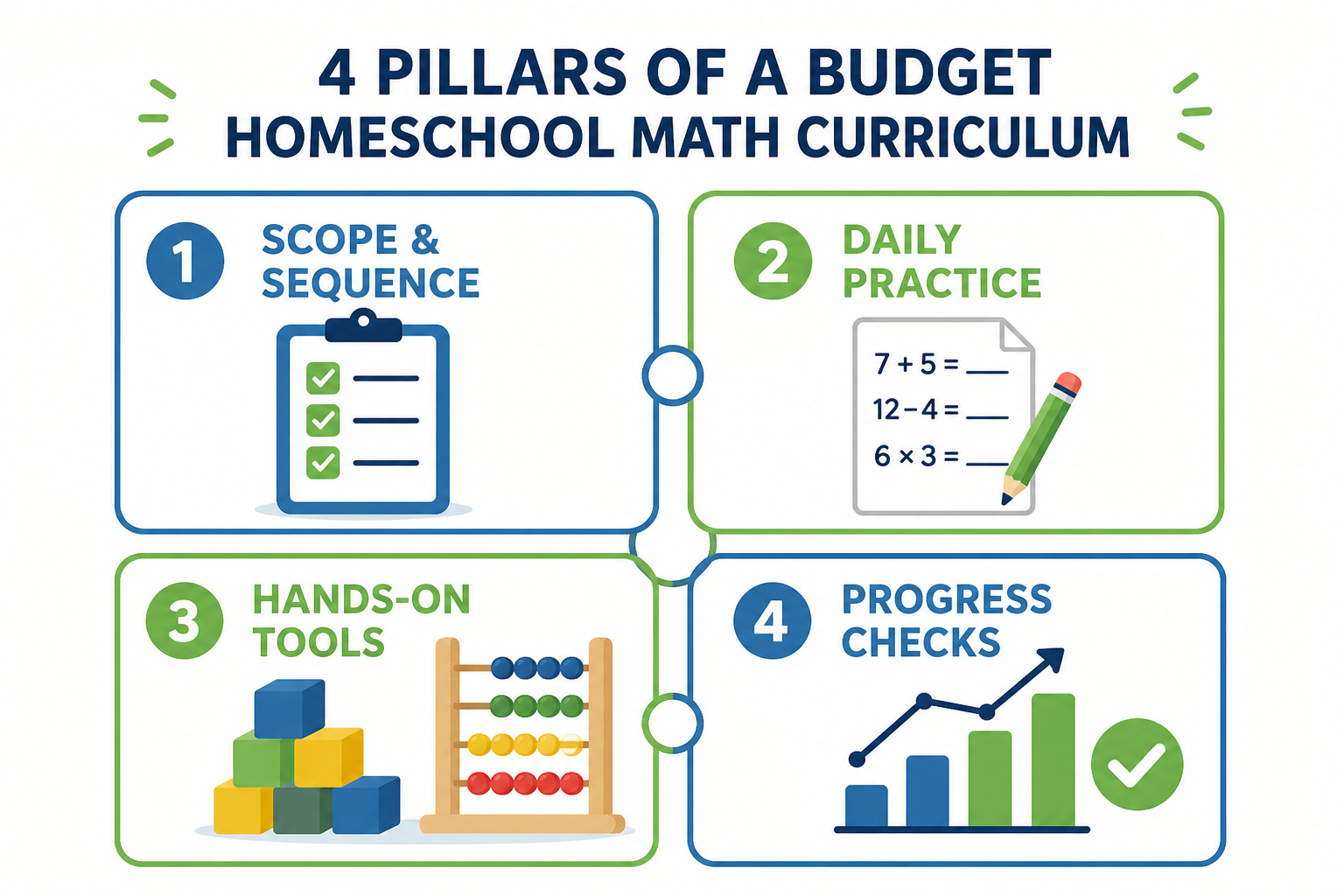
A month-by-month list of topics so you do not skip fractions or repeat addition all year. Start from Common Core math standards or your state's published expectations. Our standards-by-grade guide translates those lists into parent-friendly language.
Short, focused worksheet sessions build fluency. Print from grade pages or the math worksheet generator when you need a custom set of problems on one skill.
Young learners need objects before symbols. Coins, blocks, and measuring cups cost little and support the same goals as store-bought kits. Pair objects with hands-on and worksheet balance so practice does not replace exploration.
Weekly five-question quizzes and a monthly folder of dated work replace expensive standardized test prep for most homeschoolers. Reteach when the same mistake appears three times in a row.
Print practice for this week's topic
Pick grade and skill, generate a fresh page in seconds, and print as many copies as siblings need.
Free Math Worksheet GeneratorWhat Free and Low-Cost Resources Work Best?
Mix one teaching source with one practice source. Too many apps and workbooks create overlap without depth.
| Resource type | How to use it | Typical cost |
|---|---|---|
| Standards scope | Use Common Core or your state standards as a free pacing guide so you cover grade-level skills in order. | Free |
| Video lessons | Khan Academy and similar sites teach new concepts when you are unsure how to explain a topic. | Free |
| Library books | Picture books and math readers make concepts concrete for young learners without buying textbooks. | Free with library card |
| Printable worksheets | Grade-level pages and custom generators supply unlimited practice aligned to your weekly lesson. | Free |
| Manipulatives at home | Coins, dice, measuring cups, and index cards replace expensive kit purchases. | Low cost |
| Used workbooks | Buy one used teacher edition for answer keys; print student pages from free sources instead. | Under $20 |
For video instruction, Khan Academy math organizes lessons by grade and topic at no charge. Watch together, pause for discussion, then assign a matching worksheet page the same day so practice connects to the lesson.
What Should Each Grade Cover?
Use this overview as a pacing anchor. Adjust speed based on mastery, not calendar pressure.
| Grade band | Core focus | Budget tools |
|---|---|---|
| K | Counting, number recognition, shapes, patterns, intro addition | Kindergarten math worksheets, household counters, shape hunts |
| 1–2 | Addition and subtraction facts, place value, telling time, money | 2nd grade worksheets, coins, clocks, base-ten blocks |
| 3–4 | Multiplication, division, fractions, area, multi-step word problems | 3rd and 4th grade pages, multiplication charts, fraction tiles |
| 5–6 | Decimals, ratios, volume, coordinate planes, pre-algebra prep | 5th and 6th grade worksheets, graph paper, measuring tools |
Kindergarten families can start with kindergarten math worksheets. Second grade pacing details are in our parent's guide to 2nd grade math. Third and fourth graders benefit from 3rd grade math worksheets and 4th grade math worksheets as your weekly practice bank.
What Does a Weekly Schedule Look Like?
A repeatable weekly rhythm reduces decision fatigue. You always know what type of math block comes next.
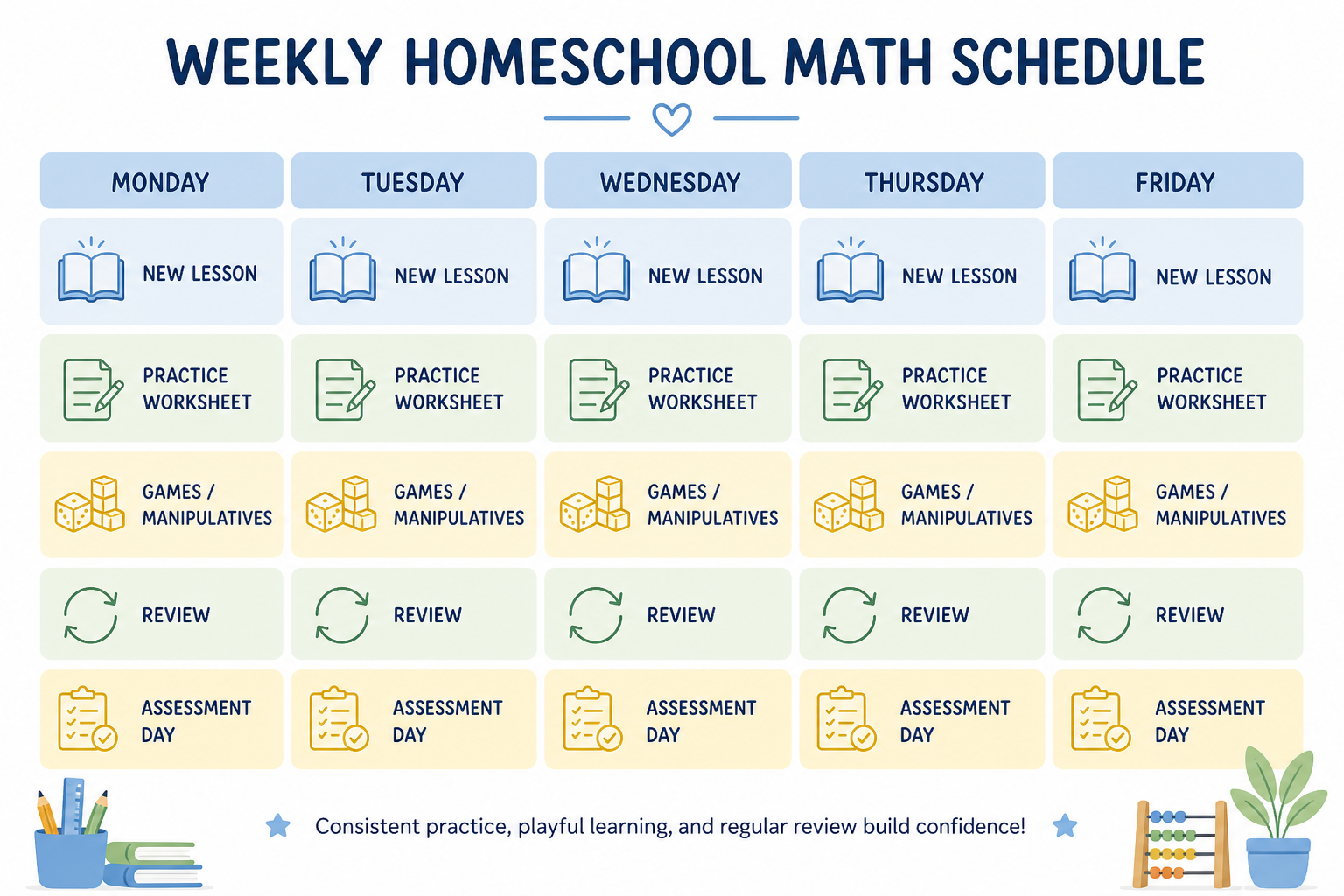
Keep total math time between 30 and 45 minutes for most elementary grades. Split into two shorter blocks if your child loses focus. A morning worksheet routine pairs well with this schedule—see our morning work routine guide for timing tips.
When Should You Use Workbooks vs. Printables?
Workbooks make sense when you want zero planning and a single answer key in one binding. They cost more per page and lock you into fixed pacing. Printables and generators win when you need extra practice on one skill, teach multiple grades, or want to print fresh problems for a struggling topic.
- Buy one workbook if you want a spine and will use 80% of the pages.
- Use printables for daily practice, siblings, and skill-specific reteaching.
- Combine both by following the workbook sequence but supplementing weak spots with generated pages.
- Skip expensive kits when household items cover the same standards.
During summer breaks, budget families often pause new lessons and run review only. Our summer math review guide shows how to keep skills sharp without buying a second curriculum.
How Do You Assess Progress on a Budget?
You do not need a paid testing service every quarter. Simple habits tell you whether your plan is working:
- Weekly five-question quiz: Mix one new skill and two review skills.
- Error notebook: Write recurring mistakes; reteach that subskill next Monday.
- Monthly portfolio folder: Date and file three representative worksheets per month for state records.
- Explain-it check: Ask your child to teach the skill back in their own words once a week.
- Generator quizzes: Print a short custom quiz from the quiz generator when you want a fresh assessment page.
If scores drop for two weeks in a row, slow the scope sequence. Mastery beats finishing a grade label by June.
Key Takeaways
- Four pillars: scope, practice, hands-on tools, and progress checks.
- Free standards, Khan Academy, library books, and printables replace most paid products.
- Follow a five-day weekly rhythm: teach, practice, explore, review, assess.
- Use workbooks as a spine only if you will actually finish them.
- Track growth with dated work samples and short weekly quizzes.
Conclusion
Building a homeschool math curriculum on a budget is about structure, not shopping. Pick your scope from published standards, teach with free or library resources, print daily practice, and check learning every Friday. Spend money only where it saves you real time—and skip the rest.
Draft next week's topic list tonight, print one practice page from the generator, and file Friday's quiz in a labeled folder. That trio is a complete curriculum engine for most K-6 homeschoolers.
Build this week's math practice for free
Custom worksheets by grade and topic—unlimited prints, no signup required.
Free Math Worksheet GeneratorRelated Articles
- Free Printable Worksheets for Homeschool — find and organize daily printables
- Understanding Common Core Math Standards by Grade — free scope and sequence reference
- Montessori vs. Traditional Worksheet Approaches — balance hands-on and paper practice
Frequently Asked Questions
Commercial boxed math programs range from $80 to $200 per year per child. A budget homeschool math curriculum can cost under $50 annually when you combine free online lessons, library books, printable worksheets, and household manipulatives. Many families spend $0 on core practice by using free generators and grade-level printables.