AI is changing educational worksheets from static downloads into on-demand, customized practice. Teachers generate quizzes in seconds, print differentiated math pages by grade, and create fresh problem sets weekly—while still reviewing every item before it reaches students. The future is not AI replacing worksheets; it is AI making worksheet prep faster, more flexible, and more responsive to what each class needs today.
For decades, worksheet prep meant searching marketplaces, hoarding PDF folders, and reusing the same pages until answer keys circulated. In 2026, generators and AI quiz tools compress that workflow into minutes. This guide explains five shifts AI is driving, how the tools compare to traditional printables, a responsible teacher workflow, benefits and limits, and what comes next.
Why Does AI Matter for Worksheets?
Worksheets remain one of the most used practice formats in K–6 classrooms. What changed is how fast teachers can produce them. When a class bombs Tuesday's lesson on equivalent fractions, you no longer wait until the weekend to find a better page—you generate one Wednesday morning.
The U.S. Department of Education's guidance on AI in education emphasizes human judgment, privacy, and using technology to support—not supplant— educators. Worksheet AI fits that frame when teachers review output and match it to their curriculum.
What Five Changes Is AI Driving?
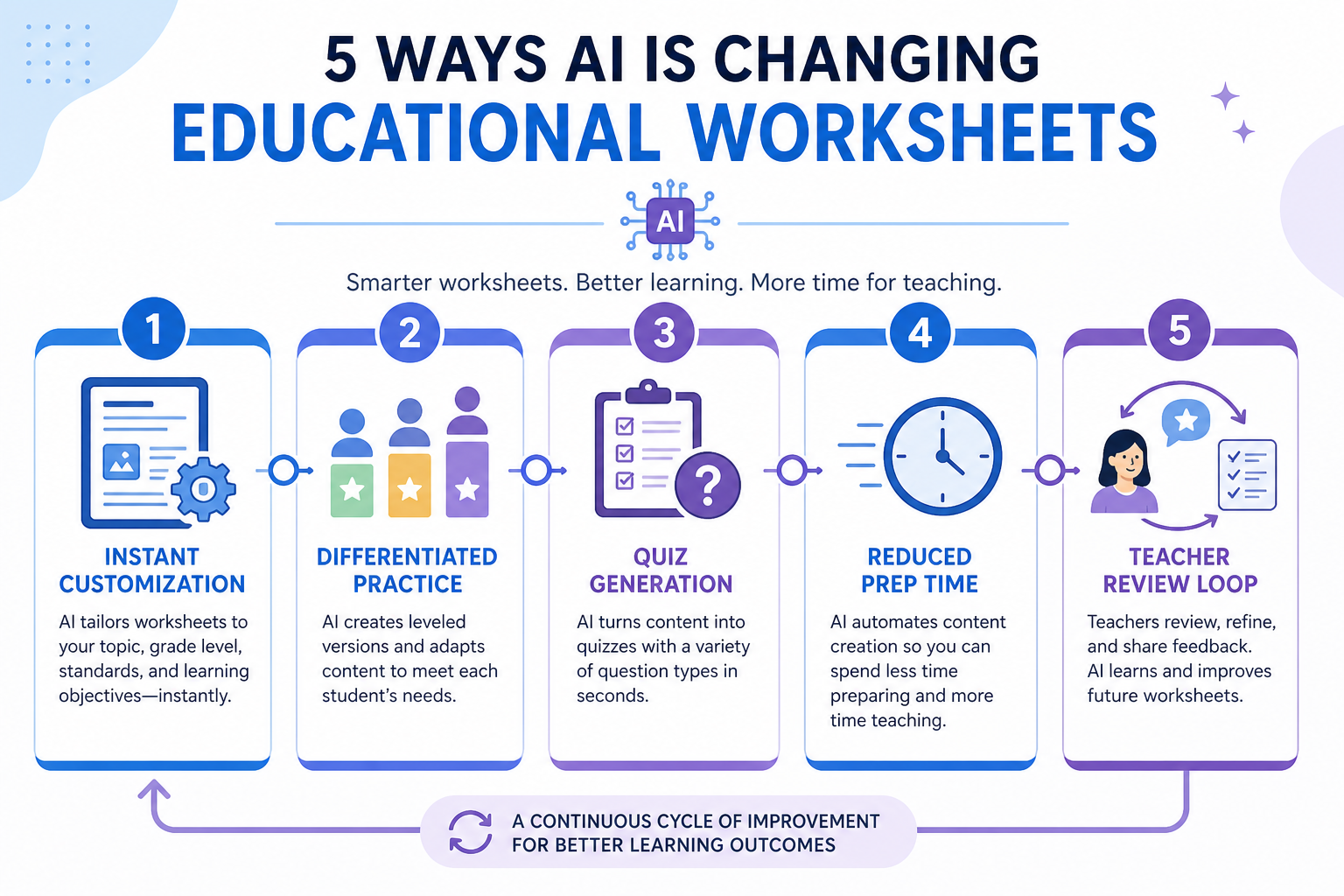
Pick grade, operation, problem count, or quiz topic—get a new page in seconds instead of searching Pinterest for an almost-right PDF.
Generate level A, B, and C sheets on the same objective without rewriting problems by hand. Each group gets appropriate rigor.
Large language models write multiple-choice, true/false, and short-answer items from a topic prompt—useful for reviews and sub days.
Sunday night printing sessions shrink when generators replace filing cabinets of stale masters.
The best workflows treat AI output as a draft. Teachers edit, approve, then print—keeping quality and standards alignment human-led.
Differentiation workflows pair naturally with our custom worksheet differentiation guide. AI quiz generation powers Friday checks described in classroom math facts challenges.
How Do AI Tools Compare to Static PDFs?
Neither side wins every category. Smart teachers mix publisher-quality reference charts, trusted grade-level pages, and generators for daily practice.
| Aspect | Traditional PDFs | AI and generators |
|---|---|---|
| Speed to create | Search, download, maybe edit in Word | Generate in under a minute from parameters |
| Differentiation | Buy multiple workbooks or rewrite by hand | Adjust grade, count, and topic per group |
| Freshness | Same PDF every year; students share answers | New problem sets each week |
| Quality control | Publisher-reviewed content | Requires teacher review every time |
| Cost | Workbooks, subscriptions, ink for bulk copies | Many free generators; pay for premium AI tiers |
| Best use | Core reference charts, trusted scope sequences | Daily practice, quizzes, reteaching sets |
Try AI quiz generation today
Enter a topic and grade—get multiple-choice, true/false, or short-answer quizzes in seconds.
Free AI Quiz GeneratorWhat Workflow Uses AI Responsibly?
Never print AI output blindly. Follow this five-step loop every time.
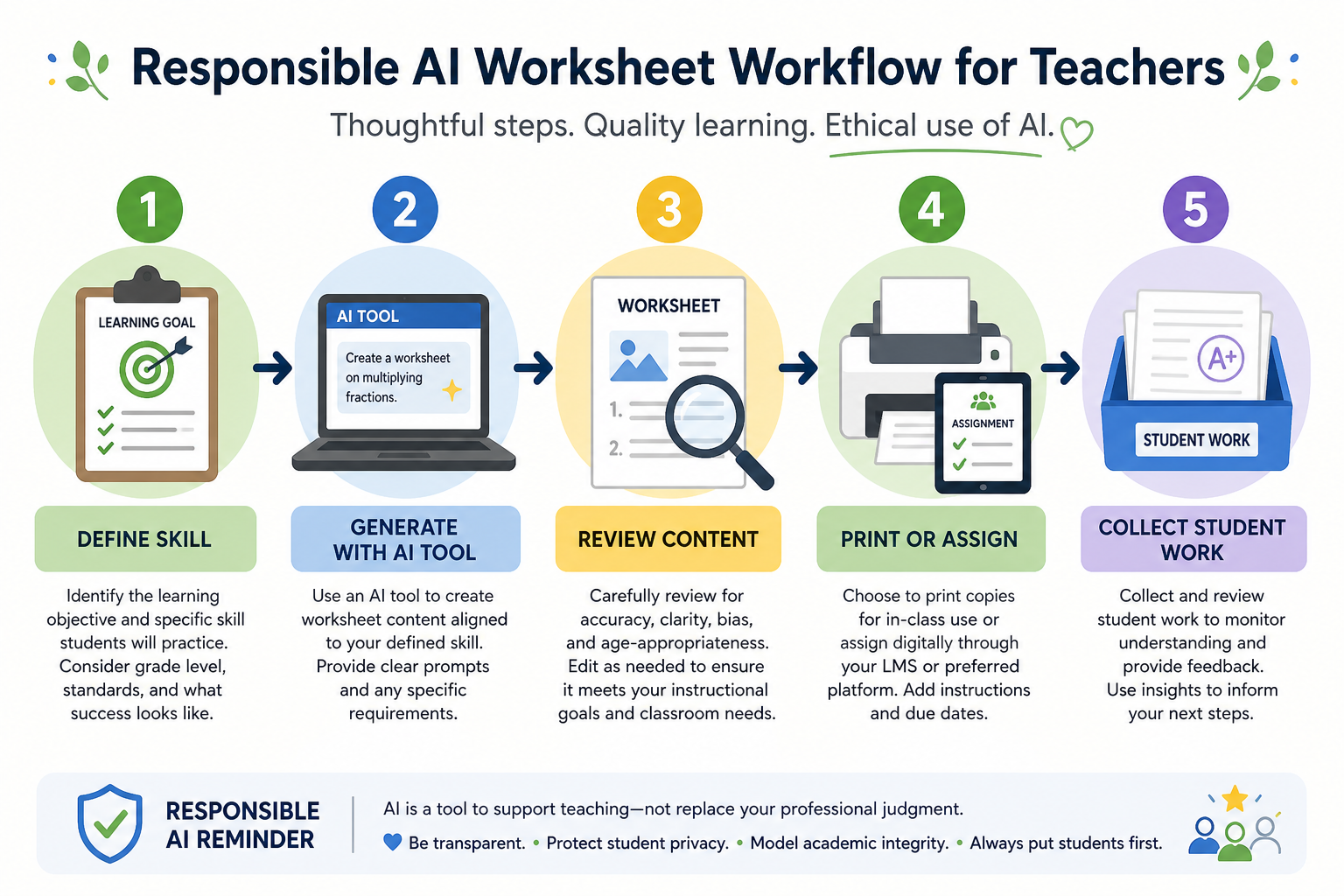
- Define the skill: name the standard, grade, and number of problems or questions.
- Generate: use a math generator, tracing tool, or AI quiz maker with clear parameters.
- Review: read every item; fix wrong answers, unclear wording, or off-level difficulty.
- Print or assign: distribute only after approval; use draft print settings to save ink.
- Collect and adjust: use results to generate a reteach set or harder follow-up page.
Pair generation with economical printing habits and effective worksheet use so AI saves time without increasing paper waste.
What Do Teachers Gain—and Keep?
Teachers gain: speed, differentiation, fresh assessments, and less folder clutter. The math worksheet generator, tracing generator, and AI quiz generator cover daily math, handwriting, and assessment without accounts or subscriptions.
Teachers keep: pacing decisions, error correction, relationship building, and conceptual instruction. AI does not run small groups, notice a confused face, or adjust a lesson mid-block. Generated worksheets work after you teach—not instead of teaching.
Browse the quiz library for community-generated assessments, or start from curated pages like 3rd grade math worksheets when you want zero-prep printables alongside AI tools.
What Risks and Limits Should You Know?
- Incorrect answers or ambiguous multiple-choice distractors
- Reading level too high or low for your grade
- Topics that drift from your standards or textbook sequence
- Student data privacy if tools require unnecessary personal information
- Over-reliance on drill without manipulatives, discussion, or projects
- Copyright and sharing rules when uploading publisher content to AI tools
Review AI quizzes the same way you review a volunteer-made test. If two questions fail your check, regenerate or edit—do not assign as-is. Our free resources guide helps you build a balanced toolkit beyond any single AI product.
What Trends Are Coming Next?
- Smarter alignment to state standards from a single prompt
- Integration with classroom platforms for auto-graded digital worksheets
- Multilingual worksheet generation for ELL classrooms
- Accessibility features: read-aloud, larger fonts, dyslexia-friendly layouts
- Hybrid libraries mixing curated content with on-demand AI supplements
The through-line is the same: faster creation, human oversight, and worksheets that serve the lesson plan—not replace it. Organize your hybrid library with our printables organization guide as you add AI tools to your bookmarks.
Key Takeaways
- AI turns worksheets from static files into on-demand, customizable practice.
- Best uses: differentiation, fresh quizzes, and rapid reteaching sets.
- Always review AI output before printing or assigning.
- Mix generators with curated pages and hands-on instruction.
- Teachers keep pacing, relationships, and quality control.
Conclusion
AI is changing the future of educational worksheets by making practice easier to create, tailor, and refresh. The teachers who benefit most will not print the most pages—they will print the right pages, reviewed and aligned to what students learned that week. Start with one AI quiz on Friday's topic, one custom math sheet for your reteach group, and the habit of reading every question before it hits student desks.
Explore WorksheetGenius AI and generators
Math, tracing, and AI quizzes—free, unlimited, ready when you are.
Related Articles
- How to Differentiate Math Instruction with Custom Worksheets — tiered practice with generators
- The Best Free Educational Resources for Teachers in 2026 — build your full free toolkit
- How to Use Worksheets Effectively in the Classroom — quality over quantity with any source
Frequently Asked Questions
AI is shifting worksheets from static PDFs to on-demand, customized practice. Teachers can generate quizzes on any topic in seconds, create differentiated problem sets by grade and skill, and produce fresh pages so students never memorize answer keys. AI also speeds prep time—but human review remains essential to catch errors and match curriculum pacing.