To use a division table effectively, connect every division fact to its multiplication partner. Rewrite 35 / 7 as "7 times what equals 35?" before looking up the answer. Practice one divisor family per week, say full equations aloud, and fade table use as recall improves. Division tables are learning tools, not permanent answer keys.
Third graders often learn division right after multiplication, but the two operations feel unrelated when taught separately. A division table (or a multiplication chart used in reverse) makes the connection visible. This guide covers how to read a table, five classroom activities, the multiplication link, common mistakes, and free printable resources.
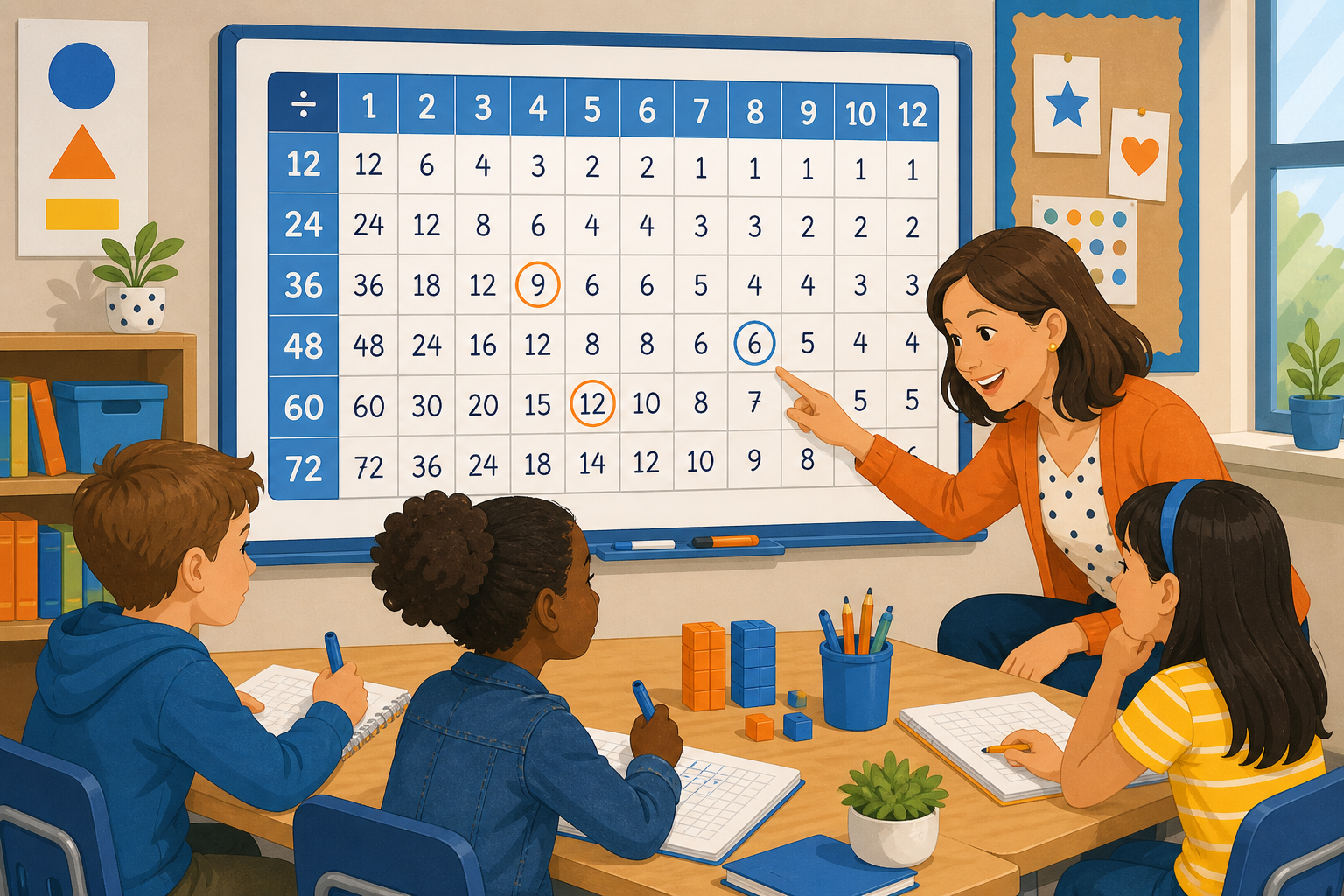
What Is a Division Table?
A division table organizes quotients so students can find answers or spot patterns. Many classrooms use a multiplication chart for both operations because every division fact has a matching multiplication fact in the same family.
The Common Core third grade operations standards expect students to understand division as an unknown-factor problem. Our guide to using a multiplication chart covers the partner tool that makes division lookup possible.
How Do You Read a Division Table?
For 35 / 7, find the row or column for 7, locate 35 in that line, and read the matching quotient: 5. Alternatively, use the multiplication chart: find where 7 and 5 meet to confirm 35.
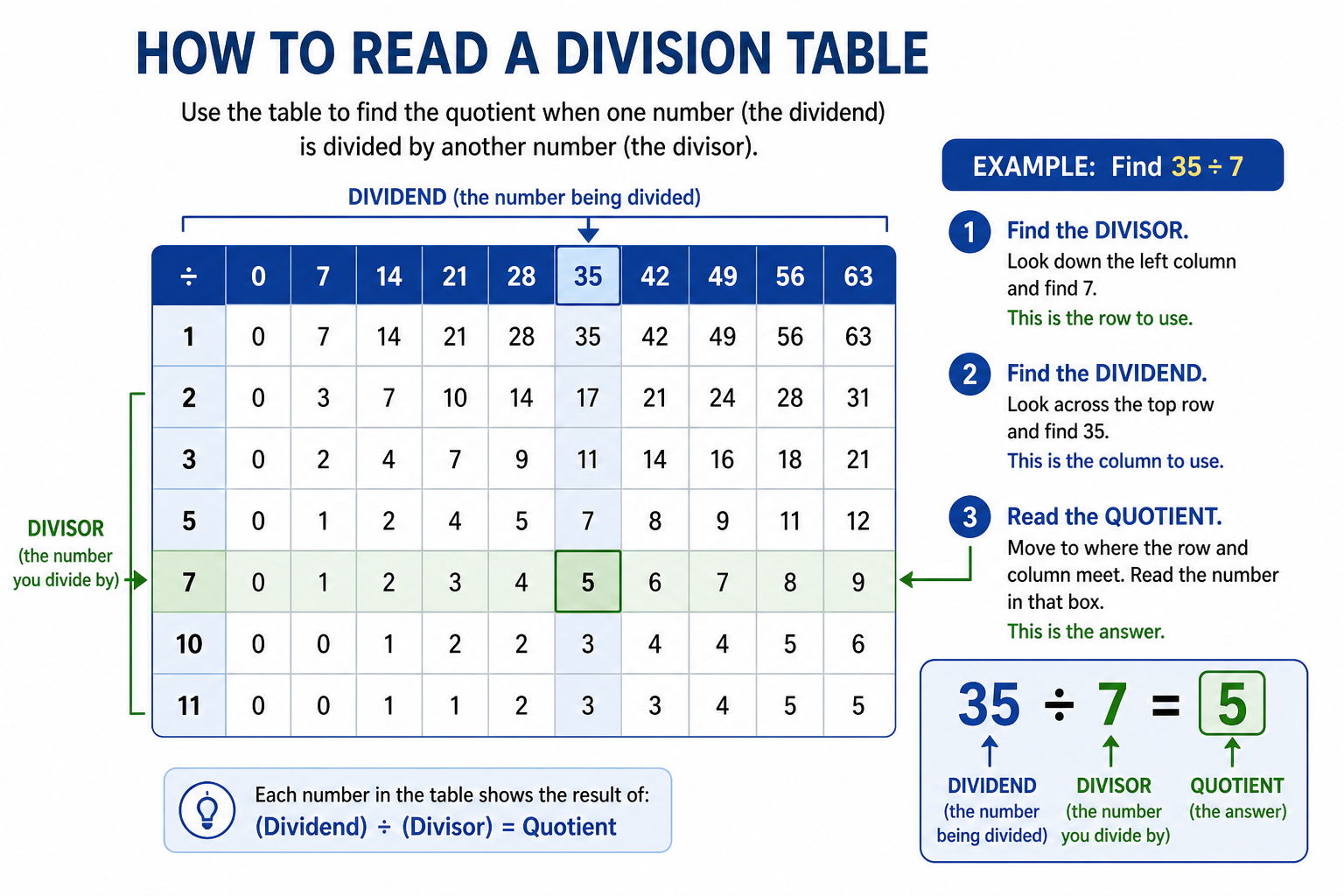
- Divisor: The number you divide by (7 in 35 / 7)
- Dividend: The number being divided (35)
- Quotient: The answer (5)
- Check: 7 x 5 = 35 confirms the quotient
What Five Activities Build Fluency?
Short daily practice on one divisor family beats a long session covering every fact at once.
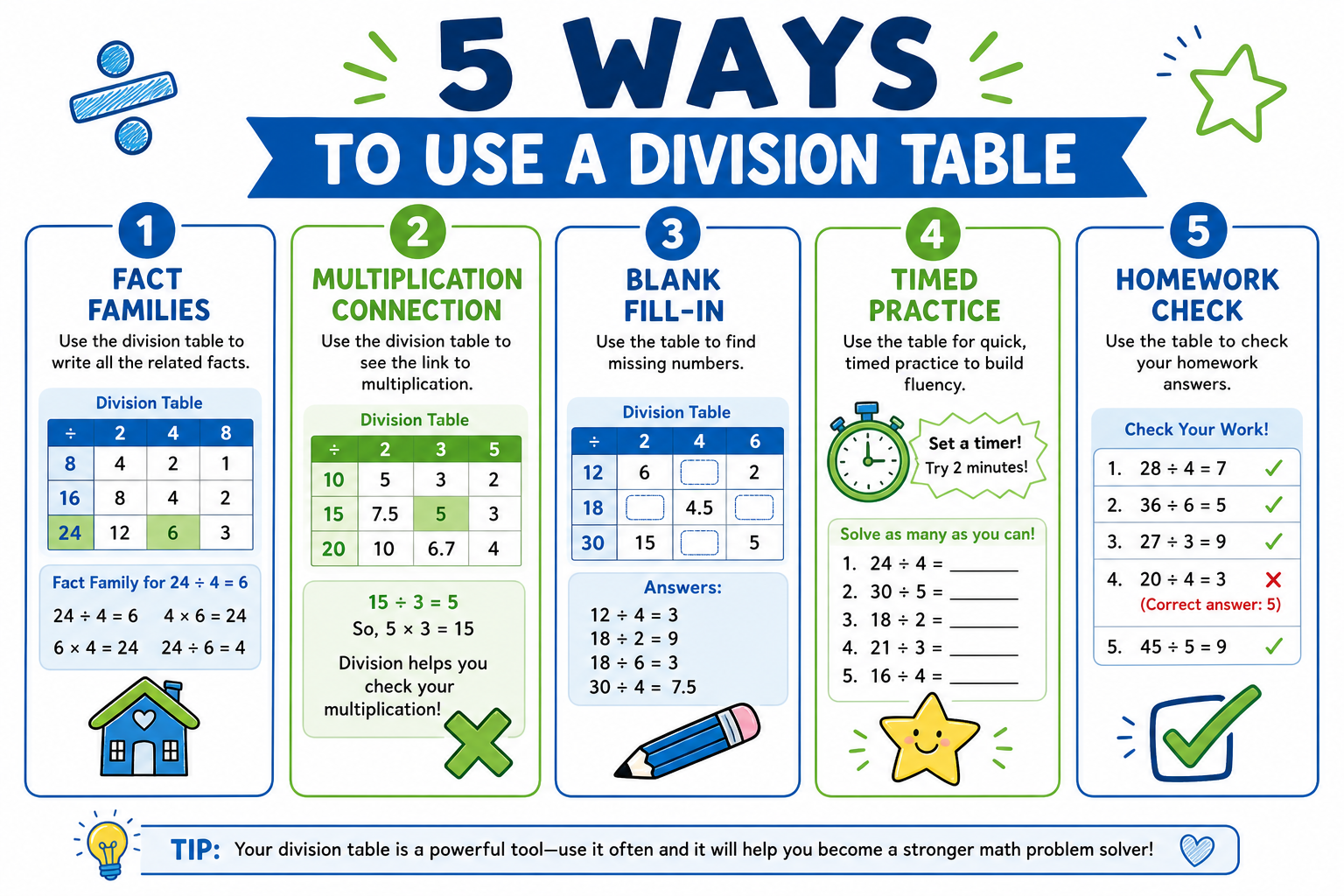
Write 7, 5, and 35 in a triangle. Students write all four equations: 7 x 5 = 35, 5 x 7 = 35, 35 / 7 = 5, 35 / 5 = 7. The table confirms each one.
For 42 / 6, ask '6 times what equals 42?' Students find 6 x 7 = 42 on the multiplication chart, then write the division fact.
Focus on all /7 facts for a week. Recite the 7 times table, then solve ten division problems with divisor 7. Check on the table.
Print a division table with missing cells. Students fill in quotients from memory, then check against a complete table.
Students attempt every division problem first. Only after trying do they use the table to verify. No lookup before effort.
Print free division tables
Complete and blank division table formats for classroom and home practice.
Division Table PrintablesHow Does Multiplication Connect to Division?
Every division fact is a multiplication fact in disguise. If students know 8 x 7 = 56, they can solve 56 / 8 by asking what times 8 equals 56. Fact family triangles make this relationship explicit.
Start each division lesson by reciting the matching times table. Before /9 facts, recite nines: "1 x 9 is 9, 2 x 9 is 18..." Then solve division problems and check on the printable multiplication chart.
What Mistakes Should Teachers Watch For?
- Using the table as a permanent crutch without building recall
- Looking up answers before attempting from memory
- Teaching division facts before multiplication facts are solid
- Skipping fact families and treating division as unrelated to multiplication
- Only reading the quotient without saying the full equation aloud
- Practicing all divisors at once instead of one table per week
Pair table work with conceptual lessons from teaching division with remainders so students understand what division means, not just where to find answers.
How Do Worksheets Support Practice?
Post a division table for reference, then assign focused practice from division table worksheets and 3rd grade math worksheets. Generate custom drills from the math worksheet generator.
Run classroom challenges using ideas from creating a math facts challenge once students can solve a row of facts with reasonable speed.
Key Takeaways
- Division tables connect to multiplication fact families.
- Rewrite division as missing-factor multiplication before lookup.
- Practice one divisor family per week for focused fluency.
- Say full equations aloud, not just the quotient number.
- Fade table use as recall improves—attempt before checking.
Conclusion
A division table works when students see it as the other side of multiplication, not a separate chart to memorize. Fact families, one-divisor practice, and multiply-to-divide thinking build fluency that lasts. Students who learn the connection solve division faster than those who only hunt for answers.
Free division table printables
Complete and blank formats for grades 3–5 division fact practice.
Division Table PrintablesRelated Articles
- How to Use a Multiplication Chart to Teach Times Tables — partner tool for fact families
- How to Teach Division with Remainders — conceptual division beyond facts
- The Benefits of Daily Math Fact Practice — build a daily facts routine
Frequently Asked Questions
A division table is a chart that lists quotients for division facts, often organized like a multiplication table turned into a lookup grid. Students find the divisor and dividend to read the answer, or use the table to see patterns in fact families. It supports fluency while students build toward memorized division facts.