Sight words and phonics both belong in early reading instruction, and tracing sheets support each one differently. Use whole-word tracing for high-frequency sight words after oral practice, and letter or pattern tracing for phonics lessons on sounds and spelling. Neither approach replaces read-alouds or decodable books—tracing reinforces motor memory in short five- to ten-minute sessions.
Parents and teachers often ask whether to prioritize flashcards or alphabet tracing. The answer is both, on different days, for different goals. This guide explains the difference, when each tracing type fits, grade-level guidance, a weekly plan, and free tools to create custom sheets.
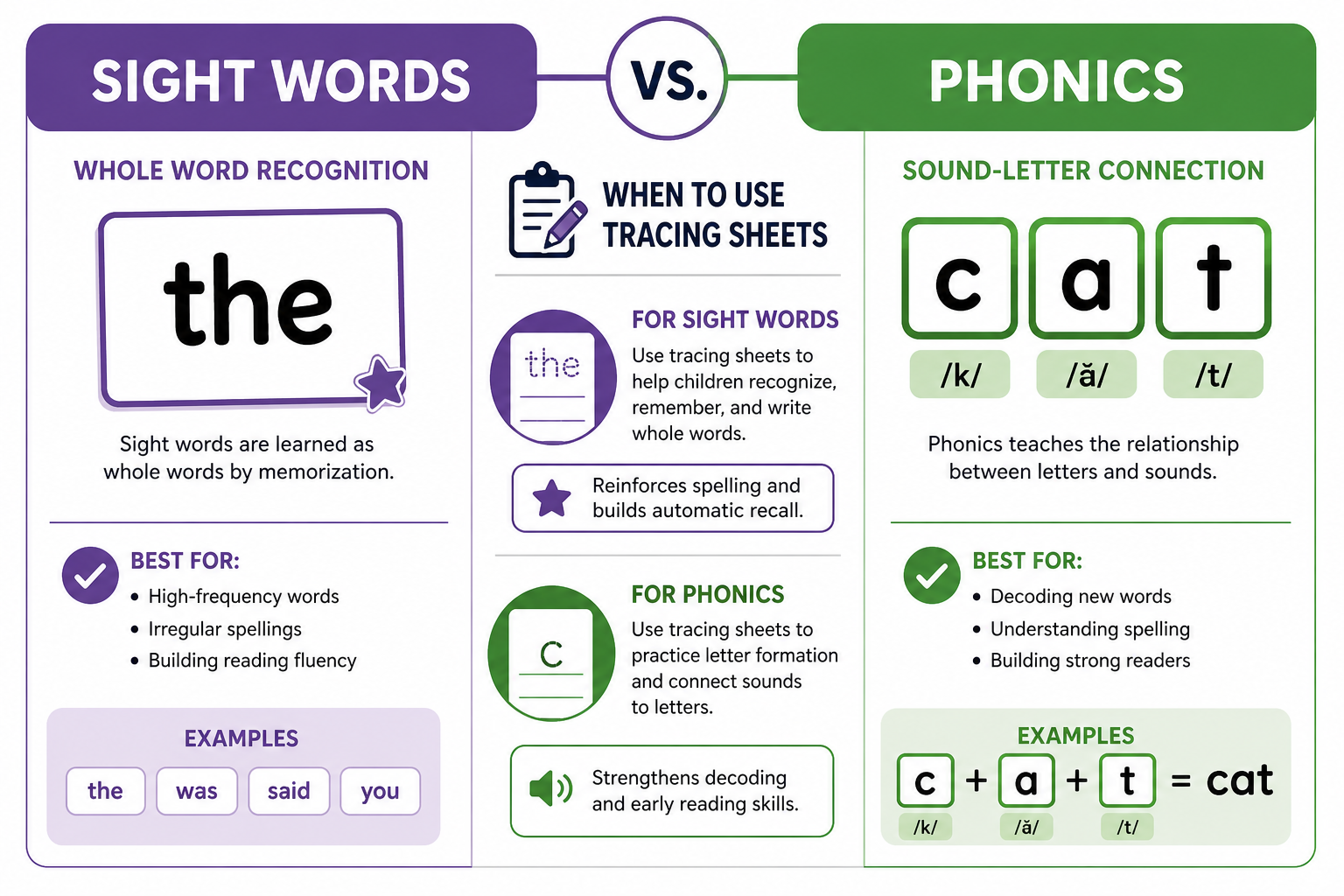
What Is the Difference Between Sight Words and Phonics?
Sight words are high-frequency words students recognize quickly—often after repeated exposure—so reading flows without sounding out every letter. Examples include the, of, said, and where. Some follow regular phonics patterns; others do not.
Phonics is the system that connects letters and letter groups to sounds. Children use phonics to decode unfamiliar words: blending c-a-t or reading shop with the sh digraph. Phonics is how students attack words they have never seen before.
Research-based reading programs combine both strands. Reading Rockets on phonics and decoding explains why systematic phonics instruction matters alongside high-frequency word practice.
| Aspect | Sight words | Phonics |
|---|---|---|
| What it teaches | High-frequency whole words read by memory (the, said, where) | Letter-sound patterns to decode new words (c-a-t, sh-op) |
| Tracing focus | Trace the whole word as one unit; build spelling memory | Trace letters and sound-spelling patterns; build formation + decoding |
| Best timing | After oral practice and word wall exposure | During letter introduction and CVC word lessons |
| Session length | 3–5 words, 5–8 minutes | 4–8 letters or 3–4 CVC words, 5–10 minutes |
How Do Tracing Sheets Support Reading?
Tracing connects handwriting, spelling, and word memory. When a child traces a word, they practice letter sequence and stroke direction—not just visual recognition on a flashcard. That motor path supports later independent writing and spelling.
Tracing does not teach decoding by itself. It reinforces words and patterns you already introduced through lessons, books, and oral practice. Pair tracing with fine motor skill development and writing center routines for a complete early literacy block.
When Should You Use Sight Word Tracing?
Introduce sight word tracing after the child has heard, seen, and said the word in sentences. The tracing sheet is repetition—not first contact.
- Child can read the word on a flashcard or word wall with prompting
- Word is on this week's school or homeschool list (three to five words max)
- Session includes saying the word aloud before and after tracing
- Font is large enough for the child's grip—see our handwriting font guide
- Tracing the whole word as a unit, not spelling letter by letter from memory
Generate custom sight word pages with the tracing worksheet generator. Type the exact words your curriculum uses so practice matches classroom lists.
Create custom sight word tracing sheets
Type any word list, pick font and size, and print dotted-line practice in seconds.
Free Tracing Worksheet GeneratorWhen Should You Use Phonics Tracing?
Phonics tracing fits during letter introduction, sound drills, and early spelling pattern lessons.
- Single letters: Trace while saying the sound—not just the letter name. Use letter tracing worksheets with dotted arrows showing stroke order.
- CVC words: Trace cat, sun, pig after blending those sounds orally.
- Patterns: Trace word families (ship, shop, shut) when teaching digraphs in first grade.
- Name writing: Names are often a child's first meaningful phonics and sight word blend—see name writing activities for preschoolers and name tracing worksheets.
The NAEYC literacy development resources emphasize play, conversation, and print exposure alongside structured skill practice. Phonics tracing sits in that structured slice—not the whole pie.
What Works by Grade Level?
Adjust word count and font size by developmental stage. These ranges are typical; follow your child's stamina.
| Grade | Sight words | Phonics | Tracing use |
|---|---|---|---|
| Pre-K | Recognize name and 2–3 environmental words | Letter tracing, letter names, initial sounds in play | Large letter tracing, name sheets, finger tracing in sand |
| K | 25–50 high-frequency words by year end (varies by list) | Letter sounds, blending CVC words | Letter tracing + 3 weekly sight words on dotted lines |
| 1 | 100+ words; phrase and sentence fluency | Digraphs, blends, long vowel patterns | Sight word lists + pattern words (ship, cake, rain) |
| 2 | Automatic reading; spelling from memory | Complex patterns, syllables, morphology intro | Spelling-pattern tracing; less daily tracing as writing matures |
What Weekly Plan Balances Both?
Alternate phonics and sight word tracing so neither crowds out reading books aloud. Wednesday stays tracing-free for decodable readers or library time.
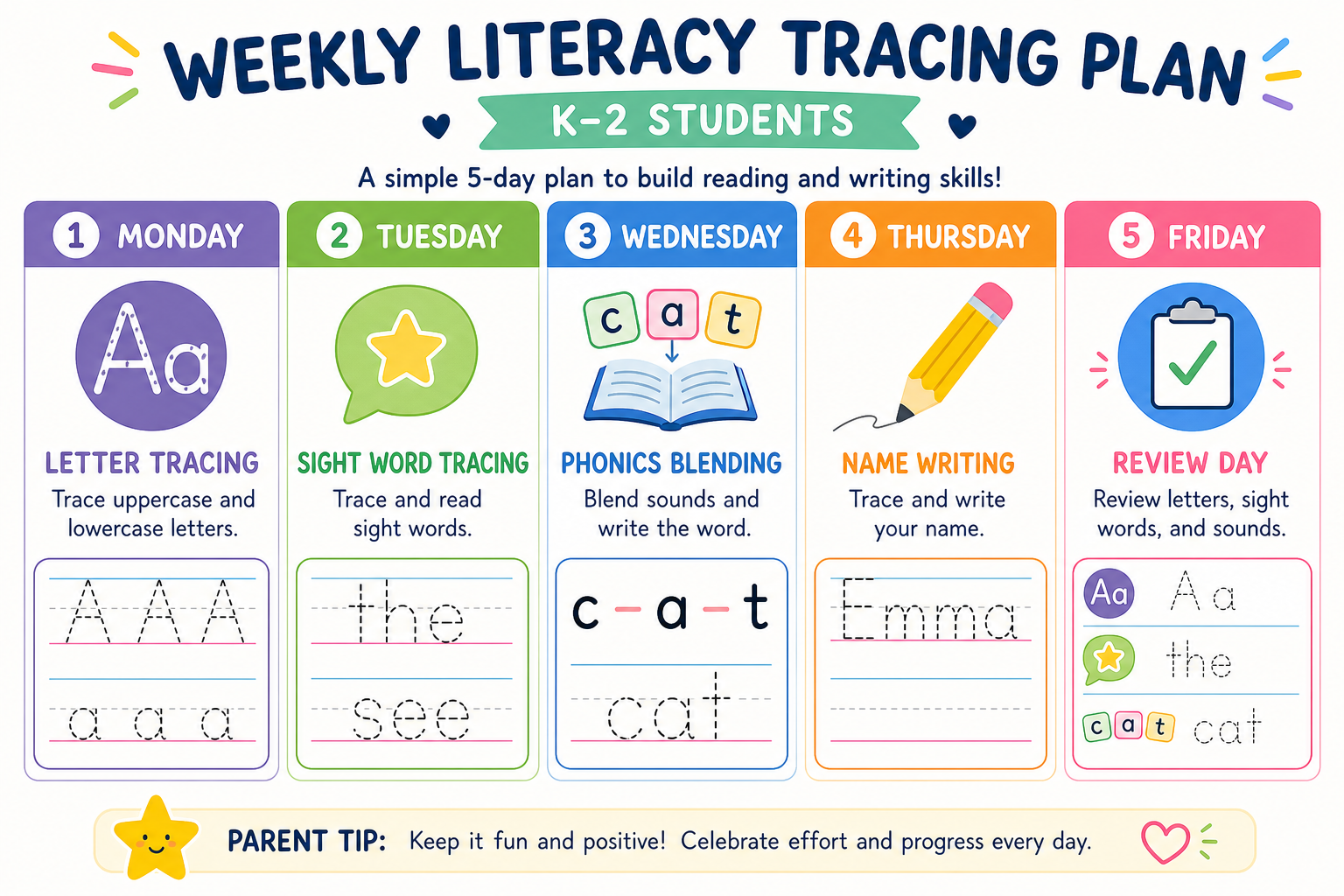
Special education and intervention students may need customized word lists on tracing pages—see worksheets for special education students for IEP-aligned tracing tips.
What Mistakes Should Teachers Avoid?
- Using tracing as the only literacy instruction
- Introducing sight words on tracing sheets before oral practice
- Tracing random words not on the child's current list
- Sessions longer than ten minutes for young writers
- Fonts too small for preschool or kindergarten hands
- Skipping phonics because sight words seem faster short-term
- Correcting grip harshly instead of offering bigger lines or shorter sessions
Key Takeaways
- Sight words build fluency; phonics builds decoding—teach both.
- Trace whole words for sight lists; trace letters and patterns for phonics.
- Introduce words orally before tracing; keep sessions under ten minutes.
- Rotate tracing with books, games, and conversation every week.
- Use custom generators so sheets match your exact word list and font needs.
Conclusion
Sight words vs. phonics is not a competition—it is a schedule question. Tracing sheets fit when they reinforce words and sounds children already know, in formats matched to their motor skills. Use phonics tracing for letters and patterns, sight word tracing for high-frequency lists, and keep the majority of literacy time on reading, talking, and listening.
Pick three sight words and one phonics pattern for next week. Print one custom tracing page for each, slot them on Tuesday and Thursday, and leave Wednesday for books only. That simple split is how most strong K-2 classrooms balance both approaches.
Free custom tracing worksheets
Sight words, names, letters, and phonics patterns—generate and print in seconds.
Free Tracing Worksheet GeneratorRelated Articles
- Writing Centers Using Tracing Sheets for Emergent Writers — station rotation for K-1
- Best Handwriting Fonts for Tracing Worksheets — pick the right font by age
- Name Writing Activities for Preschoolers — first phonics and sight word bridge
Frequently Asked Questions
Most K-2 programs teach phonics and sight words together, not one before the other. Phonics teaches how letters and patterns map to sounds so children can decode new words. Sight words build fluency for high-frequency words that appear constantly in books. Tracing sheets support both: letter tracing for phonics formation, whole-word tracing for sight word automaticity.