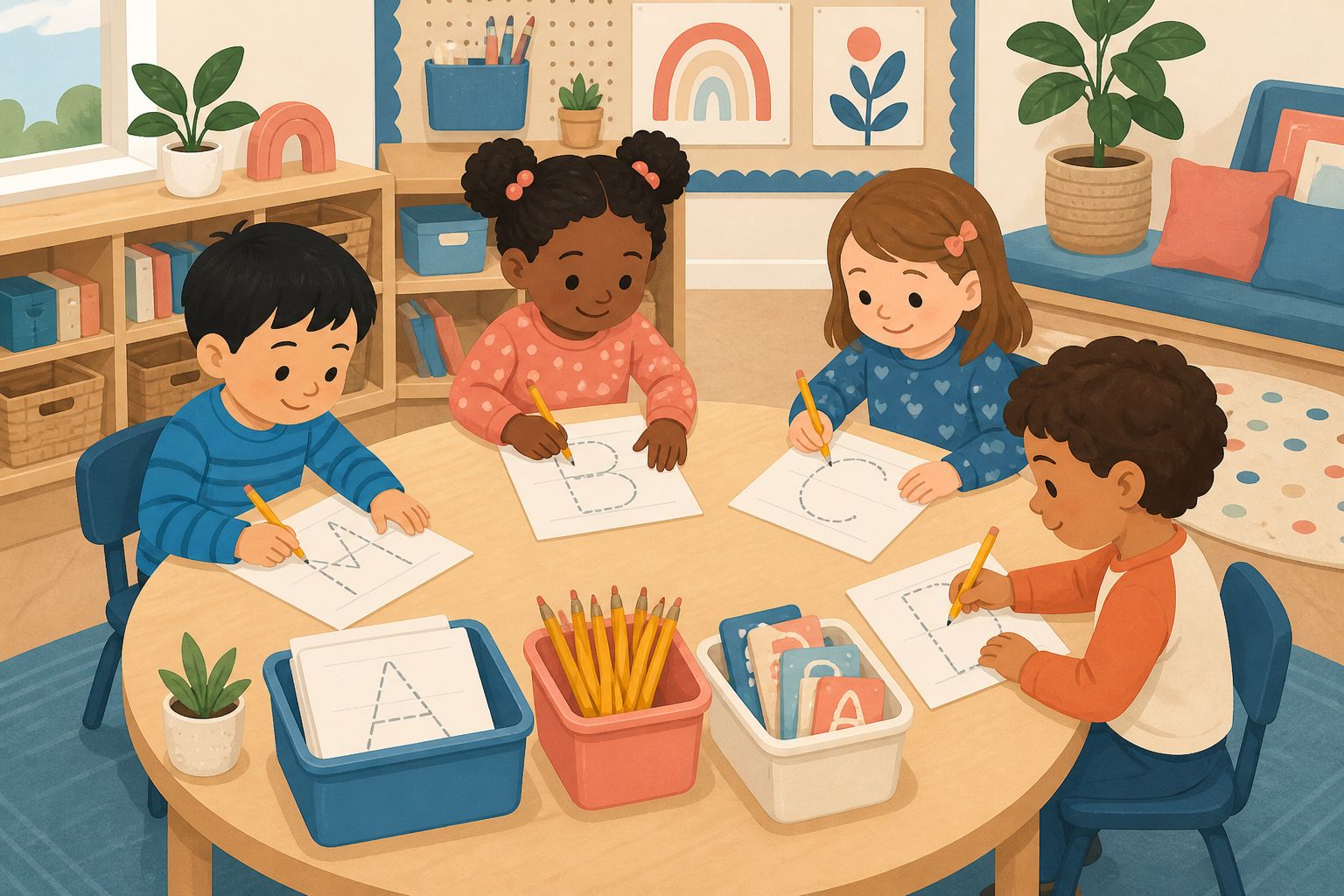
Writing centers using tracing sheets for emergent writers give preschool and kindergarten students a structured place to build letter formation, name recognition, and confidence with pencils. Emergent writers are not ready for long journal entries—they need guided paths, short tasks, and materials they can use independently while you teach elsewhere. This guide covers five station ideas, a weekly tracing rotation, setup tips, and free printable tools.
A well-run writing center balances structure and choice. Tracing sheets provide the structure; free draw and manipulatives provide the choice. Together they support the developmental stage where children move from scribbles to purposeful marks on a page.
Why Do Writing Centers Matter for Emergent Writers?
Writing centers give emergent writers daily access to literacy materials without waiting for whole-group instruction. Children practice at their own pace, revisit letters they need, and build stamina for independent work—a skill that pays off all year.
Centers also free you for small-group reading or math. When tracing stations are set up with clear routines, students know what to do, where materials live, and how long to stay. Less chaos means more actual writing time.
Early writing connects to reading development. The National Association for the Education of Young Children emphasizes play-based, developmentally appropriate literacy. Tracing in a center fits that model when it is one station among several—not the entire writing block.
How Do Tracing Sheets Support Emergent Writers?
Tracing sheets show correct letter paths before children write on blank lines. Emergent writers often know letter names but form shapes bottom-to-top or reverse letters. Dotted guides reduce those habits early.
- Muscle memory: Repeated tracing builds hand paths for later independent writing.
- Confidence: Completing a page feels achievable—important for children who avoid writing.
- Independence: Clear models let students work without constant teacher correction.
- Personal relevance: Name sheets connect literacy to identity.
Tracing supports fine motor development described in our fine motor skills and early writing guide. Pair center time with bead threading or playdough warm-ups on alternate days.
Choose fonts that match your school program—see our handwriting fonts guide for print vs. D'Nealian and size by age.
What Five Stations Should Your Writing Center Include?
Rotate children through stations across the week or let them choose one per day. Not every station needs tracing—but tracing anchors the literacy-focused options.
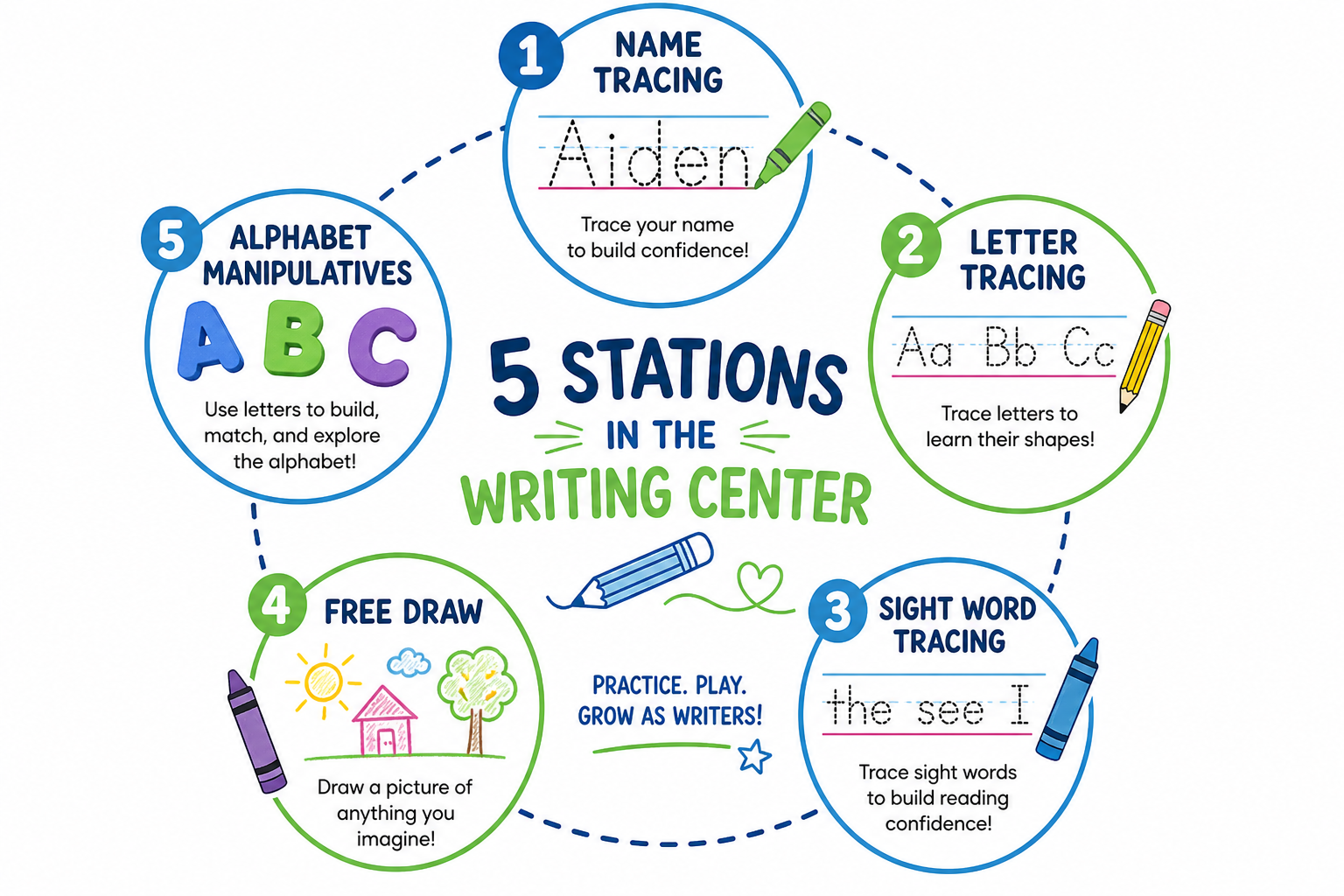
Name tracing
Materials: Custom name sheets, short pencils, name card model
Goal: Personal connection; left-to-right habit; letter sequence in child's own name
Letter tracing
Materials: Letter tracing worksheets, alphabet chart on wall
Goal: Correct stroke order; uppercase and lowercase pairs
Sight word tracing
Materials: Weekly word list on dotted lines, word wall reference
Goal: Connect high-frequency words to written form
Free draw and label
Materials: Blank paper, crayons, optional word bank
Goal: Creativity and meaning-making; children label pictures with traced or copied words
Alphabet manipulatives
Materials: Magnetic letters, sand tray, or playdough letter rolls
Goal: Build letters without paper; strengthen fingers before pencil work
Name activities extend beyond the center—our name writing activities guide has sand tracing and rainbow writing ideas to vary the routine.
How Do You Rotate Tracing Activities Each Week?
A simple rotation prevents boredom and ensures every child practices names, letters, and sight words regularly. Adjust the schedule to match your phonics sequence.
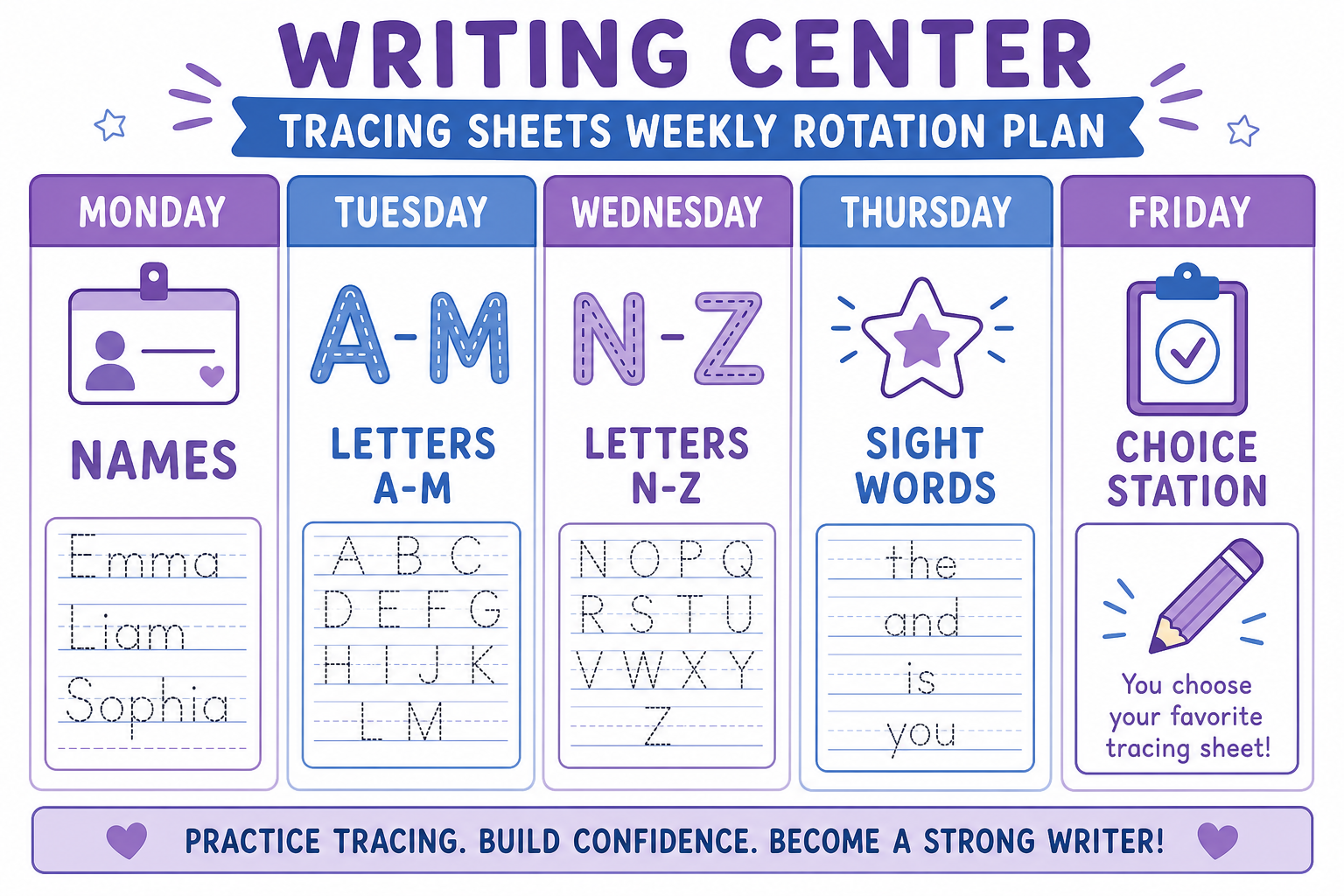
| Day | Focus | Printable |
|---|---|---|
| Monday | Name tracing — new students or name review | Create name tracing worksheets |
| Tuesday | Letter tracing — focus letters A–M or current phonics | Letter tracing worksheets |
| Wednesday | Letter tracing — letters N–Z or digraph intro | Letter tracing worksheets |
| Thursday | Sight words from word wall (2–3 words) | Tracing generator with custom words |
| Friday | Student choice — pick favorite station | Mix of name, letter, or word tracing |
Print tracing sheets for this week's rotation
Custom names, letters, and sight words—free, no signup.
How Do You Set Up and Manage the Writing Center?
A writing center fails when materials are missing or expectations are unclear. Use these setup tips once, then maintain with a five-minute Friday reset.
- Keep all materials in labeled bins children can reach independently
- Post a one-picture visual schedule: trace, then free draw
- Use short golf pencils or broken crayons to encourage tripod grip
- Laminate one model card per child for name and letter reference
- Set a sand timer for 8–10 minutes to match attention spans
- Refresh tracing sheets weekly—do not reuse worn copies with holes
Store masters in your printables library—our classroom printables organization guide recommends a dedicated tracing folder and generator bookmarks instead of hoarding PDFs.
For broader worksheet habits, read effective classroom worksheet use—short, purposeful pages fit emergent writers better than long packets.
What Mistakes Should Teachers Avoid With Tracing in Writing Centers?
- Tracing only, no free writing: Children need blank paper and drawing time too.
- Sessions too long: Ten minutes max for most preschoolers and kindergarteners.
- Wrong font or size: Match your school's handwriting style and use large lines for beginners.
- Public comparison: Do not display who finished most sheets— praise effort privately.
- Skipping fine motor warm-ups: Weak grip leads to tracing fatigue and frustration.
- Same sheet all month: Rotate words and letters weekly.
What Free Tracing Resources Support Writing Centers?
- Tracing worksheet generator — any name, word, or number sequence
- Create name tracing worksheets — Monday station staple
- Letter tracing worksheets — alphabet and phonics alignment
- Trace numbers — optional math-literacy crossover station
- Name tracing worksheets — ready-made pages and generator access
Key Takeaways
- Writing centers give emergent writers daily independent literacy practice.
- Tracing sheets guide formation; pair with free draw and manipulatives.
- Use five stations and a weekly rotation for names, letters, and sight words.
- Keep sessions short, materials labeled, and fonts consistent with your program.
- Print custom tracing sheets with free generators—rotate weekly.
Conclusion
Writing centers using tracing sheets for emergent writers turn handwriting practice into a routine children can manage themselves. Set up five stations, rotate tracing focus across the week, and keep expectations short and positive. When tracing supports—not replaces—creative writing and play, emergent writers build skills they will use for years.
Print next week's name and letter sheets today, label one bin "Writing Center," and walk your class through the routine once. By Friday, many students will head there without prompting—that is when you know the center is working.
Stock your writing center with free tracing sheets
Names, letters, and custom words. Print unlimited copies, no signup.
Free Tracing GeneratorRelated Articles
- Name Writing Activities for Preschoolers — extend name work beyond the center
- Fine Motor Skills in Early Writing — motor foundation for tracing
- Best Handwriting Fonts for Tracing — pick the right style for your center
Frequently Asked Questions
Emergent writers are young children in preschool, kindergarten, or early first grade who are beginning to connect spoken language to written symbols. They may scribble, trace letters, copy their name, or write random strings of letters. Tracing sheets support this stage by guiding hand movement along correct letter paths before independent writing.