Teaching patterns and algebraic thinking in elementary school starts with repeating shapes in kindergarten and grows into rules, missing numbers, and input-output relationships by fifth grade. Students learn to notice structure, describe rules, and find unknowns through pattern blocks, function machines, and balance models—not formal algebra symbols too early.
Algebraic thinking is not a middle school topic you preview with worksheets full of x and y. It is a habit of mind built across K–5: seeing relationships, predicting outcomes, and explaining why a sequence works. This guide covers grade progression, pattern types, six classroom activities, unknowns and equations, a weekly lesson sequence, and free practice tools.

What Is Algebraic Thinking in Elementary School?
Algebraic thinking means reasoning about relationships between quantities. A first grader who solves 8 + ? = 11 is thinking about an unknown. A third grader who says the rule for 3, 6, 9, 12 is add 3 is describing a function. Neither student needs the letter x to build the habit.
The Common Core Operations and Algebraic Thinking standards span kindergarten through fifth grade. Pattern work connects to number sense in kindergarten and later to multiplication arrays in our third grade multiplication guide.
How Do Patterns Progress by Grade?
Each grade adds complexity. Do not rush upper-grade skills into lower grades— repeating patterns in kindergarten are not baby work; they are foundation.
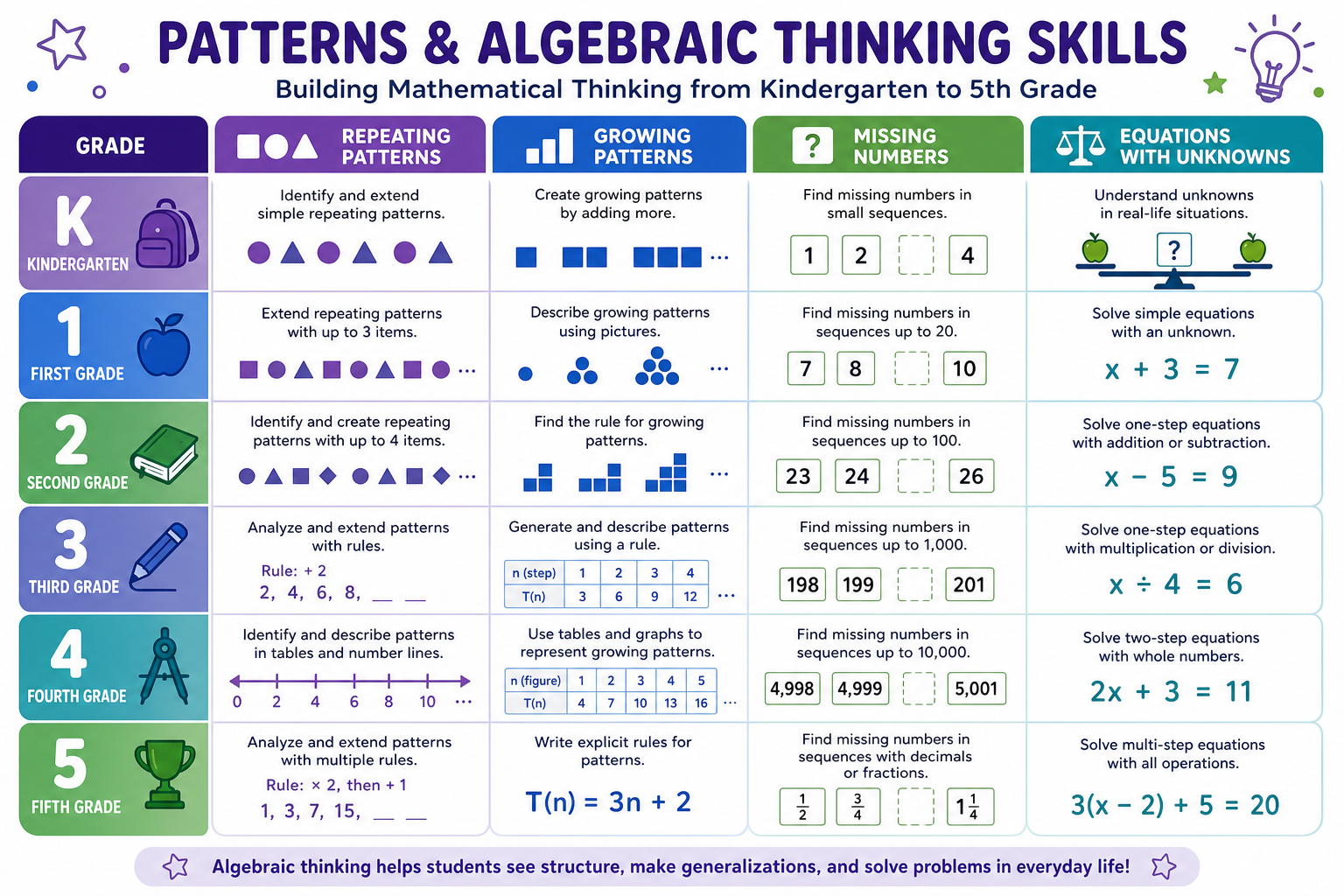
| Grade | Patterns | Algebraic thinking |
|---|---|---|
| K | Repeating AB, AAB, ABC patterns with colors and shapes | Compare more/less; what comes next in a simple sequence |
| 1–2 | Growing patterns; skip counting by 2s, 5s, 10s | Missing addend: 7 + ? = 12; equal sign as balance |
| 3 | Multiplication patterns; arrays as growing rectangles | Input-output tables; two-step word problems |
| 4–5 | Rules written in words; numerical expressions | Variables as unknowns; order of operations intro |
Fourth and fifth grade parents can cross-check related topics in our complete 4th grade math guide.
What Types of Patterns Should You Teach?
Rotate pattern types across the year so students do not only see one format.
Example: Red, blue, red, blue, red, blue…
Ask: What comes next? Can you name the unit (AB)?
Example: 1, 3, 5, 7, 9… or 2, 4, 8, 16…
Ask: What is the rule? What is the 10th term?
Example: Triangle, square, triangle, square… or rotating shapes
Ask: Describe the pattern in words before predicting.
Example: Start at 4, jump +3 each time: 4, 7, 10, 13…
Ask: How does the jump size relate to the rule?
What Six Activities Build Algebraic Habits?
Hands-on first, paper second. These six activities cover repeating through growing patterns and early unknowns.
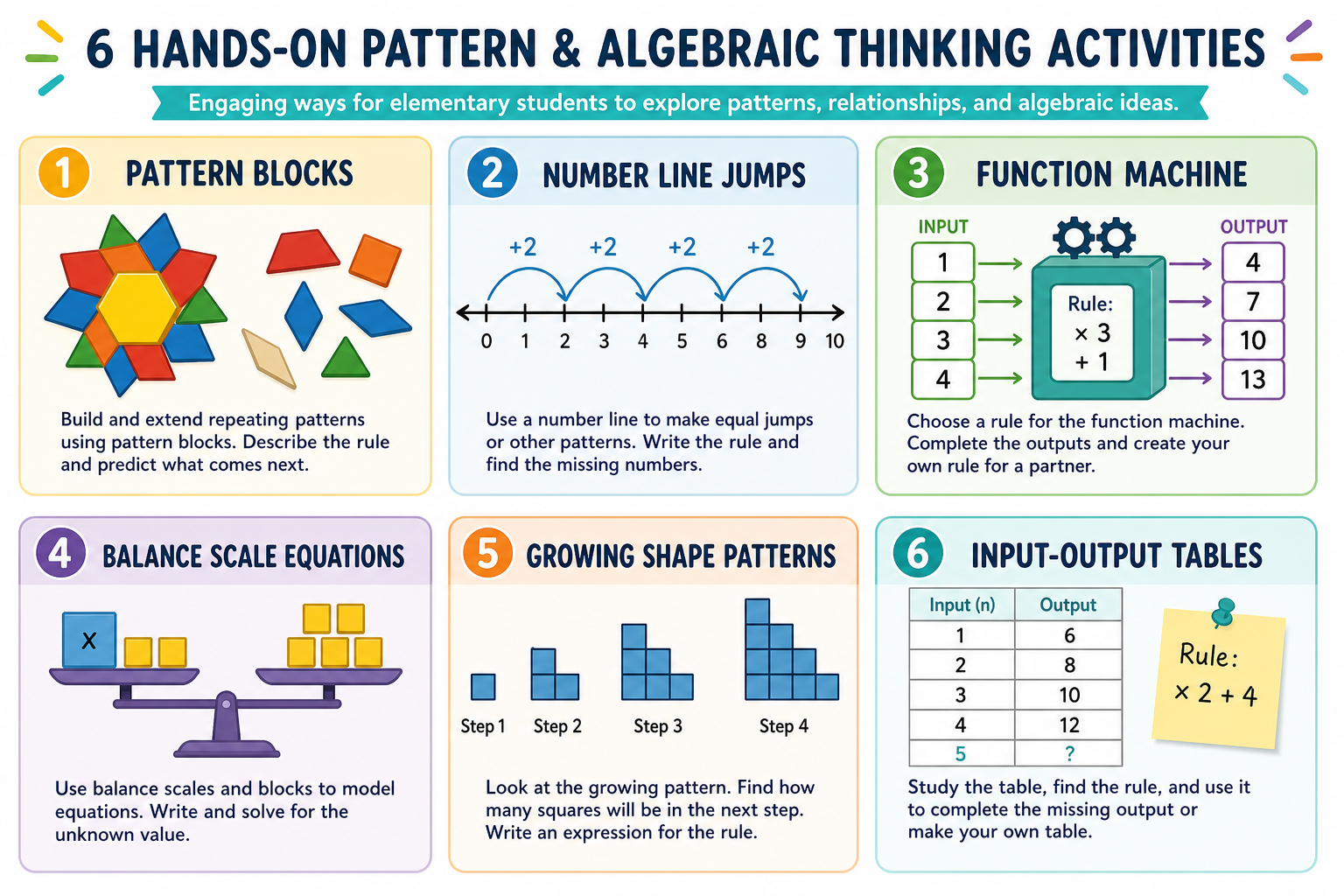
Build a repeating or growing train. Ask students to extend it and explain the rule aloud.
Drop a number in; apply a secret rule (+5, ×2); reveal the output. Students guess the rule from examples.
Both sides must match. 3 + 4 on left equals 5 + 2 on right. Introduces equation thinking visually.
Hop by equal steps from a starting number. Connect skip counting to growing patterns.
Fill a table when the rule is add 6 or multiply by 3. Bridge to formal expressions in grade 4–5.
Build successive rectangles with tiles (1×1, 1×2, 1×3). Connect pattern to area and multiplication.
Shape and area patterns connect to hands-on geometry activities when students build growing rectangles with tiles.
Print pattern and missing-number practice
Custom math worksheets for sequences, missing addends, and grade-level operations.
Free Math Worksheet GeneratorHow Do You Introduce Unknowns?
Move from concrete to symbolic in stages:
- Missing addend stories: "I have 5 marbles, get some more, now I have 12." Use cubes before writing 5 + ? = 12.
- Balance models: Both pans equal. Replace a cube with a ? card when students are ready.
- Input-output: Same rule every time—bridge to "the machine always adds 4."
- Empty box: 6 + □ = 14 before the letter n appears in grade 5.
- Variables: n + 3 = 10 only after boxes and balances are comfortable.
Word problems with unknowns use the same routines as our step-by-step word problem guide. Place value supports larger patterns—use place value worksheets when patterns cross tens or hundreds.
The NCTM Principles and Standards emphasize algebraic reasoning across all elementary grades, not as a single unit in fifth grade only.
What Weekly Lesson Sequence Works?
One pattern type per week keeps focus tight. Adjust Thursday worksheet length by grade.
What Mistakes Should Teachers Watch For?
- Skipping repeating patterns in K–1 because they seem too simple
- Only asking what comes next without asking for the rule in words
- Introducing variables before students handle missing addends concretely
- Treating patterns as art time without math vocabulary
- Using random number sequences with no clear rule
- Not connecting patterns to multiplication and area in grade 3–4
Key Takeaways
- Algebraic thinking in elementary means patterns, rules, and unknowns—not early x and y.
- Progress from repeating patterns to growing sequences to input-output tables.
- Always ask for the rule in words, not only the next term.
- Use balance scales and function machines before abstract symbols.
- Pair manipulatives Monday–Wednesday with short worksheets Thursday–Friday.
Conclusion
Teaching patterns and algebraic thinking in elementary school prepares students for middle school math without rushing symbols. Start with repeating patterns in kindergarten, grow into rules and missing numbers, and let fifth graders write expressions when models are solid. Pattern work is algebra in disguise—and students who learn to see structure early solve harder problems later.
Build one pattern block train tomorrow, name the rule aloud, and print five follow-up problems from the generator. That cycle—see, say, solve—is how algebraic thinking takes root in every grade.
Free pattern and missing-number worksheets
Custom math pages by grade—sequences, operations, and unknowns.
Free Math Worksheet GeneratorRelated Articles
- Building Number Sense in Kindergarten — foundation for early patterns
- How to Teach Multiplication to 3rd Graders — arrays as growing patterns
- How to Teach Word Problems Step by Step — unknowns in story contexts
Frequently Asked Questions
Algebraic thinking in elementary school means noticing patterns, describing relationships, and finding unknown values—not solving formal equations with x and y. Young children extend repeating color patterns; older students work with growing number sequences, input-output tables, and missing addends. These habits prepare students for variables and equations in middle school.