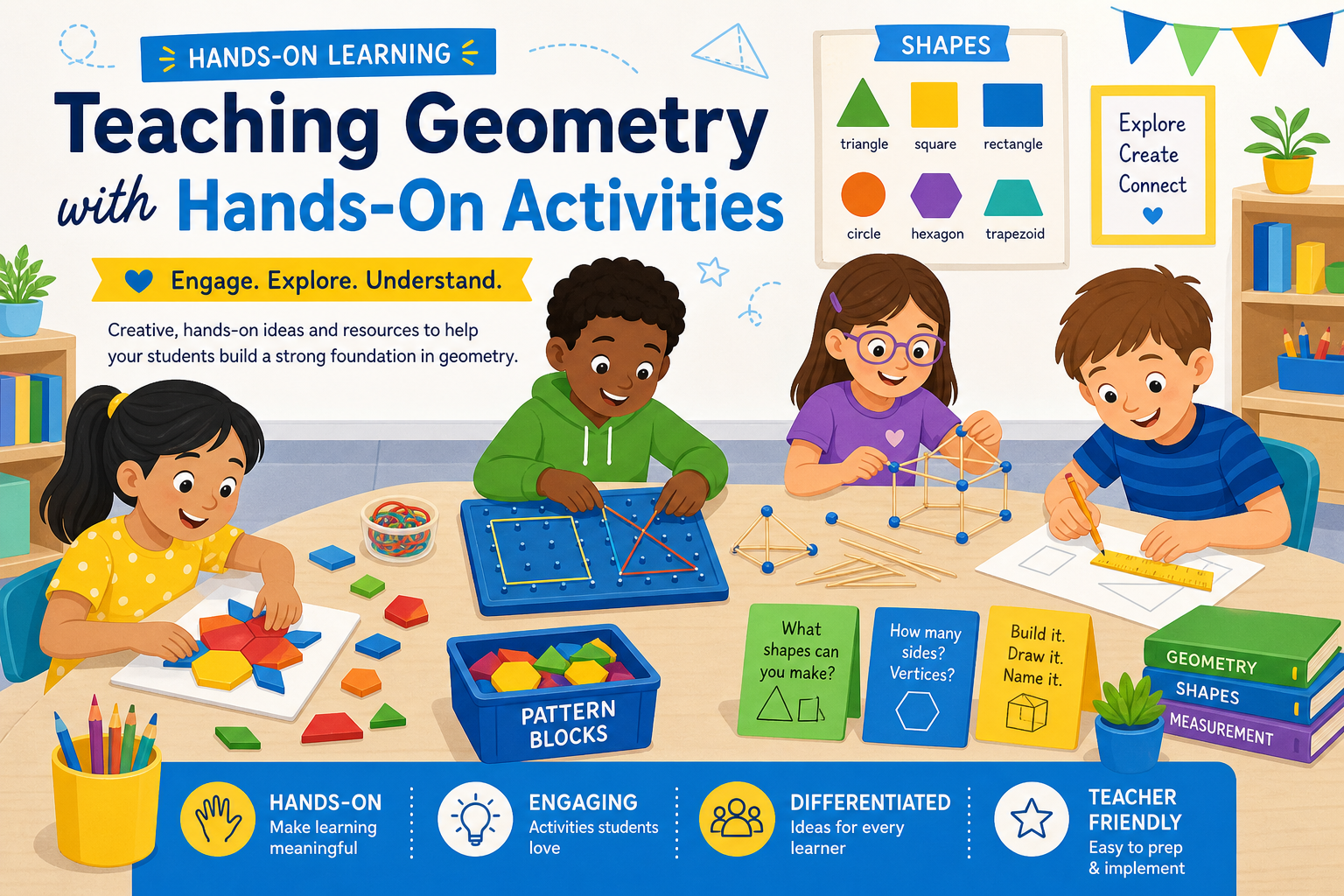
Teaching geometry with hands-on activities helps elementary students see shapes, space, and measurement before memorizing formulas. Build with blocks, tile surfaces for area, walk perimeters with string, and hunt angles in the classroom. This guide covers grade-level geometry skills, eight ready-to-use activities, symmetry and angle lessons, common mistakes, a weekly sequence, and free worksheet pairings.
Geometry is visual and physical—paper alone rarely sticks. When students touch edges, count unit squares, and fold symmetry lines, vocabulary finally matches experience.
Why Teach Geometry with Hands-On Activities?
Spatial reasoning predicts success in math beyond geometry class. Students who build and rotate shapes develop mental models for fractions, arrays, coordinates, and later algebra. Hands-on lessons also engage learners who struggle with computation but excel at visual tasks.
The Common Core geometry standards expect students to analyze shapes by attributes, not just appearance. A hands-on approach matches that expectation from kindergarten onward.
This pairs naturally with visual fraction work in our fractions with visual models guide—partitioning rectangles in second grade bridges both topics.
What Geometry Skills Appear by Grade?
Match activities to your standards pacing. Fourth grade geometry is covered in depth in our 4th grade math topics guide.
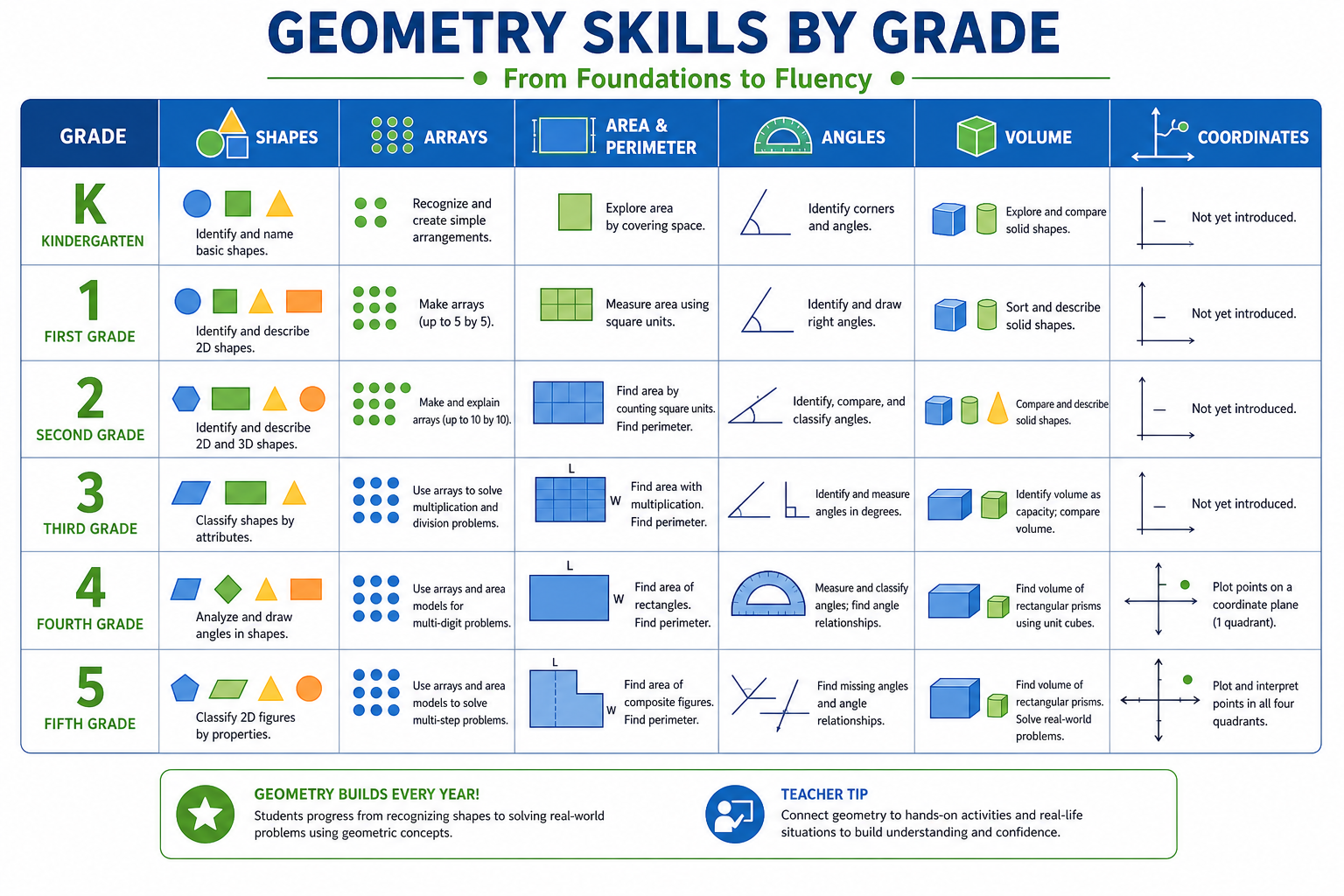
| Grade | Key skills | Sample activity |
|---|---|---|
| K–1 | Name 2D/3D shapes; describe sides and corners; compose larger shapes | Shape walk and pattern block pictures |
| 2 | Partition rectangles; rows and columns; equal shares intro | Array buildings with counters on grid paper |
| 3 | Area with unit squares; perimeter; quadrilateral categories | Tile the desk with index cards; measure perimeter with string |
| 4–5 | Angles, parallel/perpendicular lines, symmetry, volume, coordinates | Protractor measure on door frames; voxel volume with cubes |
What Eight Hands-On Activities Work Best?
These activities need minimal prep and scale from homeschool to full classrooms. Rotate them across units so geometry stays active—not a once-a-year worksheet packet.
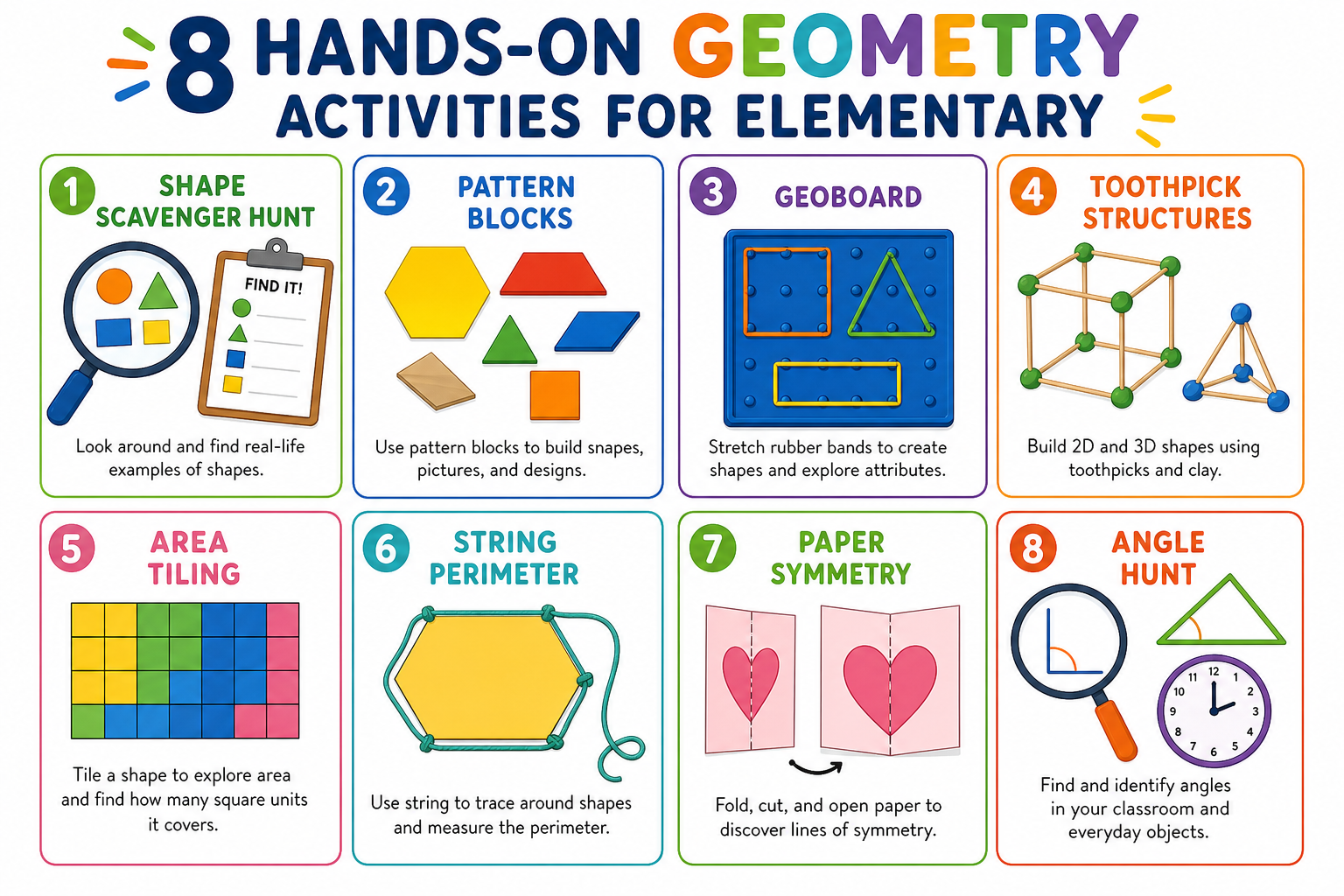
1. Shape scavenger hunt
Grades K–2
Students find circles, rectangles, and cylinders in the classroom or at home. Sketch each and label.
Builds: Shape recognition and vocabulary
2. Pattern block designs
Grades K–3
Build animals, letters, or symmetric pictures. Count how many of each shape used.
Builds: Composing and decomposing shapes
3. Geoboard figures
Grades 2–4
Stretch bands to make triangles, squares, and rectangles. Compare perimeters on the same board.
Builds: Properties of polygons
4. Toothpick and clay structures
Grades 2–5
Edges are toothpicks; vertices are clay balls. Build cubes, prisms, and pyramids.
Builds: 3D shape edges, faces, and vertices
5. Index-card area tiling
Grades 3–4
Cover a book or desk surface with index cards without gaps. Count cards for area in square units.
Builds: Area as covering without overlap
6. String perimeter walk
Grades 3–5
Measure object perimeters with string, then a ruler. Compare rectangle vs. square with same area.
Builds: Perimeter as distance around
7. Paper folding symmetry
Grades 1–4
Fold paper, cut shapes, unfold to reveal symmetry. Label line of symmetry.
Builds: Line symmetry and reflection
8. Angle hunt with protractors
Grades 4–5
Find right, acute, and obtuse angles in the room. Measure door corners and table legs.
Builds: Angle classification and measurement
Add movement with ideas from 10 fun math games for kids—shape relays and outdoor chalk geometry extend any lesson.
Pair hands-on lessons with short geometry worksheets
Generate custom math practice after manipulative exploration—5 problems, not 50.
Math Worksheet GeneratorHow Do You Teach Shapes and Symmetry?
Start with sorting real objects and pattern blocks by sides, angles, and curves. Use precise vocabulary after students describe shapes in their own words: "4 equal sides" before "square."
- Kindergarten: shape walks and attribute sorting trays
- Grade 1–2: compose rectangles from triangles; introduce line symmetry with paper folding
- Grade 3–4: classify quadrilaterals by parallel sides; mirror art with paint blot symmetry
Young learners build spatial language through kindergarten number and shape routines and kindergarten math worksheets for follow-up drawing tasks.
How Do You Teach Area and Perimeter?
Never introduce formulas on day one. Area is covering a surface with unit squares without gaps or overlaps. Perimeter is the distance around—walk it, then measure it.
- Tile a rectangle with index cards; count squares for area
- Wrap the same rectangle with string; measure for perimeter
- Compare two shapes with the same area but different perimeters
- Only then introduce length × width on grid paper
Third grade teachers can extend with 3rd grade math worksheets after the tiling lesson. Word problems connect to our word problem routine when students solve area and perimeter stories.
How Do You Introduce Angles and Lines?
Fourth and fifth graders classify angles and identify parallel and perpendicular lines in the environment before worksheets name them.
- Use two pencils hinged with a brad to show angle opening
- Classify corners in the room as right, acute, or obtuse
- Introduce protractors only after students estimate angle size by eye
- Find parallel lines on ruled paper, brick walls, and desk edges
The National Council of Teachers of Mathematics recommends connecting geometry to students' physical world. Classroom architecture is free instructional material.
What Mistakes Should Teachers Avoid?
- Defining shapes by appearance only (a "diamond") instead of properties (a rhombus)
- Teaching area and perimeter formulas before unit-square experiences
- Skipping 3D exploration—students only draw flat shapes on paper
- Using worksheets as the entire geometry block with no manipulatives
- Introducing protractors before students understand angle as rotation
- Confusing perimeter and area because both use multiplication on worksheets
Follow the five worksheet rules in using worksheets effectively: paper follows manipulatives, never replaces them in geometry units.
What Does a Weekly Lesson Sequence Look Like?
A two-week geometry unit can repeat this rhythm for each new concept—shapes, area, angles—without feeling repetitive.
| Day | Focus | Format |
|---|---|---|
| Monday | Explore with manipulatives (new concept) | Pattern blocks or geoboards |
| Tuesday | Vocabulary and drawing | Label diagrams in math journal |
| Wednesday | Real-world measure or hunt | Rulers, string, classroom objects |
| Thursday | Short worksheet practice | 5–8 problems from generator |
| Friday | Game or design challenge | Partner shape build or scavenger race |
Key Takeaways
- Geometry sticks when students build, measure, and fold before labeling.
- Match eight core activities to grade-level standards K–5.
- Teach area with tiling and perimeter with string before formulas.
- Use protractors and vocabulary after concrete angle experiences.
- Follow manipulatives with short worksheets, not long drill packets.
Conclusion
Teaching geometry with hands-on activities turns abstract vocabulary into something students can point to, walk around, and rebuild. Stock a few durable materials, run a weekly explore-draw-measure-practice cycle, and connect paper work to what students already touched. When a child can explain why a shape has perimeter but area measures covering, the lesson worked.
Plan one shape scavenger hunt or index-card tiling lesson for next week. Print five follow-up problems from the generator. That is enough to launch a geometry unit the hands-on way.
Free math worksheets to extend geometry lessons
Custom practice by grade and operation—print after every hands-on activity.
Free Math Worksheet GeneratorRelated Articles
- A Complete Guide to 4th Grade Math Topics — angles, area, and perimeter pacing
- Teaching Fractions with Visual Models — partition shapes before formal fractions
- 10 Fun Math Games for Kids — movement games for shape review
Frequently Asked Questions
Young children understand shapes, space, and measurement by touching and building before they memorize definitions. Hands-on geometry connects abstract vocabulary—vertex, parallel, perimeter—to objects students can rotate, fold, and measure. Research shows that spatial reasoning built in elementary school supports later algebra and STEM learning.