Teaching measurement—length, weight, and volume—starts with comparing real objects, then moves to standard tools like rulers, scales, and measuring cups. Elementary students need hands-on practice before formulas. This guide covers grade-level expectations, step-by-step lessons for each attribute, six classroom activities, common mistakes, and free worksheet tools for practice.
Measurement connects math to daily life: cooking, building, shopping, and science. When children measure first and label second, inches and liters stop feeling like abstract symbols on a page.
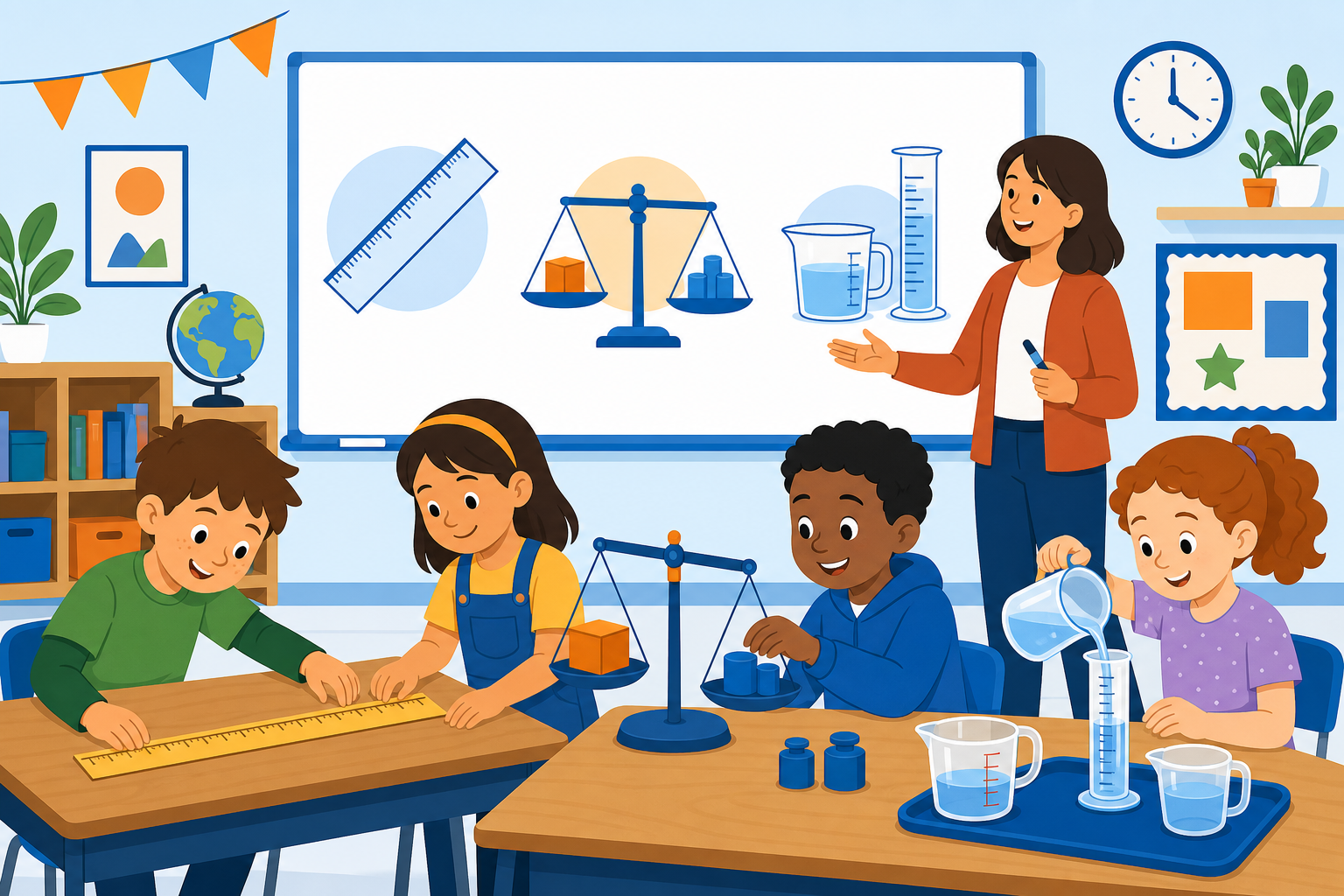
Why Does Measurement Matter in Elementary Math?
Measurement is one of four core strands in elementary math alongside number, geometry, and data. Students who struggle with rulers often struggle with fractions, graphs, and word problems later because measurement weaves through every grade.
The Common Core measurement standards progress from direct comparison in kindergarten to unit conversion and volume in fifth grade. Time is part of the same strand—see our telling time guide for clock skills that pair naturally with measurement units.
What Should Each Grade Level Know?
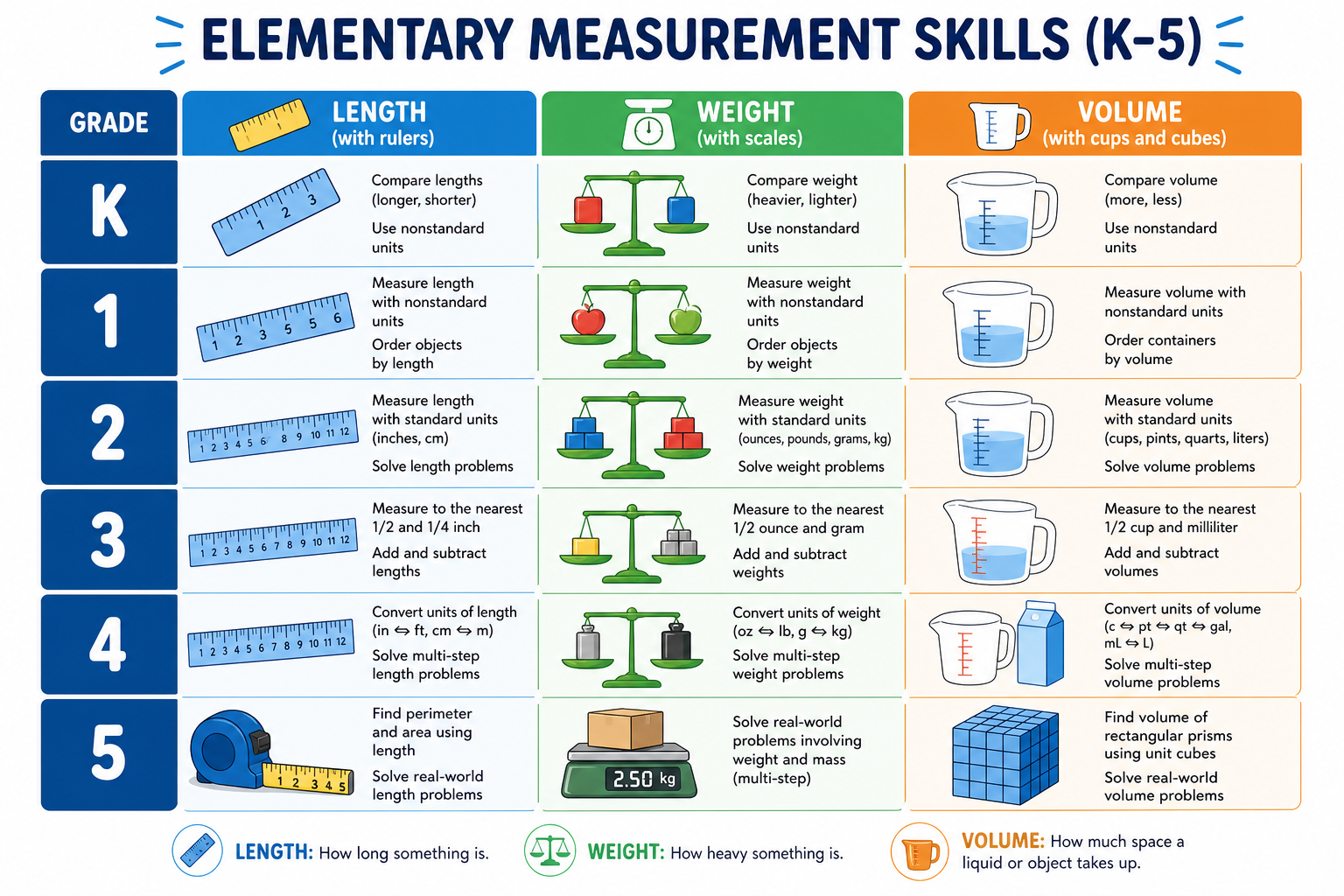
Use this table as a pacing guide. Adjust based on your state standards and student readiness.
| Grade | Length | Weight | Volume |
|---|---|---|---|
| K–1 | Compare longer/shorter; measure with non-standard units | Compare heavier/lighter with balance scales | Compare more/less liquid in containers |
| 2 | Measure to nearest inch or centimeter with rulers | Read scales in pounds or kilograms (intro) | Compare and order container capacities |
| 3–4 | Fractions on rulers; perimeter and area | Grams and kilograms; word problems | Liquid measure in cups and liters; intro solid volume |
| 5 | Customary and metric conversion | Multi-step conversion problems | Unit cubes; rectangular prism volume formulas |
Fourth grade parents can cross-check topics in our complete 4th grade math guide. Fifth graders preparing for middle school benefit from the conversion and volume sections below.
How Do You Teach Length?
Length is distance in one direction. Build the skill in six stages:
- Compare two objects: Which is longer? Order three items from shortest to longest.
- Measure with non-standard units: How many paper clips long is the desk?
- Introduce rulers: Align at zero, read to the nearest whole unit.
- Add half-inch or half-centimeter marks in grade 2–3.
- Connect to perimeter: Measure all sides of a rectangle and add.
- Convert units in grade 4–5: feet to inches, meters to centimeters.
Emphasize ruler alignment: the end of the object lines up with zero, not the edge of the ruler. Demonstrate on a projector, then circulate while pairs measure desks and books. Perimeter connects length to hands-on geometry activities when students walk string around a shape and measure each side.
How Do You Teach Weight and Mass?
Young students compare weight before they read numbers on a scale. Start with a balance: Which side goes down? Then introduce units—ounces and pounds in customary, grams and kilograms in metric.
- K–1: Heavier/lighter vocabulary; balance scale predictions
- Grade 2–3: Read dial or digital scales; record weights in a table
- Grade 4–5: Convert ounces to pounds, grams to kilograms; multi-step word problems
Use the word mass when you discuss metric science contexts; weightis fine for everyday classroom language. The key is separating weight from volume—a common student confusion addressed in the FAQ below.
Print measurement practice by grade
Custom math worksheets for length, conversion, perimeter, and volume word problems—generated in seconds.
Free Math Worksheet GeneratorHow Do You Teach Volume?
Volume has two elementary meanings: liquid capacity (how much a container holds) and solid volume (how much space a 3D object fills). Teach them separately before combining.
Liquid volume: Use measuring cups, liters, and milliliters. Pour water between containers so students see that shape changes but amount can stay the same. Cooking projects make this stick.
Solid volume: Fill a box with unit cubes. Count layers: length × width × height. Connect to the rectangular prism formula in fifth grade only after students have built models. Area (flat) and volume (3D) should not share the same lesson day in grades 3–4.
The NCTM Principles and Standards recommend connecting measurement to real contexts. Science experiments and PBL units are ideal—see how worksheets support project-based learning with data collection logs during measurement projects.
What Hands-On Activities Work Best?
Rotate stations so every student touches each attribute within two weeks.
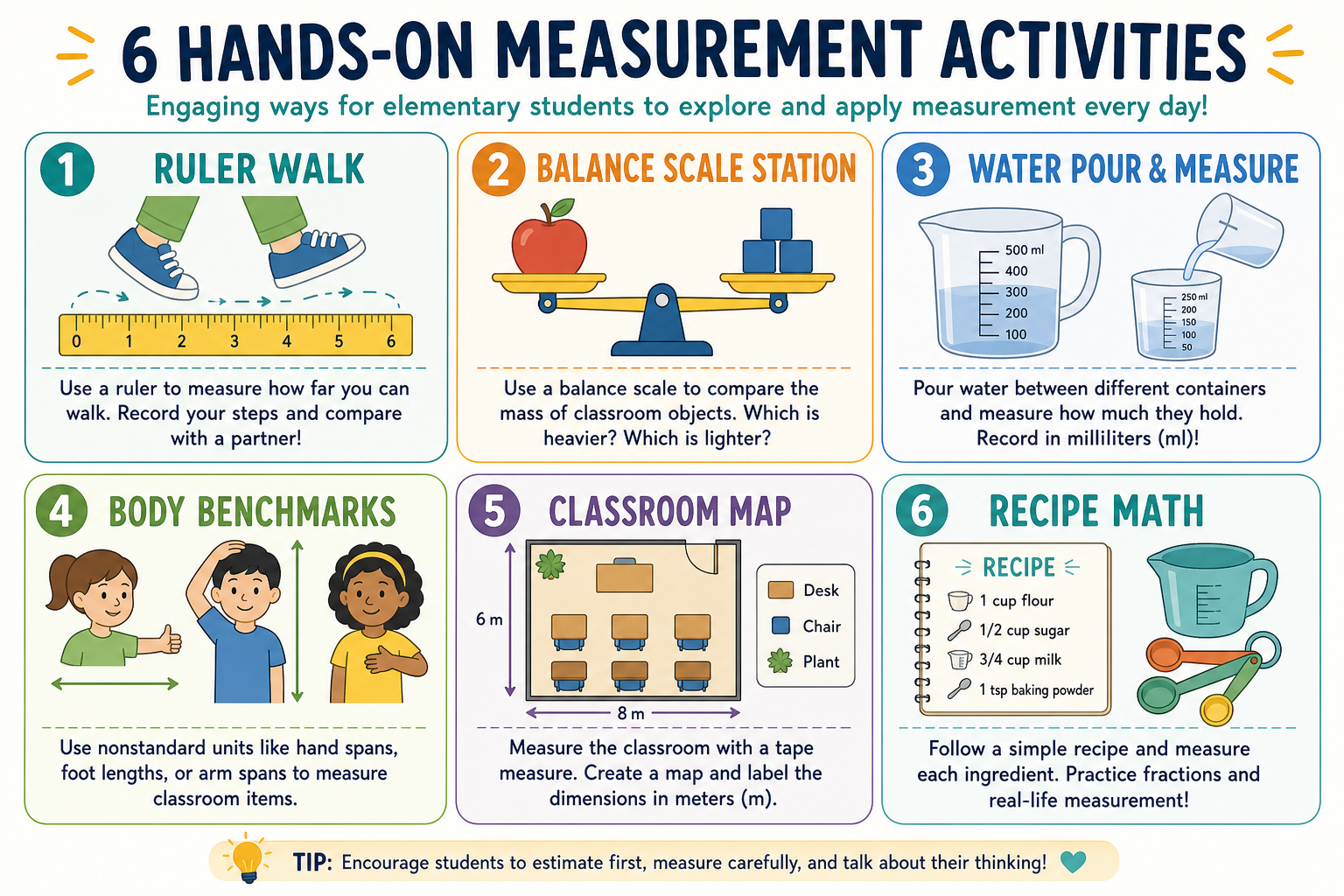
Measure classroom objects in pairs. Record length, then compare who found the longest item.
Predict which object is heavier, then test on a balance. Record results in a table.
Pour water between cups, liters, and milliliter containers. Discuss which holds more.
Use hand span, foot length, and arm span as non-standard units for K–1 estimation.
Measure desk lengths and aisle widths. Scale drawings connect measurement to real space.
Double or halve a recipe. Practice cups, tablespoons, and fraction cups in context.
What Mistakes Should Teachers Watch For?
- Starting rulers at the 1 mark instead of zero
- Confusing weight and volume vocabulary (heavy vs. full)
- Mixing perimeter, area, and volume formulas without separate models
- Teaching conversion charts before students can measure accurately
- Using only worksheet pictures without real tools first
- Ignoring metric units until fifth grade (introduce both systems early)
Estimation supports measurement fluency. Before precise ruler work, ask students to guess lengths and weights, then check. Our rounding and estimation guide pairs well with measurement word problems that ask for approximate answers.
How Do Worksheets Support Measurement?
Worksheets follow hands-on lessons, not the other way around. After a ruler station, assign five problems measuring pictured objects. After a volume pour lab, assign two conversion word problems.
- Recording sheets: Tables for station data double as assessment evidence.
- Conversion practice: Short custom pages from the math worksheet generator after students master tools.
- Word problems: Connect measurement to step-by-step word problem routines.
- Place value support: Decimal measurement ties to place value worksheets when students read 2.5 cm or 3.75 liters.
Key Takeaways
- Teach length, weight, and volume as separate attributes with the right tools.
- Compare and order before rulers, scales, and measuring cups.
- Keep perimeter, area, and volume in distinct lessons with different models.
- Use stations, cooking, and classroom maps for real measurement experience.
- Assign short worksheets only after hands-on practice.
Conclusion
Teaching measurement—length, weight, and volume—works when students measure real things first and label units second. Follow the grade progression from comparison to conversion, rotate hands-on stations, and fix ruler-zero habits early. Measurement is math students use every day; give them tools they will reach for outside school.
Set up one balance scale station and one ruler walk tomorrow. Record results on a simple table, then print five follow-up problems from the generator. That cycle— measure, record, practice—is the backbone of every measurement unit.
Free measurement practice worksheets
Custom math pages by grade—length, conversion, perimeter, and volume.
Free Math Worksheet GeneratorRelated Articles
- Teaching Telling Time to First and Second Graders — another core measurement strand
- Teaching Geometry with Hands-On Activities — perimeter, area, and volume models
- How to Teach Word Problems Step by Step — measurement story problems
Frequently Asked Questions
Kindergarten and first grade introduce comparing lengths and weights with non-standard units like paper clips or cubes. Second grade adds measuring with rulers to the nearest inch or centimeter. Third and fourth graders work with fractions on rulers, area, and metric conversion. Fifth grade adds volume with unit cubes and liquid measurement in cups, pints, and liters.