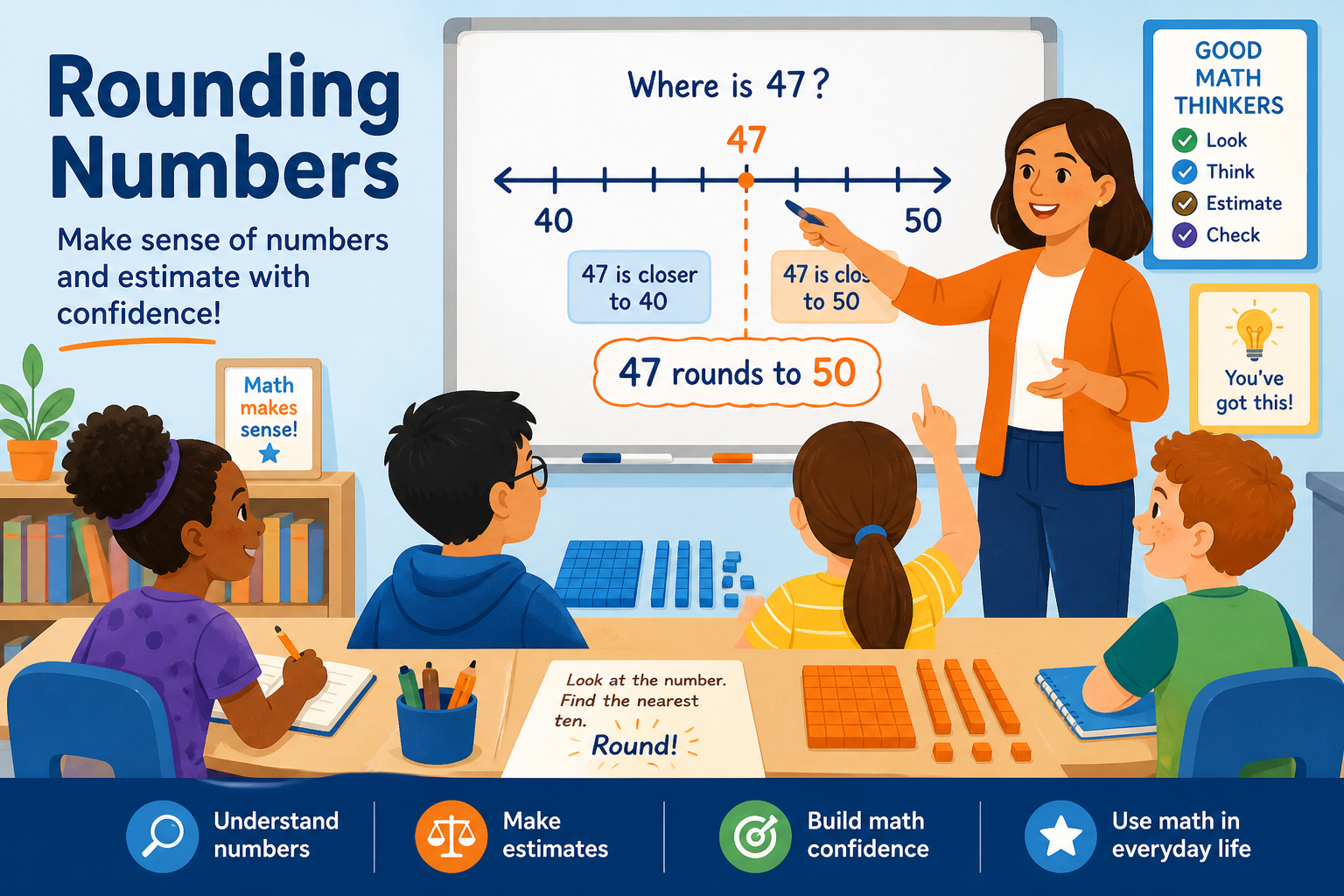
To teach rounding numbers, start with place value and number lines before any "five or more round up" chant. Students round to the nearest ten, hundred, or thousand by finding which benchmark is closer, then zeroing digits to the right. This guide covers grade-level expectations, a five-step lesson sequence, the number line method, the standard rounding rule, common mistakes, real-world practice, and free worksheet tools.
Rounding is estimation—not a trick. When children see 47 on a line between 40 and 50, the rule finally makes sense instead of feeling like magic.
What Is Rounding and Why Does It Matter?
Rounding replaces a number with a nearby value that is easier to work with. We round 48 to 50 when estimating a grocery total, or 3,847 to 3,800 when checking whether a calculation is reasonable. Rounding supports mental math, measurement, and error checking—not just worksheet answers.
The Common Core third grade number standards expect fluency rounding to tens and hundreds. Fourth graders extend to larger numbers and decimals—see our decimals in 4th grade guide for tenths and hundredths rounding.
What Prerequisites Should Be Solid First?
Students who cannot name place values will round incorrectly every time. Confirm these skills before lesson one:
- Identify ones, tens, and hundreds digits in three- and four-digit numbers
- Understand that 63 is 6 tens and 3 ones—not just "six-three"
- Plot numbers on an open number line with benchmarks at intervals of 10 or 100
- Compare which of two numbers is closer to a benchmark
Reteach with base-ten blocks, a place value chart, and place value worksheets if students hesitate on any item above.
What Should Each Grade Level Know?
| Grade | Skills | Example |
|---|---|---|
| 2 | Intro to nearest ten with models; understand tens as groups of ten | 63 rounds to 60 |
| 3 | Round to nearest 10 and 100; use number lines | 346 rounds to 350 or 300 |
| 4–5 | Round multi-digit whole numbers; round decimals to tenths/hundredths | 3,847 rounds to 3,800; 2.46 rounds to 2.5 |
Second grade parents can preview skills in our 2nd grade math guide. Fourth grade pacing details live in the 4th grade topics guide.
What Five-Step Lesson Sequence Works?
Spread these steps across one to two weeks. Do not rush to hundreds before tens are automatic on a number line.
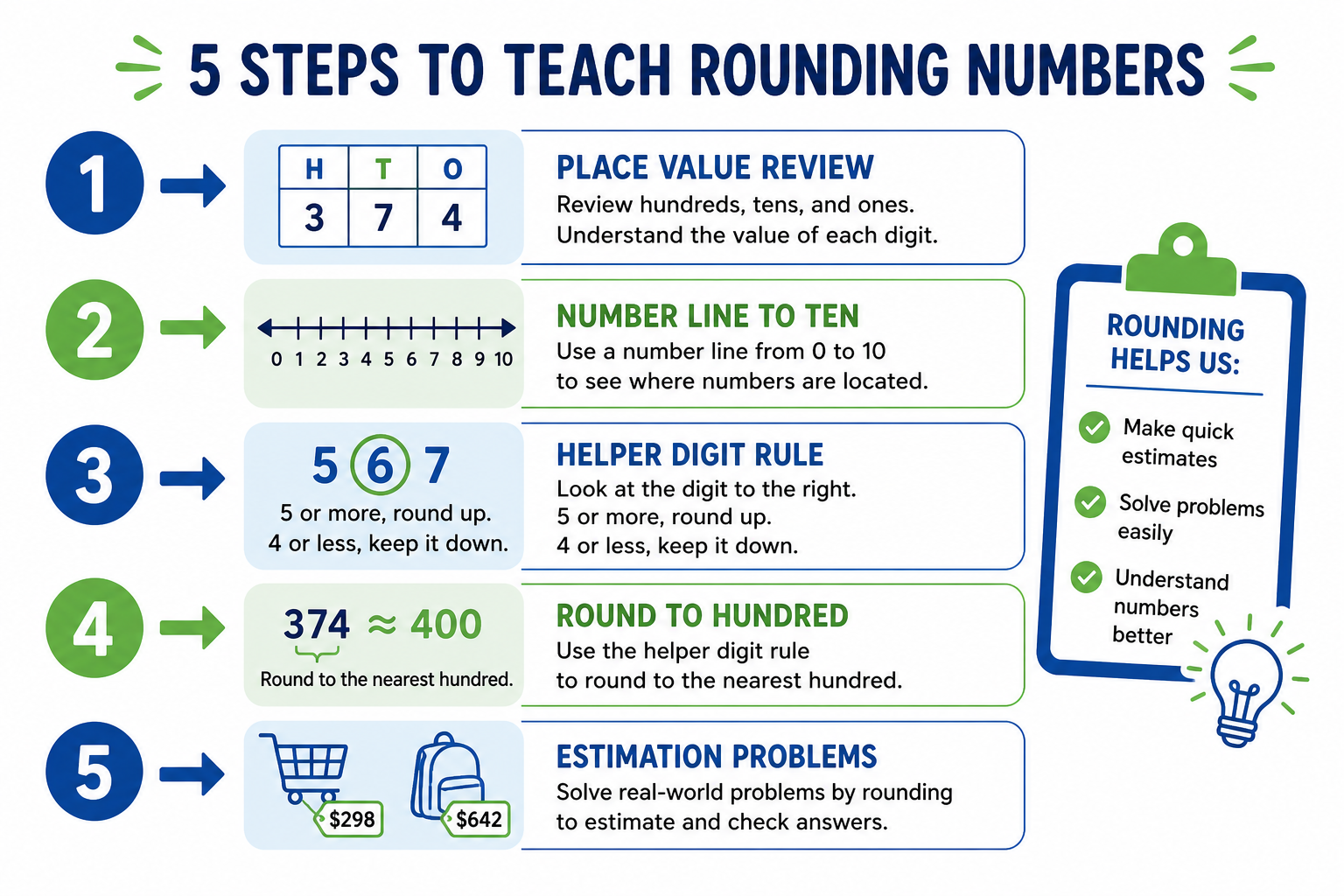
Step 1: Review place value
Students name the tens and hundreds digit in a three-digit number. Use base-ten blocks or a place value chart before any rounding.
Step 2: Round to nearest ten with a number line
Plot the number between two tens. Ask which ten is closer. Do five examples before stating any rule.
Step 3: Introduce the helper-digit rule
Underline the place you are rounding to. Circle the digit to its right. Five or more round up; four or less round down.
Step 4: Round to nearest hundred
Same process—now the helper digit is in the tens place. Zero out all digits to the right of the rounded place.
Step 5: Apply to estimation and word problems
Estimate sums and differences by rounding each number first. Connect to money and measurement stories.
How Does the Number Line Method Help?
Draw a line with endpoints at the two nearest tens. Mark the number. Ask: "Which endpoint is closer?" Distance is visible—no rule required yet.
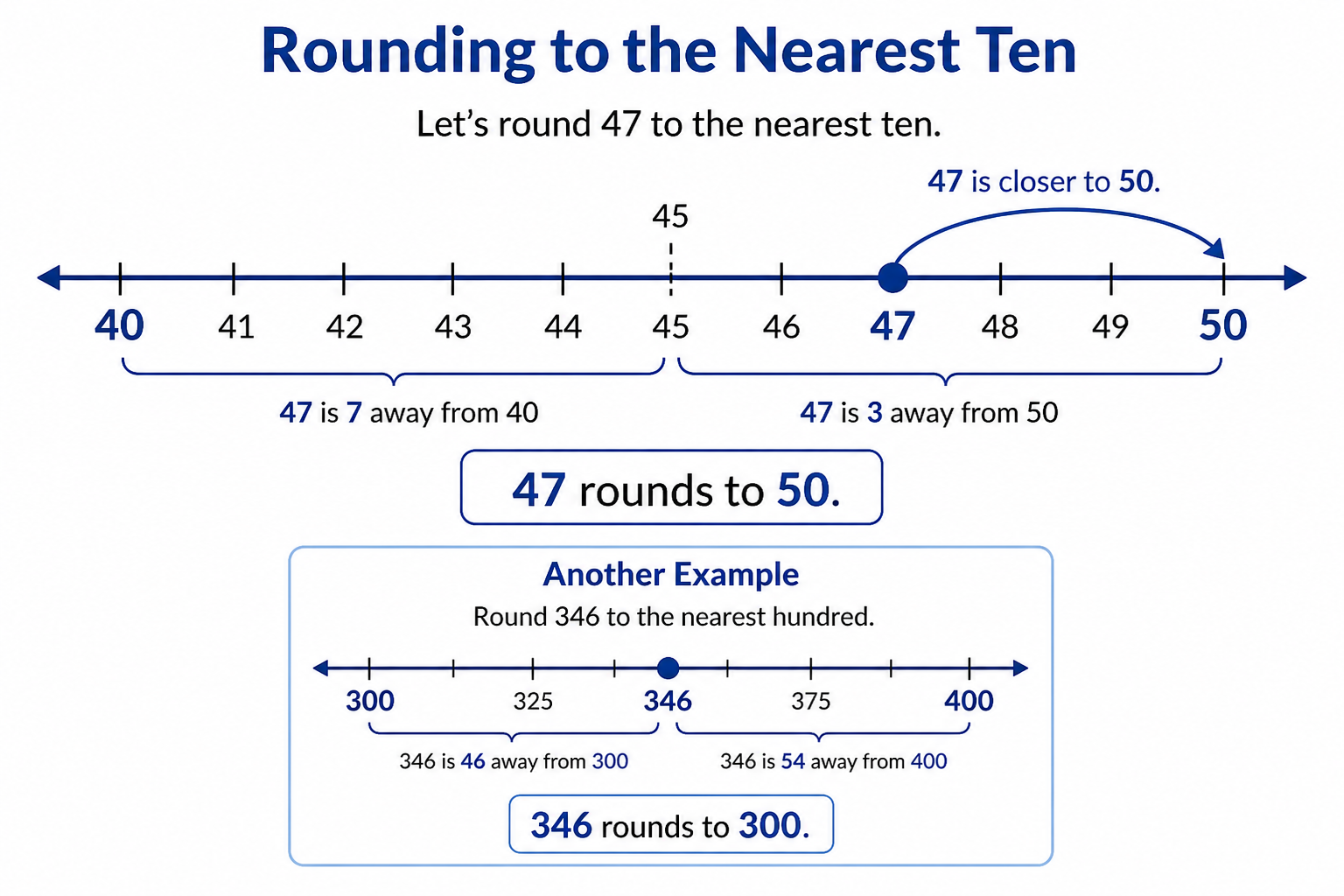
For 73, the line runs from 70 to 80; 73 is closer to 70. For 78, it rounds to 80. Midpoint numbers (75, 850) follow the standard rule: round up when exactly halfway. Model those cases explicitly so students do not guess.
When Do You Teach the Rounding Rule?
After five to ten number line successes, introduce the shortcut most adults remember:
- Underline the digit in the place you are rounding to
- Look at the digit immediately to the right (the helper digit)
- If the helper is 5, 6, 7, 8, or 9, round up (add one to the underlined digit)
- If the helper is 0, 1, 2, 3, or 4, round down (keep the underlined digit)
- Change every digit to the right of the underlined place to zero
Example: round 4,682 to the nearest hundred. Underline the 6 (hundreds place). Helper digit is 8 → round up → 4,700. The National Council of Teachers of Mathematics emphasizes connecting procedures to models—always link the rule back to a quick sketch on the line.
Generate rounding practice by place value
Custom math worksheets for nearest ten, hundred, and estimation—print in seconds.
Math Worksheet GeneratorWhat Mistakes Should Teachers Watch For?
- Rounding the wrong place (changing the ones digit when rounding to the ten)
- Changing every digit after the target instead of zeroing them
- Rounding 450 down because "four" is in the hundreds place—not the tens helper digit
- Teaching the rule before number line understanding
- Skipping place value review when students confuse 3,482 and 3,842
- Mixing rounding with exact computation on the same line without labeling estimates
Students who confuse rounding with truncating need more number line work—not more worksheets. When errors persist, check confidence-building strategies and reduce problem counts using differentiated worksheets.
How Do You Practice Rounding in Real Life?
Connect rounding to estimation students already care about. One real example beats ten abstract drill problems.
Money rounding links to our money and financial literacy guide. Estimation in word problems uses the same routines as teaching word problems step by step.
Key Takeaways
- Place value and number lines come before the rounding rule.
- Teach nearest ten, then hundred, then larger places and decimals.
- Underline the target digit; use the helper digit to the right.
- Zero all digits after the rounded place—change only one digit when rounding up.
- Practice through real estimation, then short custom worksheets.
Conclusion
Teaching rounding numbers works when students see distance on a line before memorizing a rhyme. Review place value, model tens and hundreds with lines and blocks, teach the helper-digit rule, and apply skills to money and measurement estimates. When a child can explain why 38 rounds to 40 without chanting, they are ready for harder problems.
Draw one number line for 47 and 83 tomorrow, then print five practice problems from the generator. That pair—model plus practice—is the core of every rounding lesson.
Free rounding and place value practice
Custom math worksheets by grade and skill—unlimited prints, no signup.
Free Math Worksheet GeneratorRelated Articles
- Teaching Place Value with Base-Ten Blocks — foundation before rounding
- How to Introduce Decimals in 4th Grade — round decimals to tenths and hundredths
- A Parent's Guide to 2nd Grade Math — intro rounding to the nearest ten
Frequently Asked Questions
Most students first round to the nearest ten in late second or early third grade, after place value is solid. Third grade adds rounding to the nearest hundred. Fourth and fifth graders round larger whole numbers and decimals. If a student cannot identify the tens or hundreds digit, reteach place value before introducing rounding rules.