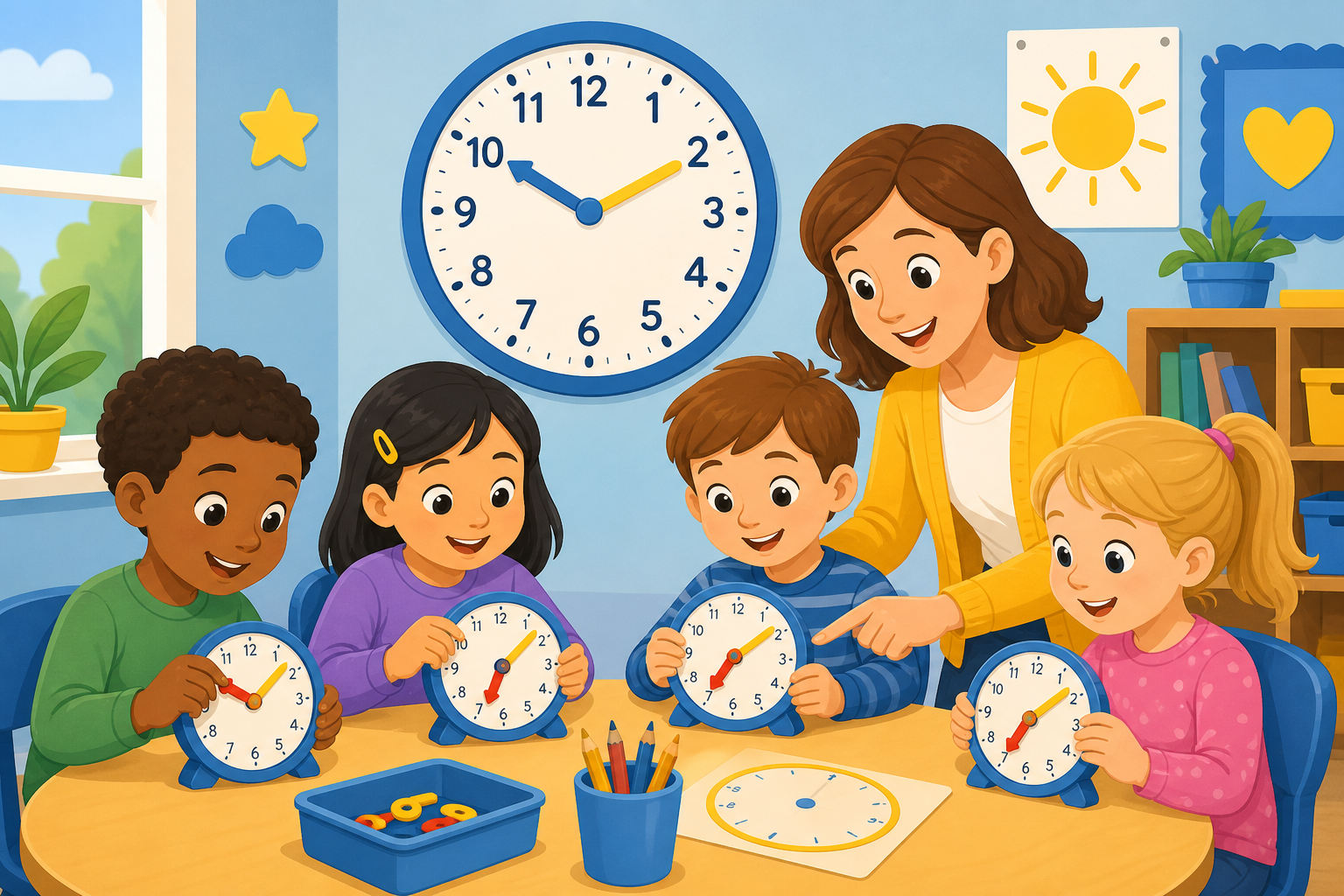
Teaching telling time to first and second graders works best as a step-by-step progression: clock parts, hour, half hour, quarter hour, then five-minute intervals and short elapsed-time stories. Analog clocks are harder than digital because two hands share one face. This guide covers grade expectations, prerequisites, a six-step lesson sequence, hands-on activities, common mistakes, and a weekly practice plan with free worksheets.
Time is measurement—and like length or weight, children need concrete experience before symbols stick. Point at real clocks throughout the day instead of saving time for one isolated math unit.
What Should First and Second Graders Know?
Grade-level expectations vary slightly by state, but most curricula align with measurement standards that introduce time in early elementary. First grade builds the foundation; second grade adds precision and problem solving.
| Grade | Skills | Example |
|---|---|---|
| 1st grade | Hour and half hour; identify a.m./p.m. in context; match analog to digital for :00 and :30 | "The clock shows half past 4. What time is it?" |
| 2nd grade | Five-minute intervals; quarter hour; elapsed time within an hour; word problems with time | "School starts at 8:15. What time is it 20 minutes later?" |
The Common Core first grade measurement standards expect students to tell and write time in hours and half hours. Second grade extends to five-minute marks. Our parent guide to 2nd grade math includes time and money among core second-grade topics.
What Prerequisites Come First?
Students who struggle with time often lack supporting skills—not clock aversion. Check these before pushing past half hour:
- Counting to 60 and skip-counting by fives: The minute hand uses multiples of five. Practice 5, 10, 15 … 60 on a number line first.
- Half and quarter language: Connect to fractions if students have partitioned shapes. Half past links to one-half of an hour.
- Number sense: Strong kindergarten number sense supports reading double-digit minute values like 45 and 55.
- Left-to-right reading: Clocks move clockwise—reinforce direction with movement games.
What Six-Step Progression Works Best?
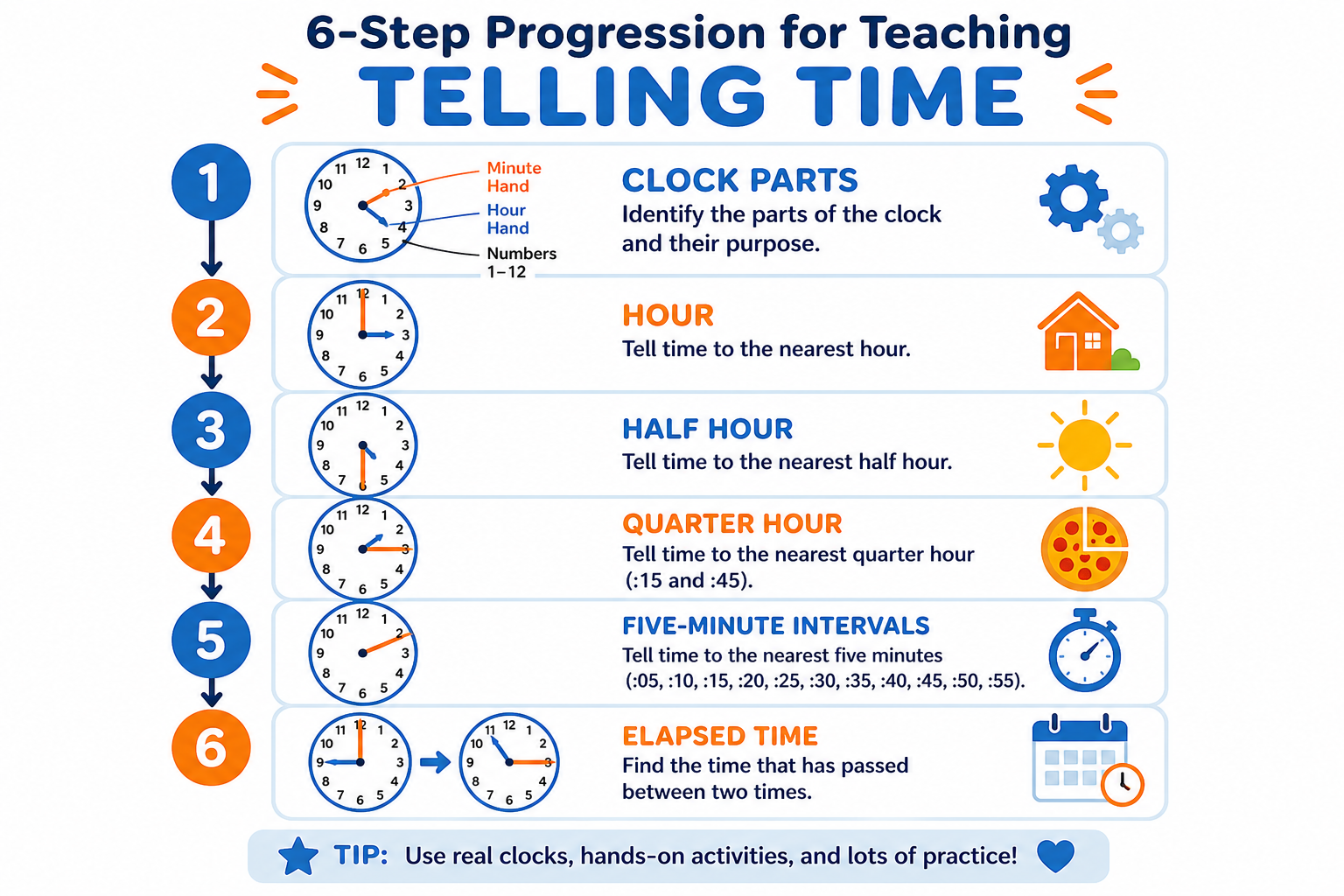
Move through these steps in order. Spend at least two lessons on each stage before advancing. Rushing to five-minute intervals causes the errors you will spend weeks unteaching.
Step 1: Learn clock parts
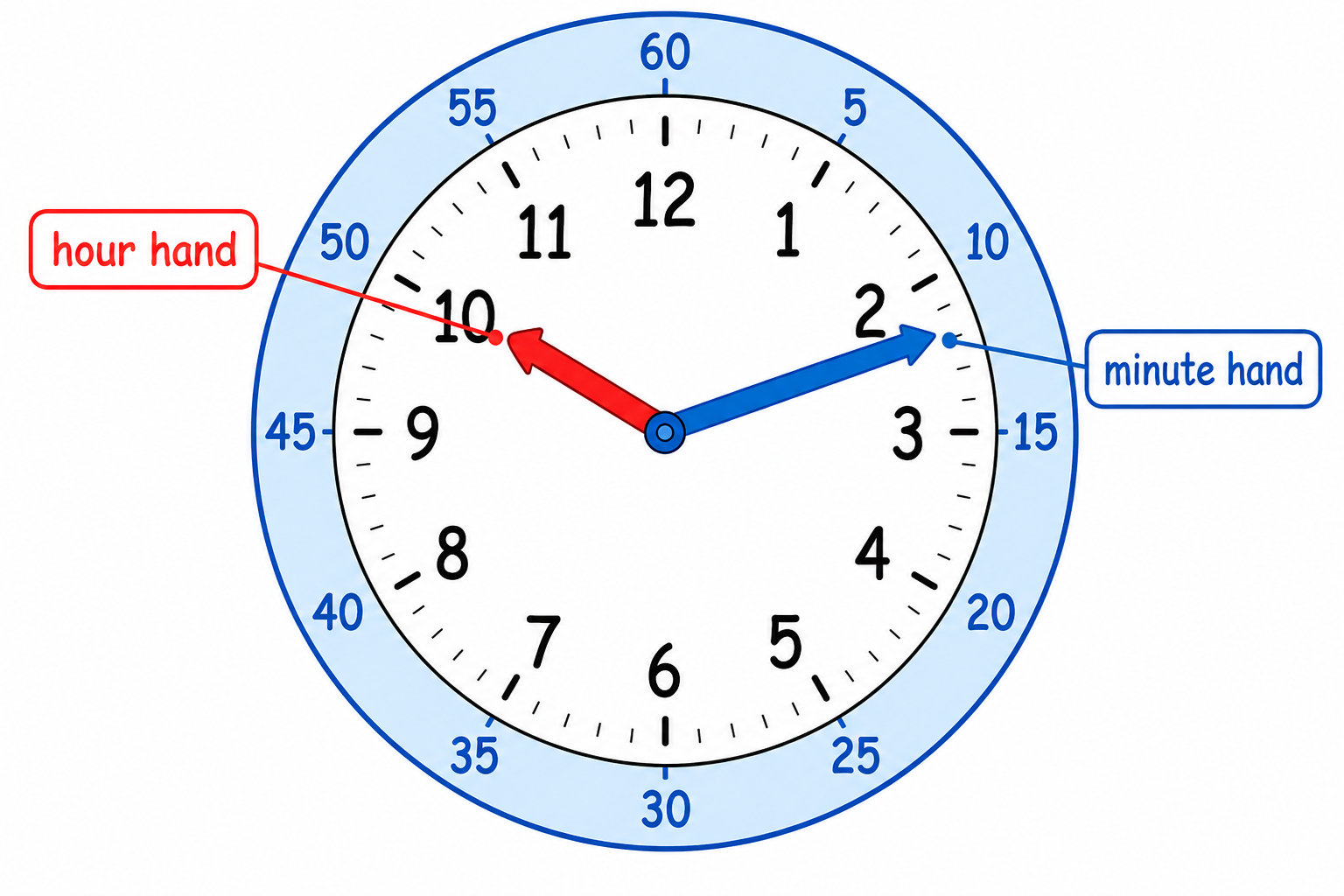
Introduce the face, hour hand, minute hand, and numbers 1–12. Stress that the minute hand moves faster. Use a large demonstration clock every student can see.
Step 2: Tell time to the hour
When the minute hand points to 12, name the hour the short hand indicates. Practice 2:00, 7:00, 11:00 until automatic. Connect to daily events: "Lunch is at 12:00."
Step 3: Tell time to the half hour
Minute hand at 6 means 30 minutes—half past the hour. Say both formats: "4:30" and "half past 4." Draw a line from 12 to 6 to show half the clock.
Step 4: Introduce quarter hours
Minute hand at 3 means 15 minutes (quarter past); at 9 means 45 minutes (quarter to). Use fraction language from your unit on quarters if students have seen pizza or fraction circles.
Step 5: Count by fives for five-minute intervals
Label the minute values: 1 = 5, 2 = 10, 3 = 15, and so on. Skip-count around the clock before reading random times. This step unlocks second grade expectations.
Step 6: Elapsed time and word problems
Start with moving forward 30 minutes or one hour on a practice clock. Then solve short stories: start time plus minutes elapsed. Keep numbers within the same hour at first.
Generate time practice worksheets by grade
Custom math sheets for first and second grade—print after hands-on clock lessons.
What Hands-On Activities Help?
Paper practice cannot replace turning clock hands. These activities take five to fifteen minutes and fit math centers or homeschool blocks.
Movable-hand practice clocks
Students set the time you call out, then swap and check a partner's clock.
Daily schedule chart
Draw a horizontal timeline of the school day with clock faces at recess, lunch, and dismissal.
Time scavenger hunt
Find five analog clocks in the building or at home; record each time in digital format.
Human clock
Students stand in a circle as hour numbers; two volunteers are the hands.
Time matching cards
Match analog cards to digital cards for the same moment (e.g., 2:45 and quarter to 3).
Pair movement with play using ideas from making math practice fun at home. First grade teachers can stock centers with essentials from our first grade printables guide.
How Do You Connect Analog and Digital?
Show both formats for every time you teach. When the practice clock reads half past 7, write 7:30 on the board immediately. Students should flip between representations without re-counting from scratch.
- Display a digital clock beside your wall analog clock all week
- Use sentence frames: "The digital clock shows ___ which is ___ on the analog clock."
- Practice a.m. and p.m. with real events—morning recess vs. evening dinner
- For elapsed time, move the minute hand on a practice clock, then write the new digital time
The National Council of Teachers of Mathematics encourages connecting measurement to daily life. Time is one of the easiest strands to link to routines children already know.
What Mistakes Should Teachers Watch For?
- Reading the hour hand as the minute hand (or vice versa)
- Naming the hour the minute hand points to instead of the hour hand
- Forgetting to count by fives on the minute hand (calling 2:03 when the minute hand is on the 3)
- Skipping analog practice because digital clocks feel easier
- Introducing elapsed time before five-minute reading is solid
- Using only worksheets without touching a real or practice clock
When a student calls 3:50 "three fifty hours" or reads the 3 on the minute hand as the hour, return to color-coded hands and skip-counting. Differentiate with tiered worksheets: some students stay on hour and half hour while others work on five-minute intervals.
What Does a Weekly Practice Plan Look Like?
A focused time unit runs two to three weeks in most classrooms. Use this daily rhythm during the unit and sprinkle clock checks afterward so skills do not fade.
| Day | Lesson focus | Practice |
|---|---|---|
| Monday | Review clock parts; read times to the hour | Partner clock setting |
| Tuesday | Half hour on analog and digital | Schedule drawing activity |
| Wednesday | Quarter hour or five-minute intervals (by grade) | Matching card game |
| Thursday | Mixed review; a.m. vs p.m. | 5-problem custom worksheet |
| Friday | Elapsed time story or real-clock check | Record three times from home clocks |
After the unit, ask "What time is it?" once per day during morning meeting. Spaced review beats a single intensive week—see our guide on spaced repetition in math practice for scheduling tips.
Key Takeaways
- First grade: hour and half hour. Second grade: five minutes and elapsed time.
- Teach skip-counting by fives before five-minute clock reading.
- Use movable clocks and daily routines—not worksheets alone.
- Pair analog and digital every lesson.
- Follow a six-step progression and do not rush stages.
Conclusion
Teaching telling time to first and second graders takes patience and repetition on real clocks. Build from parts to hour, half hour, quarters, and five-minute marks before elapsed-time word problems. When children set times on practice clocks, read the lunch schedule, and match analog to digital cards, worksheets become quick review—not the whole lesson.
Post a labeled clock this Monday, practice skip-counting by fives on Tuesday, and read the time together at one meal each day. Small daily habits teach time better than a single end-of-unit packet.
Free math practice for first and second grade
Generate custom worksheets after your clock lessons. Unlimited prints, no signup.
Free Math Worksheet GeneratorRelated Articles
- A Parent's Guide to 2nd Grade Math — time, money, and measurement skills
- Printable Resources Every 1st Grade Teacher Needs — first grade math printables
- Teaching Fractions with Visual Models — quarter hour connects to fraction language
Frequently Asked Questions
First graders typically tell time to the hour and half hour on analog and digital clocks. They should understand that the short hand shows the hour and the long hand shows the minutes. Many curricula also introduce quarter hour by the end of first grade. Daily routines like reading the clock at lunch reinforce these skills.