Transitioning from 5th to 6th grade math means mastering fractions, decimals, and volume in fifth grade, then adding ratios, integers, expressions, and statistics in sixth. Students who leave fifth grade with solid fraction fluency handle sixth grade ratios far better than those rushed into new topics with shaky foundations. Use a four-week summer bridge plan and short daily practice to close gaps before August.
Sixth grade is often the first year students feel math got harder—not because arithmetic changed, but because reasoning changed. Numbers now represent relationships, movement on a line, and unknown quantities. This guide covers exit skills for fifth grade, new sixth grade topics, a skills comparison, a summer bridge schedule, and free practice resources.

Why Does the 5th to 6th Transition Matter?
Sixth grade is the bridge to middle school math. Students meet multiple teachers, faster pacing, and homework loads that assume independent study habits. Math gaps from fifth grade—especially fractions—compound quickly when ratios and rates appear in the first quarter.
The Common Core sixth grade math standards expect students to reason about ratios and use variables while maintaining computational accuracy. That dual demand makes the fifth grade foundation critical.
Our summer math review guide applies directly here—short sessions beat cramming the week before school starts.
What Fifth Grade Skills Should Be Solid?
Use this checklist as an end-of-year or summer diagnostic. Any unchecked skill deserves practice before sixth grade ratios begin.
- Add and subtract fractions with unlike denominators
- Multiply fractions and mixed numbers
- Divide unit fractions by whole numbers and vice versa
- Read, write, and compare decimals to thousandths
- Add, subtract, multiply, and divide decimals
- Calculate volume of rectangular prisms (V = l × w × h)
- Plot points and solve problems on coordinate planes
- Convert measurement units within a system
- Write and interpret numerical expressions
- Solve multi-step word problems with all four operations
Practice fifth grade skills with 5th grade math worksheets and fraction pages like our equivalent fractions worksheet. Weak division? Review long division mastery before summer ends.
What New Topics Appear in Sixth Grade?
Preview these topics so students recognize the vocabulary on day one. Full instruction still belongs in the classroom.
Understand ratio language, unit rates, and tables. Connect to fractions and real contexts like recipes and speed.
Negative numbers on number lines; add, subtract, multiply, and divide positive and negative integers.
Write and evaluate expressions with variables; solve one-step equations.
Apply fraction division in word problems, often tied to ratios and measurement.
Mean, median, range, and variability; interpret dot plots and histograms.
Distance on coordinate planes; area of polygons drawn on grids.
Early algebra habits from patterns and algebraic thinking pay off when variables appear in sixth grade expressions.
How Do Fifth and Sixth Grade Compare?
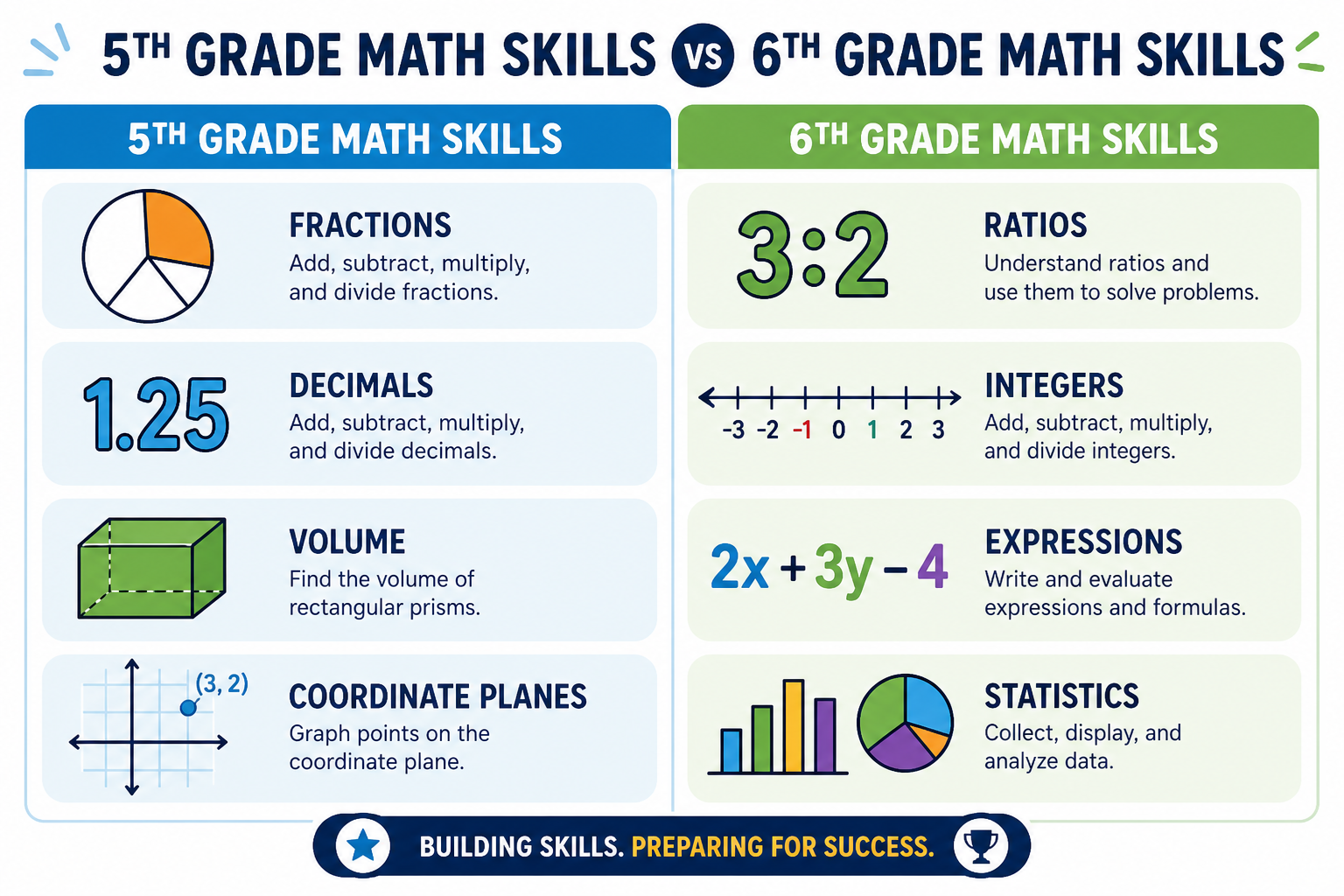
| Fifth grade focus | Sixth grade focus |
|---|---|
| Fraction and decimal operations | Ratios, rates, and proportional reasoning |
| Volume of rectangular prisms | Area of polygons on coordinate planes |
| Coordinate plotting | Distance and geometry on the coordinate plane |
| Numerical expressions | Algebraic expressions and one-step equations |
| Whole-number and fraction computation | Integer operations including negatives |
| Line plots and basic data | Mean, median, range, and variability |
Practice for fifth or sixth grade
Generate custom worksheets by grade—fractions, ratios, integers, and more.
What Summer Bridge Plan Works?
Four weeks, fifteen minutes per day. Adjust pace if your child needs more time on week one fractions.
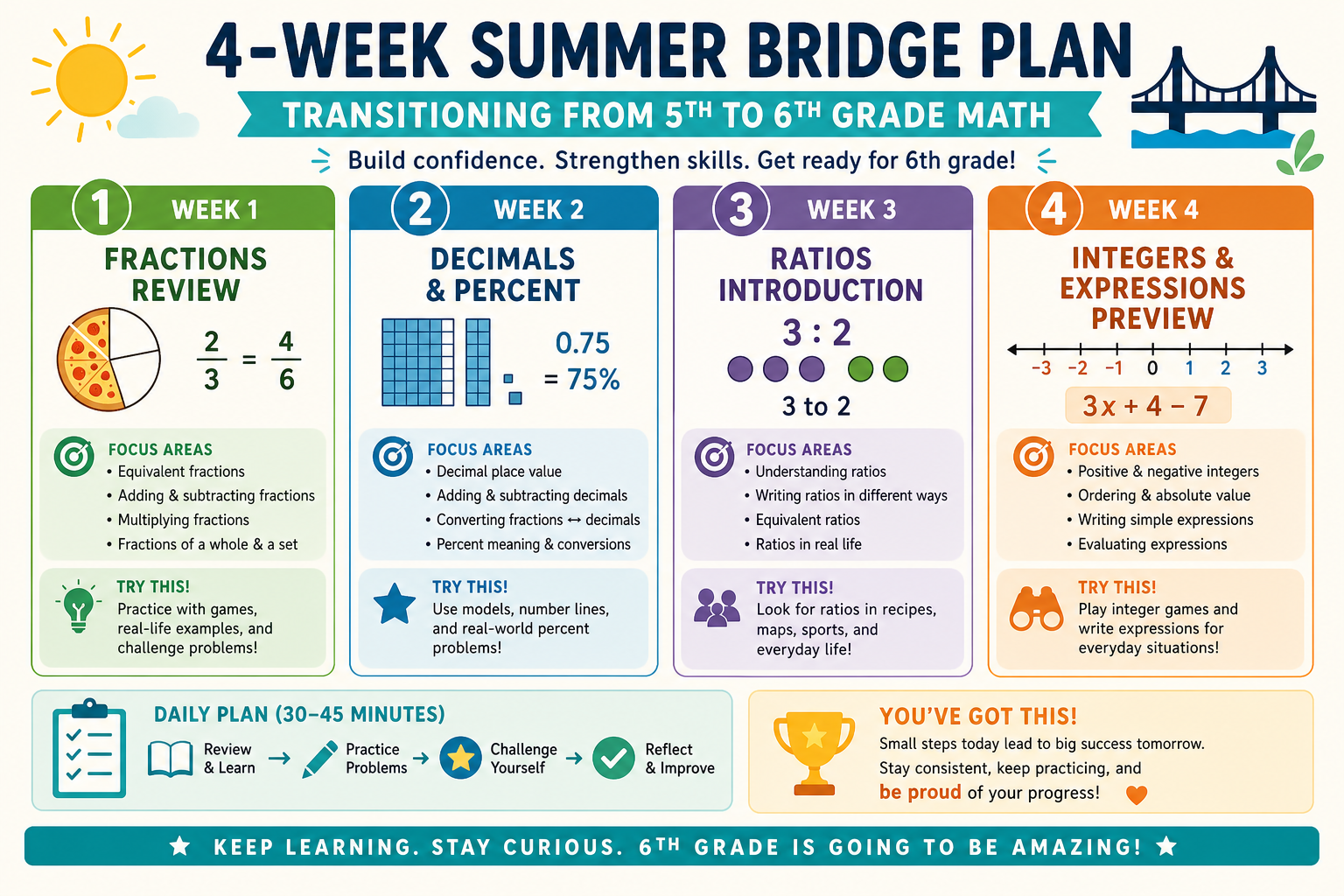
Print daily practice from the math worksheet generator with problem counts matched to your child's stamina—five to eight problems is enough for most summer days.
What Tips Help Parents and Teachers?
- Diagnose before drilling: Run a short fifth grade mixed review to find gaps, then target those skills—not random sixth grade pages.
- Use real ratio language: "For every 2 cups flour, 1 cup sugar" at home before formal ratio tables at school.
- Keep fact fluency alive: Five minutes of multiplication and division facts weekly through summer.
- Model showing work: Sixth grade teachers expect organized steps on multi-step problems.
- Communicate with the new teacher: Share which fifth grade units were strong or weak at the start of the year.
Teachers preparing students for state tests can align review with our state assessment prep guide before the transition year begins.
What Struggles Should You Watch For?
- Weak fraction skills blocking ratio understanding
- Confusion with negative numbers and integer rules
- Not showing work on multi-step problems
- Memorizing ratio shortcuts without understanding units
- Lost when variables appear in expressions
- Summer slide in multiplication and division facts
When fraction gaps appear, return to simplifying fractions and fifth grade pages before assigning ratio homework. Building confidence matters as much as catching up on content—see building math confidence for support strategies.
Key Takeaways
- Fifth grade exit skills—especially fractions—predict sixth grade success.
- Sixth grade adds ratios, integers, expressions, and statistics.
- Use a four-week summer bridge with 15-minute daily sessions.
- Introduce ratio language in real life before formal tables.
- Print targeted practice from fifth or sixth grade worksheet pages.
Conclusion
Transitioning from 5th to 6th grade math works best when students leave fifth grade with fraction fluency and enter sixth grade ready for new types of reasoning. Use the exit checklist, follow the four-week bridge plan, and practice briefly each day. Sixth grade math is challenging—but students with solid fifth grade foundations rise to it.
Free fifth and sixth grade practice
Grade-level worksheets and custom generators—unlimited prints.
Free Math Worksheet GeneratorRelated Articles
- Summer Math Review: Keeping Skills Sharp Over Break — daily summer practice routine
- A Complete Guide to 4th Grade Math Topics — earlier skills that feed fifth grade
- Teaching Patterns and Algebraic Thinking in Elementary School — prep for sixth grade expressions
Frequently Asked Questions
Fifth grade focuses on fraction operations, decimal place value, volume, and coordinate graphing. Sixth grade introduces ratios and rates, integer operations, algebraic expressions and equations, dividing fractions in context, and statistics. Students also work with more abstract reasoning and multi-step problems. The jump is less about harder arithmetic and more about new types of relationships between numbers.