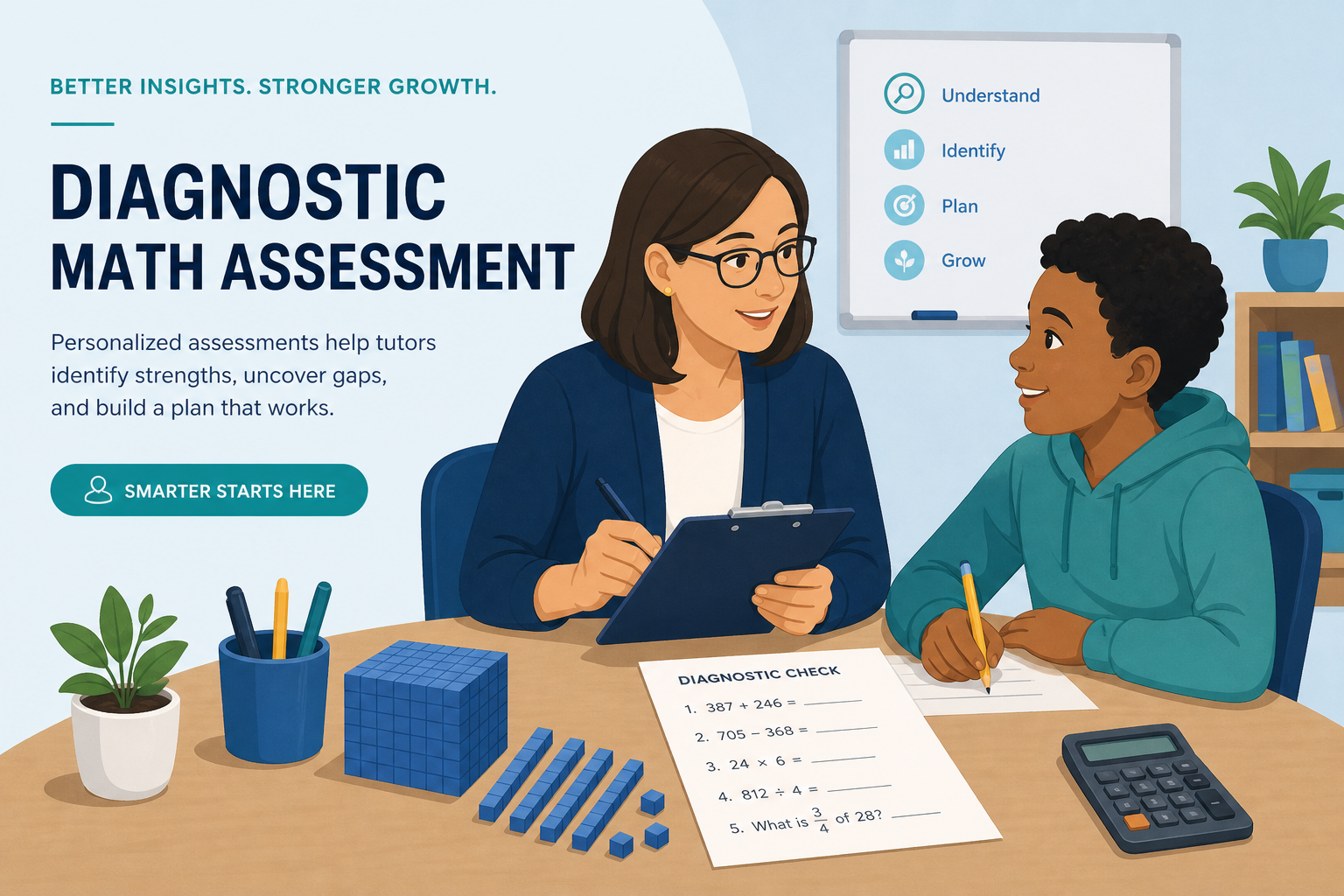
A tutor's diagnostic math assessment finds skill gaps before reteaching an entire grade. In 30 to 45 minutes, probe five strands—number sense, facts, operations, fractions/decimals, and word problems—and stop when errors cluster. Record ceilings, not just totals. This guide covers why diagnosis comes first, a first-session protocol, grade-level priorities, free tools, planning from results, and when to refer beyond tutoring.
Parents hire tutors for faster progress. A quick diagnostic proves you know where to start—and saves weeks of practicing skills the student already owns.
Why Should Tutors Diagnose Before Teaching?
Grade-level homework often hides older gaps. A fifth grader failing fraction problems may lack multiplication fluency or place value understanding. Teaching fifth grade chapters without diagnosis repeats the classroom experience that did not work.
Diagnostic assessment answers three tutor questions: What does the student already know? Where do errors start? What single skill unlocks the most progress? Targeted tutoring beats generic review every time.
This differs from state test prep covered in our state assessment guide. Diagnostics find root causes; test prep practices formats and mixed review.
What Five Strands Should You Assess?
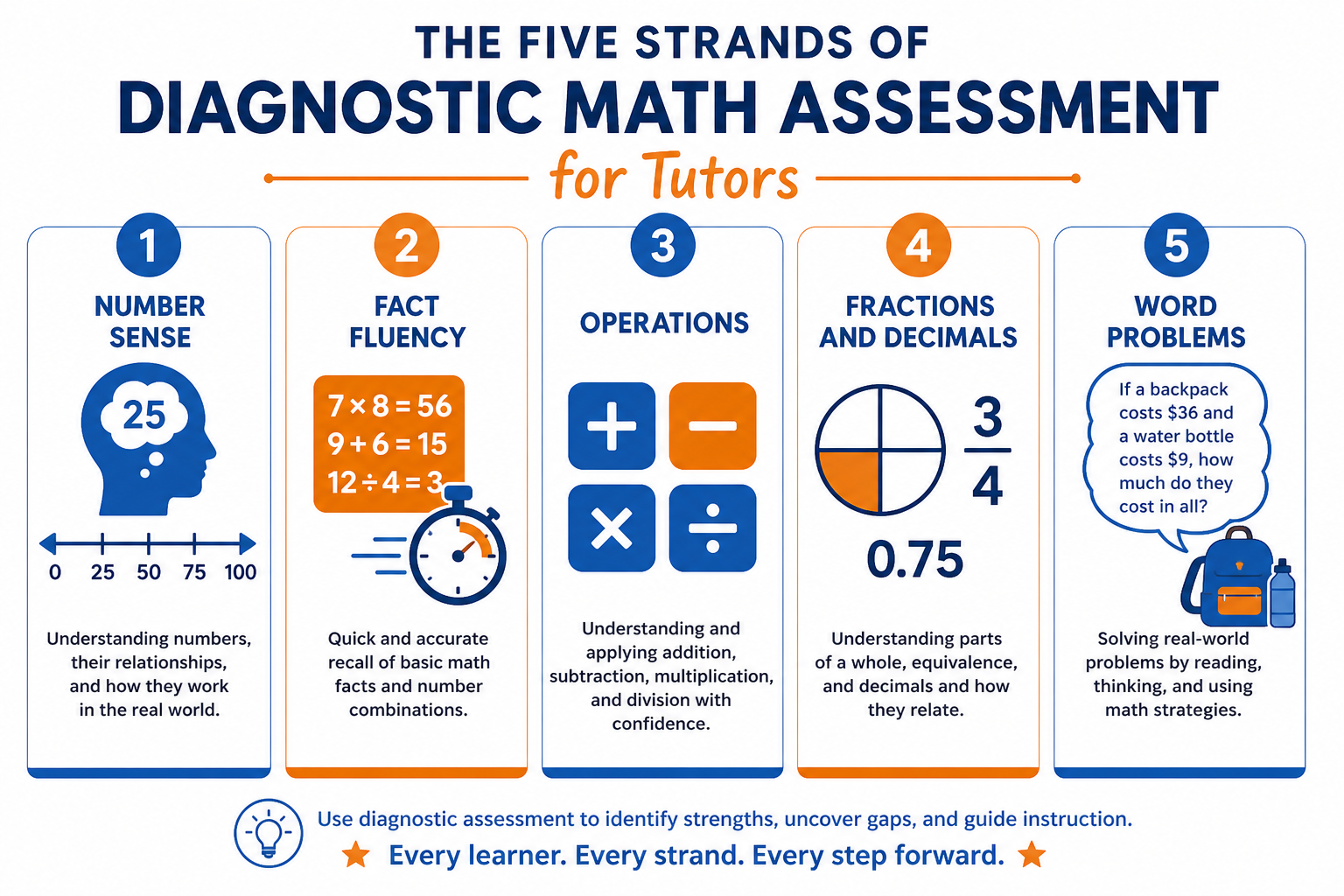
Use a strand map so you do not over-test one area and skip another. Two to three probe questions per strand is enough for a first session.
| Strand | Sample probes | Gap signal |
|---|---|---|
| Number sense and place value | Count forward/back, read 3-digit numbers, compare values, regroup with blocks | Cannot explain what each digit means in 406 |
| Fact fluency | Addition/subtraction within 20; multiplication/division facts to 12 | Counts on fingers for every problem; long pauses on 7×8 |
| Operations and algorithms | Add/subtract with regrouping; multi-digit × and ÷ at grade level | Random errors in carrying or lining up columns |
| Fractions and decimals | Identify parts of a whole; equivalents; compare; tenths/hundredths | Adds numerators and denominators; cannot shade 3/4 |
| Word problems and reasoning | One-step and two-step stories; explain strategy aloud | Adds first two numbers seen; cannot retell the story |
What Does a First-Session Protocol Look Like?
Follow the same sequence every new student so you collect comparable data and build trust quickly.
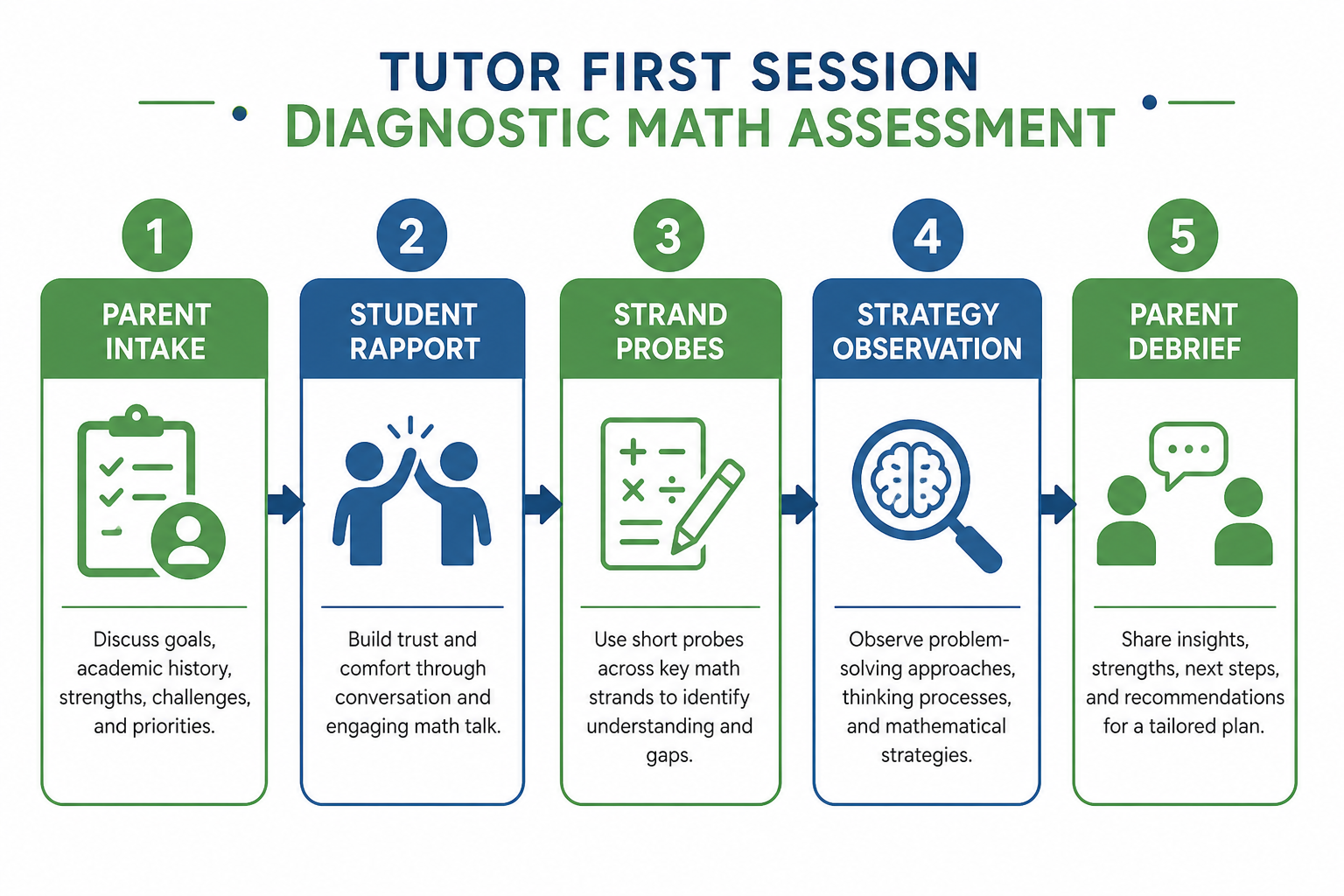
1. Parent intake (5 min)
Ask grade, teacher concerns, IEP/504 status, anxiety triggers, and what help is wanted. Note recent report card topics.
2. Student rapport (5 min)
Low-stakes chat: favorite subject, how math feels, one thing they are proud of. Reduces test panic before any paper appears.
3. Strand probes (20 min)
2–3 items per strand, easiest to harder. Stop a strand when two consecutive errors occur—mark the ceiling.
4. Strategy observation
Note manipulatives used, finger counting, self-talk, and whether the student checks answers. Process matters as much as score.
5. Debrief (5–10 min)
Share strengths first, then one or two priority gaps and a proposed focus for the next three sessions. Send a brief written summary to parents.
Watch for anxiety signs from our math anxiety guide. Split the diagnostic across two visits if the student shuts down mid-session.
What Should You Prioritize by Grade?
Start probes near the student's enrolled grade, but always step backward when errors appear. A fourth grader who cannot regroup needs second-grade repair before fraction work intensifies.
Grades K–1
Counting, number recognition, addition/subtraction within 10–20
Practice probes: kindergarten math worksheets
Grades 2–3
Place value, regrouping, multiplication facts, intro fractions
Practice probes: 2nd grade math worksheets
Grades 4–5
Multi-digit ops, fraction equivalence, decimals, multi-step word problems
Practice probes: 4th grade math worksheets
Deep grade maps live in posts like our 2nd grade parent guide and 4th grade topics guide—use them to pick probe difficulty after the diagnostic ceiling is set.
Build custom diagnostic quizzes and practice sets
Generate short math quizzes by operation and grade—perfect for tutor intake and follow-up.
What Tools and Materials Do You Need?
Keep a portable diagnostic kit so sessions run the same way at a library, home, or online desk.
- Oral probes: Fastest for K–2 number sense and anxiety-prone students
- 5–10 problem custom worksheet: One strand per half-page from the math generator
- Auto-graded quiz: Quick fact fluency snapshot via the quiz generator
- Manipulatives: Base-ten blocks or a printed place value chart
- Fraction circles or blank grids: For shading and equivalence probes
- Recording sheet: Strand checklist with mastered / emerging / gap columns
The National Council of Teachers of Mathematics emphasizes understanding student thinking through observation—not only final answers. Ask "How did you know?" on two problems per strand.
How Do You Record Results and Build a Plan?
File a one-page diagnostic summary after every intake. Parents share it with teachers; you use it to sequence lessons.
- Student name, date, grade, and session length
- Strand ceiling scores (mastered / emerging / gap)
- Sample errors copied verbatim—do not rely on memory
- Behavior notes: anxiety, avoidance, strong verbal reasoning
- Priority skill for next 3 sessions
- Parent-facing summary in plain language
Turn gaps into a three-session sprint on one skill, then reassess with a five-problem quiz. Use spaced repetition to schedule review of mastered strands so they do not fade while you fix gaps.
For leveled follow-up practice, apply the tier model from differentiated custom worksheets. Tutoring is differentiation for one student.
What Red Flags Need Referral Beyond Tutoring?
Tutors teach math—they do not diagnose learning disabilities or provide therapy. Flag these patterns to parents and recommend school or clinical follow-up.
- Severe math anxiety affecting sleep or school attendance
- Significant discrepancy suggesting possible learning disability—seek school evaluation
- Regression in skills previously mastered across subjects
- Inability to count or recognize numbers far below grade (possible developmental concern)
- Vision or hearing issues affecting written work—refer to medical screening
Pair academic support with confidence strategies from helping struggling students build confidence when anxiety—not only skill gaps—blocks progress.
Key Takeaways
- Diagnose before teaching—find ceilings in five math strands.
- Use a 30–45 minute first-session protocol with parent debrief.
- Step back to earlier grades when errors cluster.
- Record gaps and plan three focused sessions before reassessing.
- Refer severe anxiety or possible learning disabilities to specialists.
Conclusion
A tutor's diagnostic math assessment is the foundation of effective tutoring. Short, strand-based probes reveal where to start; a written summary builds parent trust and saves lesson time. Run the same protocol for every new student, generate custom practice from the results, and reassess after each skill sprint—not months later.
Print a five-strand checklist and a ten-problem mixed quiz before your next intake. Thirty minutes of diagnosis can redirect ten hours of tutoring in the right direction.
Free tools for tutor diagnostics and practice
Custom quizzes and worksheets by grade and operation—unlimited prints.
Free Quiz GeneratorRelated Articles
- Differentiate Math with Custom Worksheets — tiered practice after diagnosis
- Helping Struggling Math Students Build Confidence — when gaps meet anxiety
- How to Help Your Child with Math Homework — share coaching tips with parents
Frequently Asked Questions
A diagnostic math assessment identifies which specific skills a student has mastered and which gaps block progress. Unlike a single grade-level test, it probes foundations—counting, place value, facts, operations, fractions—and stops when errors cluster. Tutors use results to build a targeted plan instead of reteaching an entire grade.